
Baku, Azerbaijan, ʿAshura, 2019. A few thousand men, women, and children had lined either side of the streets in the vicinity of the humble Meshedi Dadash mosque in central Baku’s Kubinka neighborhood. Crowds had flocked to the neighborhood for each of the first nine nights of Muḥarram but seemed to have doubled on the morning of ʿAshura. The mosque, an inconspicuous concrete building with a small dome with an Azerbaijani flag drooping above it, was unable to contain more than a couple hundred people inside. The original building is said to have been built in the eighteenth century as a space for mourning Imam Husain. During the Soviet era it had been shut down and used as a warehouse, library, and club, before resuming its function as a mosque in 1990. Since the 2010s, Meshedi Dadash had become one of the most active congregations in the country thanks to its hugely popular and charismatic prayer leader Haji Shahin Hasanli (b. 1974, d. 2023) and the regular appearance of Sayyid Taleh Boradigahi and his younger brother Sayyid Peyman, two of the most popular məddah[1] devotional reciters in the country. Unlike mourning gatherings I had attended in Turkey, Iran, and Germany, not everyone here was dressed in black. Men wore different colored shirts, a couple with Azerbaijani flags draped over their shoulders. A few women wore black with red headbands reading “Ya Husain,” but many sported brightly colored headscarves loosely tied around their heads. The mosque’s volunteers in light blue vests ushered newcomers into place while cameras on cranes passed over the heads of the mourners, capturing the whole occasion for the livestream on Haji Shahin’s YouTube channel. Two billboards had been attached to the outer walls of the mosque. One had a large map of Azerbaijan colored in with the national flag and with pictures of men who had died whilst in service, “national martyrs.” The other had portraits of “national poets,” with lines and short verses each had composed about Husain and Karbala.
The ceremony began with Sayyid Peyman reading a verse of poetry from the sixteenth-century poet Fuzuli (b. 1495, d. 1556). As he stood facing the crowd, microphone in hand, his voice amplified across the neighborhood. He then started reciting a series of növhə, song-like verses of melodized lament, to which those gathered beat their chests softly with their hands, repeating choruses and refrains in unison. During this recitation Haji Shahin arrived and made his way through the tangibly excited crowds before greeting Sayyid Peyman and entering the mosque. As the növhə recitation came to an end, attention turned to Haji Shahin, who had taken his seat inside the mosque and started his sermon, also beginning with a verse of poetry but this time from the nineteenth-century poet Mirza Muhammad Taqi Qumri (b. 1819, d. 1891). He paused. Then his voice reverberated across the neighborhood through the loudspeakers set up around the crowded streets.
Today is ʿAshura. ʿAshura is not just the anniversary of a historical event. ʿAshura is an event that opened the boundaries of time and space. Karbala is ever relevant, an event that is renewed day by day. Oh, how they wanted to erase every trace of Imam Husain. Oh, how they wanted Imam Husain’s name to be forgotten. But look how history unfolded. . . . History has shown us how his small band of followers becomes a bigger force. Year on year all over the world the martyrs of Karbala are remembered. Husain’s murder started a fire in the hearts of believers that will never be put out. Until the Day of Judgment this flame will never be extinguished. Our recent history shows us this. In Soviet times, under the strictest prohibitions our people relived this event. They lived this event in their houses and wherever they could, they kept Imam Husain’s mourning and held gatherings in his honor. Today all over the world people hold dear the memory of Imam Husain. What is the secret to this? Why does time not erase this?
The sermon continued for almost an hour, from this opening discussion of the significance of ʿAshura to recounting the unfolding of the tragedy itself. As this narration of the events reached a climax, Sayyid Peyman returned to the microphone, this time inside the mosque, and recited a mərsiyə, a longer unmetered lament recounting the suffering of Husain and his companions. Some men and women in the streets were visibly crying, rubbing and holding up tissues to their eyes. The sound of weeping inside the mosque could be heard through the amplifiers. The mərsiyə transitioned into another round of növhə, taken from different sources. Some were new compositions, popularized in recordings by Sayyid Peyman’s older brother Sayyid Taleh, who was currently in Istanbul, where he has been reciting each year during Muḥarram for the last decade. Other laments were from older sources of written poetry, taken from poets in the Iranian Azerbaijani city of Ardabil or transmitted orally from previous generations.
As midday approached, the gathering at Meshedi Dadash came to an end with Haji Shahin offering supplications for the crowds from the entrance of the mosque. The crowds dispersed slowly, and I decided to walk toward the Sovetski neighborhood in the heart of the city to see what was happening at the other mosques. Along the way most of the shops and supermarkets were open as usual, some playing recordings of növhə on television screens while others played the latest Turkish pop tunes. The two-hundred-year-old neighborhood, once a bustling məhəllə (neighborhood) home to fifty-to-sixty thousand, had been radically transformed in the last decade, with old houses and even mosques being demolished to make way for new apartment complexes, roads, and parks as part of a state-led urban planning campaign. I walked by two mosques from which small crowds were leaving, and then through some older streets where a few families had set up tables to distribute tea and food in honor of Husain. As I reached the Taza Pir mosque, the largest central mosque in the city and headquarters of the Muslim Board of the Caucasus, which had also served as a cinema and barn during the early Soviet period, I noticed a sign pointing to the entrance where devotees could donate blood, an act promoted by the state religious body. People were flowing in and out of the mosque’s main courtyard, which was busy but certainly not as crowded as Meshedi Dadash. The amplified sound of an older man reciting növhə rang from the mosque but was drowned out by the bustle of activity in the courtyard. A blind man weaved his way through the crowds asking for alms in honor of Husain along with another man holding a basic ʿalam, a long stick covered in silk headscarves that represents Husain’s standard, and which people touched for blessings. On the side of the courtyard many people had circled a group of men performing sinəzən, beating their chests to the repetition of short refrains. Speaking to one of the onlookers, I was told that there had been a small scuffle the previous year when some had insisted on flagellating themselves with chains, an act fiercely condemned by the religious authorities at the mosque.
Although most of city life continued as normal, the commemoration of ʿAshura at these mosques drew men and women from different walks of life and backgrounds in crowds incomparable to the small numbers who attend weekly prayers at the same mosques. This enthusiastic participation in the mourning of Imam Husain during Muḥarram through various forms of sensory-embodied devotional forms—listening to and reciting lamentation poetry, various forms of self-flagellation, and the distribution and consuming of offerings of food and drink—appears to be a persistent feature of Shiʿi devotional life in the Caucasus, despite the social and political changes that have often been hostile. Haji Shahin’s words on the growing devotion to Husain may seem romantic or hyperbolic, but in the context of over seventy years of Soviet rule and the imposition of state atheism, the presence of zealous crowds mourning the Imam does raise important questions about the resilience of these rituals. What is the secret for their persistence? Why were the Soviets ineffective in their attempts to eliminate religious devotion? Or is it that Islam was reintroduced to the country after years of atheism by foreign missionaries?
These kinds of questions have dominated the literature on Islam in the Caucasus and Central Asia in the post-Soviet era. Following the collapse of the Soviet Union, accounts portrayed the region as a new frontier zone in which local and foreign religious actors fought to attract new followings and gain influence in a “theater of Islamic revival” (Balci 2007) brought about by locals’ search for identity (Motika 2001). Much of this literature has attempted to delineate the role of internal and external factors in the apparent Islamic revival, examining the role of missionary movements emanating from countries like Saudi Arabia, Iran, or Turkey and analyzing local religious organizations, structures, and policy. Studies of post-Soviet Azerbaijan also emphasized the “revival” of Islam in the country (Wiktor-Mach 2017; Goyushov 2008), highlighting the multifaceted nature of Islam following independence, the dynamics of Islam and secularism, and Sunni-Shiʿi relations in the postindependence era, particularly in relation to foreign influences from Iran and Turkey (Balci 2004; Balci and Goyushov 2013; Motika 2001). While some scholars described this revival in Azerbaijan as a “largely foreign import” (Goyushov 2008), others have begun to unearth the more complex realities of religious life in the Soviet era (Grant 2011).
Rather than attempt to pinpoint the cause and effects of the apparent “revival” of Islam in Azerbaijan by looking at religious organizations, policy, and geopolitical influences, this article focuses on Muḥarram mourning and the debates and discussions surrounding it to contribute to an understanding of continuity and change in Islam in the region. By tracing some of the persisting yet changing forms of Muḥarram rituals through different sociopolitical contexts, I propose an understanding of Shiʿi ritual in terms of resilience rather than revival. This is not to argue, like Haji Shahin, for a cosmological significance of an eternal mourning and devotion to Imam Husain but, instead, an attempt to understand how these devotional forms continue to remain relevant to Shiʿa in different social-political contexts. I argue that Shiʿi devotional ritual forms, as nonobligatory and “demotic” (Scharbrodt 2023) practices, are particularly resilient to changing contexts.
Scholars of Shiʿi rituals have already noted elsewhere the fluidity and diversity of Shiʿi ritual practice. Several sensory-aesthetic elements of Muḥarram mourning appear to be common to Shiʿi Muslims around the globe, including the recitation of lamentation poetry, processions, theatrical re-enactments, and self-flagellation, yet these take on different forms, qualities, and degrees of importance at different times and places. Oliver Scharbordt (2023) has described this diversity in terms of the “demotic” (“of the people”) quality of the rituals, vernacular practices that are able to incorporate new ritual forms and adapt to different sociocultural and political contexts. This, he argues, means that Shiʿi ritual practice is particularly contested, posing challenges for clerical authority. In her analysis of the highly contested practice of ritual bloodletting, Ingvild Flaskerud (2016) similarly highlights the plurality of the ritual complex that makes up Muḥarram mourning. Rather than undermining the authority and dignity of a ritual, as previously claimed by theorists of ritual, Flaskerud argues that the inter- and intra-ritual character of Muḥarram mourning allows for specific ritual forms to be removed, replaced, or added to in different social and political settings without undermining the rituals’ authority. In relation to bloodletting rituals, both scholars demonstrate the diversity of viewpoints of high-ranking Shiʿi clerics, whose opinions, because of the horizontal structure of the marājiʿ or highest level of Twelver Shiʿi clerics, are unable to override each other. As we will see, ritual forms and practice are not only the subject of contestation among clerics and authority figures but also by Shiʿi practitioners themselves, along with other interlocutors.
The diverse elements of ritual practice I witnessed in Baku in 2019 point to this flexibility of the Muḥarram ritual complex; poetry from the fifteenth and nineteenth centuries is recited alongside contemporary verses and popular slogans, and chest-beating and blood donation coexist as different expressions of embodied grief. Since no single element is indispensable to the entire ritual mourning complex, Muḥarram mourning continues to endure despite changes, critique, or imposed bans and restrictions. In this article I argue that this flexibility is essential to Shiʿi ritual resilience by demonstrating how practices of mourning have persisted and adapted over years of debate, critique, and state restrictions in Azerbaijan. I draw on archival material, firsthand interviews, and conversations with Shiʿi practitioners in the country, as well as data collected from Azerbaijani websites, YouTube, and social media sources. I begin by providing an overview of Shiʿism in the Caucasus with early accounts of Muḥarram rituals in the region. I then turn to early critiques of Muḥarram rituals in the late nineteenth century, before offering some examples of the Soviet Union’s anti-Muḥarram campaigns. These critiques often centered on reciters and practices of self-flagellation. Moving to the contemporary period, I show how practices of recitation have developed rapidly following the collapse of the Soviet Union over thirty years ago. Despite the growth in popularity of semiprofessional reciters, known as məddah in Azeri-Turkish, who are innovating and developing, they have remained at the center of debate among critics of Muḥarram mourning. By focusing on Muḥarram mourning, I demonstrate how ritual practice is not a superficial feature of religious life, secondary to religious organizations, education, and policy but rather central to, often very public, debates around Islam and secularism in the Caucasus.
Muḥarram in the Caucasus
The Caucasus, situated between the Black and Caspian seas, is often characterized as a “crossroads region,” between Europe and Asia, Islam and Christianity, and historically caught between multiple empires—Persian, Russian, and Ottoman. Along with the multiplicity of languages spoken here, the region is also home to multiple religions. The presence of Islam in the region dates to the mid-seventh century, when the first Muslims entered modern-day Azerbaijan and Dagestan. The formation of the Turkic Seljuk Empire marked an important shift in religious dynamics in the region, with the increased proportion of Turkic-speaking people and Sunni Muslims. Although Shiʿi groups had been present earlier, it was not until the rise of the Safavid dynasty in the early sixteenth century that Twelver Shiʿism became widespread in the region, with most Azeri-Turks in the Caucasus joining this branch of Islam. The Russian conquest in the nineteenth century meant that the Azeri-Turkish population was split between Russian and Iranian rule, bringing about further important shifts in the development of Islam in the Caucasus. Under Russian rule, a local, secular-educated Azeri-Turkish elite was formed, who eventually declared independence as the Azerbaijan Democratic Republic, which lasted from 1918 to 1920 before being incorporated into the Soviet Union.
After seventy-one years of Soviet rule, the Republic of Azerbaijan declared its independence on October 18, 1991. According to state statistics, 96 percent of Azerbaijan’s 9.8 million population is Muslim, of which 65 percent is Shiʿa (Goyushov 2019). The most active Shiʿi communities in Azerbaijan are in the Absheron Peninsula, the capital city Baku, and its surrounding villages, as well as in the south of the country toward the Iranian border and in the exclave of Nakhichevan.[2]
Like Shiʿi Muslims across the globe, devotion to the family of the Prophet Muhammad, the Ahl-e Bait (Az: Əhli-Beyt), is central to Shiʿi religiosity in the Caucasus. This devotion takes many forms, many of which are cognate with those of other Shiʿi communities elsewhere. The practice of taking first names from the members of the Ahl-e Bait has long been popular among Azeri-Turks and remained so throughout the Soviet period. Pilgrims from Azerbaijan have long joined others from across the globe in visiting the main Shiʿi shrines of the Imams in Iraq and Iran, but several important smaller shrines and holy places, known as ziyarətgah, relating to the Ahl-e-Bait are also found across the country.[3]
The writing, recitation, and listening to devotional poetry in honor of the Ahl-e Bait by poets and reciters has a longer history in the region. The key period for the development of devotional literature was at the turn of the sixteenth century with the Turkic-language poetry of Fuzuli (1480–1556), whose Ḥadīqat al-soʿadāʾ was an adaptation from Husain Vaʿez Kashifi’s Persian work Rowẓat al-shohadāʾ. The founding of the Safavid dynasty in Ardabil by Shah Ismaʿil (r. 1501–1524), who also composed Turkic-language poetry in praise of Imam ʿAli and the Ahl-e Bait under the pen name Khataʾi, led to the blossoming of such literature among Azeri-Turkish speakers in the Caucasus and Iran in the centuries that followed. Different poetic forms—növhə, mərsiyə, and rövzə—make up the repertoire of specialist vocal reciters, known as məddah or other titles depending on the form they specialize in (növhəxan, mərsiyəxan, or rövzəxan). In more recent years, as we shall see, this devotional recitation has become increasingly popular with the circulation of recordings in various media forms, although they remain at the center of the annual cycle of gatherings, known as majlis, held to commemorate the lives and deaths of the members of the Ahl-e Bait.
Most prominent out of these commemorations is the mourning of the martyrdom of Imam Husain, the Prophet’s grandson and third Imam, who died in Karbala, present day Iraq, in 680 ce during the Islamic month of Muḥarram. Ritual mourning during Muḥarram, like devotional literature, began to take shape in the Caucasus, along with the rest of Iran in the Safavid era (Rahimi 2011).[4] Together with the recitation of lamentation poetry, ritual gatherings over the last centuries have included various forms of embodied expressions of grief, including theatrical performances known as şəbih, and different types of self-flagellation, commonly referred to as Şaxsey-Vaxsey, a contraction of the exclamation “Shah Husain Vah Husain.” Flagellation mostly involves the beating of the chest with the palm of the hands (sinəzən/sinə vurmaq) or the back with chains (zəncirzən/zəncir vurmaq) but also the now largely defunct practice of bloodletting using daggers and blades on the head (qəmə zəni/baş yarmaq). These practices have been the most contested within the Shiʿi mourning tradition (Ruffle 2015; Masoudi Nejad 2017; Pinault 2001; Flaskerud 2016; Scharbrodt 2023), and, although the exact origins of these rituals are hard to ascertain, their practice in the Caucasus can be traced back quite far, with some scholars suggesting that they originated there and were then transported to Iran, Iraq, and elsewhere (Nakash 1993; Rahimi 2011).
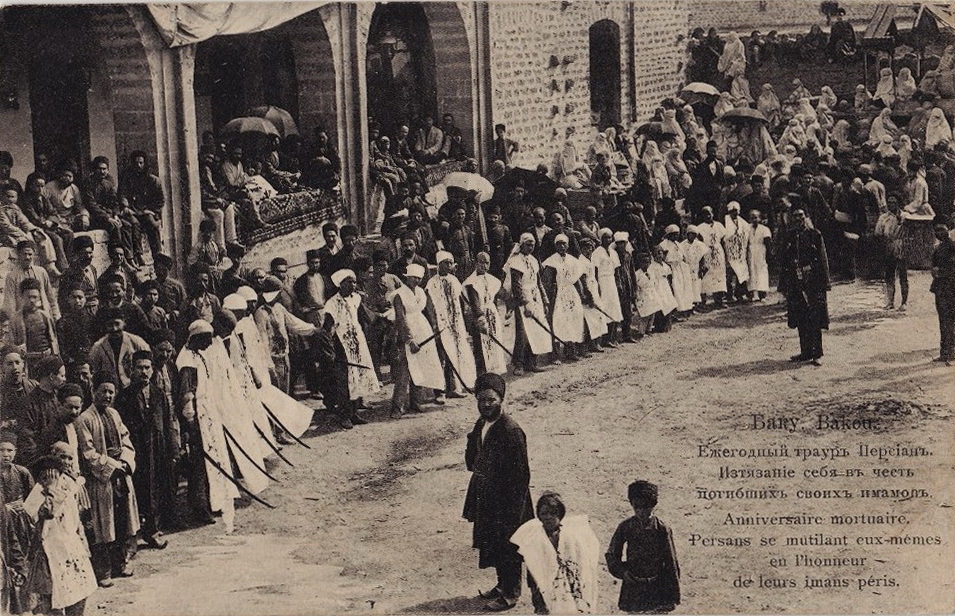
The accounts of travelers to the Caucasus in the nineteenth and early twentieth centuries, although outdated and full of condescending and Orientalist language and depictions of locals, provide important insights into the forms of Muḥarram mourning present there at the time. The Russian artist Vasily Vereshchagin (1842–1904) traveled through the Caucasus and produced a series of paintings of flagellants during Muḥarram in the town of Shusha in Karabagh in 1865. These black and white images depict groups of mourners in a grotesque manner, with daggers, blades, and chains hanging from them, wearing white burial shrouds covered in blood while marching through the streets of Shusha, and noble men and clerics wearing white turbans and tall black wooly papaq hats beating their chests while watching the flagellants. A series of images of Muḥarram ceremonies in Baku, including those of flagellants, also appeared on Russian postcards produced in the early twentieth century that were not dissimilar to Vereshchagin’s illustrations (figures 1 and 2). The Russian writer Maxim Gorky also offers a rich description of the Muḥarram processions in Tbilisi in his 1892 article. Like Vereshchagin, Gorky focuses on the acts of self-flagellation and bloodletting using daggers but also comments on the other sensory features of the procession including the sounds of the laments, which he describes as “a strange song, full of resignation to fate, a song composed of solemn notes, long and monotonous . . . a strange melody that lulls the mind” (Gorky 1892).
_of_a_large-scale_public_ashura_commemoration__inc.jpeg)
_depicting_flagellants.jpeg)
The most extensive available account of Muḥarram mourning at the turn of the twentieth century is offered by the Finnish writer Ivar Lassy, who documented the ritual mourning ceremonies in the Absheron Peninsula in his 1916 dissertation. This book covers the mourning services held at mosques as well as specific spaces set up during the first ten days of Muḥarram and describes, with a significant attention to detail, the different elements of these ceremonies, from their material culture (ʿalam, flags) to the foods and drinks prepared and distributed on these days, as well as the practices of flagellation and recitation (including translations of poetry examples). Lassy describes the large number of reciters involved in these gatherings, groups of men of different ages who would be present at the gatherings and wait in turn to recite shorter növhə and mərsiyə. After this an ākhūnd, cleric, would give a sermon “on a moral subject” that preceded the specialist rövzəxan’s recitation of a longer rövzə narrating the events and suffering of Imam Husain and his followers in Karbala. The recitation of lamentation poetry on these nights was said to have lasted several hours “without any interruption” (Lassy 1916, 72), with a new text recited every night, taken from different books or read from manuscripts (ibid., 66). Lassy categorizes these laments as folk poetry due to the insignificance paid by devotees to the authorship and the way reciters would add to, and amend, the written texts in performances. Reciters are said to “borrow, steal, receive influences from every available source, causing exasperation in their colleagues thus defrauded, and being all the while almost unconscious of committing an act of wrong” (ibid., 71). The vocal quality of the recitations Lassy heard appears to be similar to that of rövzə recited today, in that upon reaching the climax of the recitation the vocalization contains indexes of weeping and a descending pitch (65). Describing the different forms of self-flagellation in detail, Lassy claims that the flagellants were drawn from the poorest population. Theatrical performances of the tragedy were also said to be more popular in the poorer villages of Baku.
While these travel accounts and images offer us some descriptive insights into Muḥarram rituals at the turn of the century, they present them as timeless and static, ignoring or unaware of the fervent debate that surrounded these practices at the same time. Discussions about the legitimacy and form of Muḥarram rituals have been ongoing, but they assumed greater prominence in Azerbaijan between 1875 and 1932, when practices such as flagellation and recitation attracted criticism from modernist circles, Pan-Islamic ʿulamā, and eventually the Bolsheviks (Adam 2001; Goyushov and Esgerov 2009).
Reformist detractors in the late nineteenth century
The second half of the nineteenth century saw a process of secularization and the growth of modernist intellectual trends in the Caucasus. These currents led to the proposition of social, educational, and religious reforms. The publishing of Əkinçi (“The Cultivator”), the first Turkic-language newspaper in the Russian Empire in 1875 edited by Hasan bey Zardabi, created a platform for the dissemination of the ideas of reformists and secularist thinkers. In its pages, discussions on education, identity, and religion featured alongside news, poetry, and literature. Early issues of the newspaper published around the time of Muḥarram included fierce critiques of the practices of ritual mourning, with some authors taking great pains to stress their Shiʿi background, adding for example “A true Twelver Shiʿa” to their names, in order to prevent readers from mistaking the authors for non-Shiʿa mocking Muḥarram practices (Adam 2001, 120). Some of these critiques were informed by pan-Islamic ideas and focused on the issue of Islamic unity, arguing for the end of Muḥarram mourning in an attempt to erase sectarian differentiation (ibid., 122). Others were harsher in their tone, labeling mourning rituals as superstitious and abhorrent.
The first of these articles appeared in 1875 with Muhammad Sadiq’s piece targeting the practice of excessive flagellation. In it he claimed such practices were a recent innovation that had started in the Karabagh region before being spread to Tabriz and other towns. Sadiq argued that such practices had no basis in the sharīʿah but instead originated from superstitious beliefs, claiming that this could be seen in the fact that the flagellants were mostly from the uneducated classes. The newspaper later published a response to Sadiq’s criticism in which a Muslim officer from the Tsarist army, a Captain Sultanov from Quba, attempted to defend the rituals, even going on to thank the Tsar for freely permitting the public mourning commemorations (ibid., 121). This response in turn led to several further comebacks in 1877, which criticized the practices in even stronger terms (ibid.). While most of the critiques focused on the practices of bloodletting and flagellation, the reciters were also frequently attacked, being depicted as performers who explicitly sought to trick and fool the masses for their own personal gain. This can be seen in a well-known poem “Address to the Muslims of the Caucasus” (Qafqaz Müsəlmanlarına Xitab) by Sayyid Azim Shirvani, one of the most famous poets of the era, published in the newspaper on July 22, 1875:
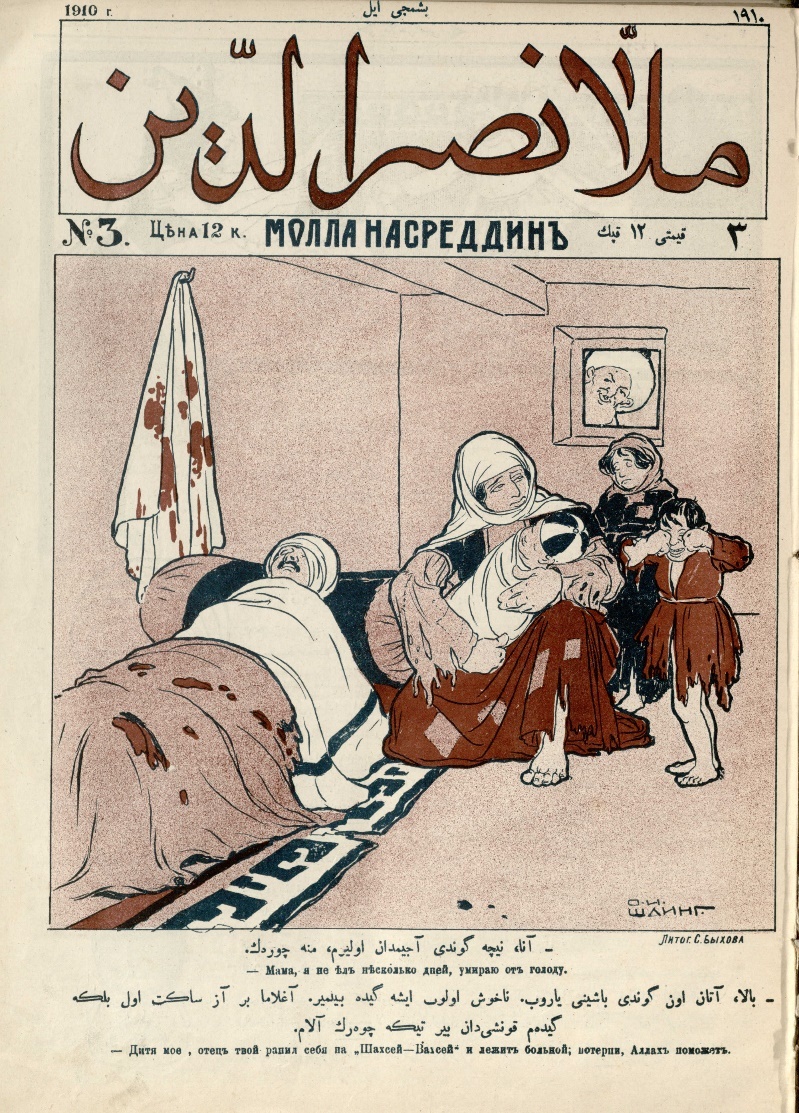
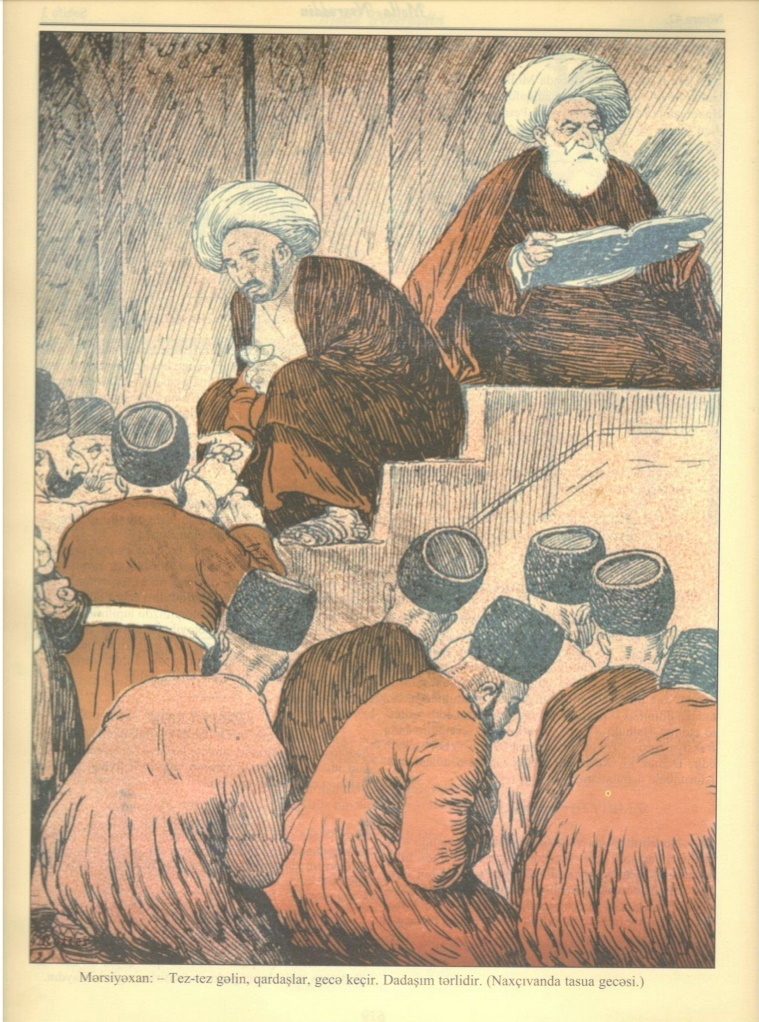
In the years that followed, similar protests were published in the extremely popular eight-page satirical periodical Molla Nasreddin, first published in Tbilisi between 1906 and 1912. The broadsheet published in Azeri-Turkish began in the wake of the 1905 revolution in the Russian Empire, on the heels of a relaxing of press laws that opened doors on social criticism in print. The magazine targeted colonial powers, the corruption of the local elite, and the hypocrisy of clerics using a sharp sense of humor. Each year during Muḥarram, the magazine published letters, short articles, and poems, similar to those in Əkinçi, criticizing Muḥarram mourning rituals and often using caricatures and illustrations to this end. It was mostly the practices of self-flagellation and bloodletting that were again the target of these critiques (figure 3) and the reciters of laments, too (figure 4). The popularity of the journal, not only in the Caucasus but in Iran and the Ottoman Empire, was accompanied by the anger it generated, with the anti-clerical content leading to attacks on the publication’s offices and even a fatwa issued against the editors by high-ranking clerics in Najaf, Iraq (Javanshir 2016, 25–26). While very few rejected Islam entirely, many of the Azerbaijani intelligentsia were critical of the apparent excesses of Muḥarram, but these critiques do not appear to have been effective in eliminating these practices, given their continued popularity in the years immediately before World War I in the Caucasus and Iran (Adam 2001, 126).

_satirizing_reciters_profiting_from_m.jpeg)
Soviet anti-Muḥarram campaigns
With the Soviet takeover of Azerbaijan came periods of differing approaches toward Islam by the state. Although Muḥarram mourning was forbidden right after the incorporation of Azerbaijan into the Soviet Union in 1920, the authorities initially avoided administrative measures due to divided approaches on how to treat such events. While many members of the Azerbaijani Central Committee wanted to enact the ban on processions and gatherings, Nariman Narimanov, who headed the Azerbaijan Revolutionary Committee and, subsequently, the Azerbaijan Soviet Socialist Republic, insisted that the party should not antagonize the participants (Brinegar 2017, 387).
In this period the Bolsheviks hoped to mobilize the “revolutionary potential” of Muḥarram to weaken the influence of Britain and France in Asia, portraying themselves as the protectors of Muslims and Islam. ʿAshura was subsequently made into an official holiday, with Soviet propaganda labeling British imperialism as the “Yazid of our days,” encouraging mourners to avoid spilling their own blood and instead take up the sword to support Muslims in the face of imperialism (Hadjibeyli 1958). Narimanov’s position prevailed in 1920 and 1921 when he was in Baku, but the ban came into place in his absence in 1922, resulting in the Red Army firing on participants (Brinegar 2017, 387–88). Between 1922 and the early 1930s, annual anti-Muḥarram campaigns took place that involved the mobilization of multiple forms of propaganda.
Public lectures and sermons in mosques decried these practices, as did articles in newspapers and anti-Muḥarram theatre productions. These articles offered various interpretations of the Muḥarram narrative and the rituals in their attempts to refute them. One of the most ardent critics of Muḥarram mourning during this period was the writer Mammed Said Ordubadi (1872–1950), who dedicated two essays to the shortcomings of the reciters (Ordubadi 1924). He criticized both the poetry and the sources of the “exaggerated” accounts used by reciters, such as the works of Fazil Derbendi (1785–1870). Ordubadi also attempted to trace the origins of these ritual practices, claiming that the recitation of lamentation poetry originated in Iran and that many reciters came to Azerbaijan to earn their bread by exhorting the population to cry and mourn throughout the year.
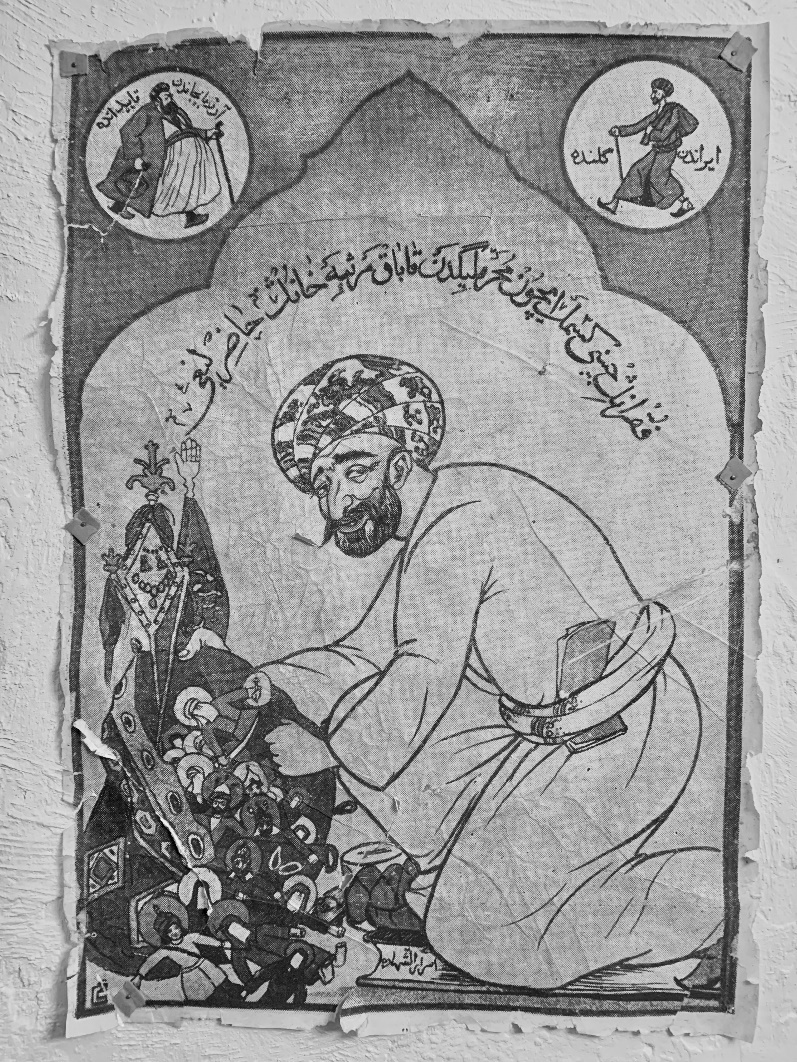
Posters and brochures were produced and distributed (Bobrovnikov 2017), some reusing illustrations from Molla Nasreddin (Hadjibeyli 1958), which targeted the practices and ritual practitioners of Muḥarram mourning, including reciters (figure 5). During this period, Bismillah (1925), one of the first Soviet films in Azerbaijan, was made. It was a critique of religious clerics and includes footage shot during Muḥarram with real flagellants. This film was then shown across the country, and over the next years screenings attracted large audiences of men and women. This anti-Muḥarram propaganda continued with different tactics (Hadjibeyli 1958).
_on_display_at_the_shirvanshah_museum_restaurant__baku_2019._th.jpeg)
Despite this sustained campaign against Muḥarram mourning, accounts and figures demonstrate that the commemoration of Imam Husain’s martyrdom continued throughout the Soviet era, both in private but also quite publicly, especially in the later decades of the Soviet Union. This was repeatedly recounted to me in interviews and conversations with Shiʿi Muslims who lived through the Soviet Union in Georgia and Azerbaijan. In a village on the outskirts of Baku, one man in his seventies recalled how, in certain instances, restrictions were not enforced, as sympathetic officers would turn a blind eye to mourners visiting shrines in the Absheron Peninsula during Muḥarram. However, he also described how, during other years, mourning gatherings had to take place secretly at home with children acting as lookouts to warn of approaching police. Others mentioned how the death of villagers during Muḥarram was seen as a good thing, as it allowed mourners to combine their mourning with rituals for Husain. “They couldn’t stop us from mourning for our dead,” one said.
Official figures for mosque attendance throughout the years show consistently that Muḥarram was the busiest period for mosque attendance in Soviet Azerbaijan, with numbers increasing over time (Ro’i 2000). By the late 1980s, before the final collapse of the Soviet Union and independence of the Republic of Azerbaijan, Muḥarram rituals took on an increasingly public character. Videos from those years, which were shared with me and also those available on YouTube, capture large-scale gatherings that include recitation, flagellation with chains, and bloodletting with daggers. The public resurfacing of these ritual practices in the late Soviet period demonstrates their persistence despite decades of harsh denunciation and periods of forceful repression.
Public mourning in independent Azerbaijan
In the immediate period following independence, Muḥarram rituals regained some legitimacy, with ʿAshura attracting larger numbers of mourners at mosques. In her work on women in Azerbaijan in the immediate period following independence, Farideh Heyat (2002) notes that in 1992–93 large numbers of worshipers, particularly women, attended the ʿAshura ceremony at Taza Pir. Videos from this period show large-scale processions in the suburbs of Baku and the south of the country as well as the families of men killed in the fighting over Karabagh reciting növhə while mourning for their loved ones. The most striking example of the acceptance of these rituals in this period was the appearance of Heydar Aliyev, the third president of independent Azerbaijan and father of current president Ilham Aliyev, at Taza Pir mosque on ʿAshura in 1994. President Aliyev, who had been the head of the KGB and the Azerbaijani SSR, gave a speech in which he connected the national struggle and war over Karabagh with the tragedy of Karbala. He stated that the “sons of Azerbaijan” were defending the motherland and being martyred like Imam Husain (Aliyev 1995). This attempt to connect Karbala to Azerbaijani nationalism has continued throughout the post-Soviet period, especially with the intensification of the conflict with Armenia in more recent years.
When compared with pre-Soviet accounts of Muḥarram, mourning ceremonies in the post-Soviet period have undergone substantial changes while keeping many of the same basic features. As already seen, the mourning məclis (gathering) takes on relatively the same structure as that described in the early twentieth century—the recitation of növhə, to which mourners beat their chest lightly, followed by a sermon by an ākhūnd, and then the recitation of a longer rövzə or mərsiyə. Many of the visual and material elements of the ceremonies, such as ʿalams, banners and flags, described by Lassy and present in neighboring Iranian Azerbaijan, are largely absent, while the presence of the Azerbaijani flag is conspicuous. Theatrical performances of şəbih are extremely rare,[5] while self-flagellation has largely disappeared due to continued bans and the forbidding of such practices by the state religious authorities. Each year the Caucasus Muslim Board, through its leader Sheikh-ul-Islam Allahshukur Pashazadeh, issues statements and fatwas declaring it improper and urging the faithful to mourn in the “right” manner.
Since the early 2010s increasing emphasis has been placed on inviting Muslims to donate blood, an act that has become popular in other parts of the world (Flaskerud 2016; Hashemi 2020). Every year, the Caucasus Muslim Board announces a list of blood donation points at mosques as well as shrines and, after medical checks, the donations are then transferred to the Central Blood Bank. The practice of bloodletting has also been condemned and criticized by “unofficial” religious groups and figures in the country, including those sympathetic to the Islamic Republic of Iran due to Ayatollah Khameneʾi’s fatwa against the practice of taṭbīr in 1994. These official and unofficial religious declarations against bloodletting are accompanied by articles, social media posts, and media commentary condemning self-flagellation. Criticism and debate intensified in 2017 when a video circulated online showing mourners with daggers in the Baku suburb of Bina (Meydan TV 2017).
Changing practice in devotional recitation
Although recitation appears to be one of the most consistent features of Muḥarram mourning over the last century, it too has seen substantial development and change. In the early twenty-first century there has been a blossoming in the number of semiprofessional reciters, known as məddah in Azerbaijan. Specialized reciters played an important role in the persistence of devotion to the Ahl-e Bait throughout the Soviet period as they continued to write and recite devotional poetry in smaller settings.
One attestation of the continued presence of reciters, despite the intense criticism and ridicule they came under, is a book written by Akhūnd Soltan Alizade in 1994 called Azerbaijani Dervishes and Rövzəxan. The book offers short sketches of biographies of reciters, many of them born in the Soviet period, and gives insights into their lives and poetry recited. Reciters known as dervishes were not devotees of Sufi orders or ascetics but individuals possessing a “good voice,” knowledge of poetry, and devotion to God and the Ahl-e Bait. These accounts contain references to both the musical and religious training of several reciters, describing the qualities of their voices and demonstrating their knowledge of local musical genres.
These reciters, the majority from the Absheron Peninsula, had mostly performed at dervish weddings (dərviş toy) and at private mourning gatherings during Muḥarram throughout the Soviet era. According to the ethnomusicologist Inna Naroditskaya (2004), who describes a dervish wedding she attended in 1997, these weddings had remained popular in the region throughout the Soviet era and, in contrast to other wedding performers, included the proclamation of love for the Imams and the Ahl-e Bait. At these weddings, dervish reciters drew on a variety of poetic forms, including classic forms like qəsidə and qəzəl as well as qoşma, poetic stanza associated with the aşıq bardic tradition, displaying a great versatility in their repertoires.
In addition to these older local reciters who played an important role in transmitting devotional poetry to other generations, contemporary reciters talk about the significant influence of Iranian Azeri-Turkish reciters. These reciters, notably Salim Moazenzadeh from Ardabil, first attracted listeners from Azerbaijan through radio transmissions and the smuggling of cassettes across the border in the 1980s. Both older local reciters and Iranian Azeri-Turkish məddah have been an important influence on the development of a distinct practice of devotional reciters in the post-Soviet period. The increasing accessibility of recording equipment and media led to the semi-professionalization of reciters in the late 1990s and early 2000s, as reciters began recording devotional material in studios and then circulating it first on cassette, then CD and VCD, before moving on to the internet. The ability to record and distribute devotional material throughout the year allowed for the expansion of the məddah repertoire in different directions beyond the recitation of lamentation poetry at mourning gatherings.
One of the most popular early examples of this experimentation was the Ahl-e Bait Group (Əhli-Beyt Qrupu,) which developed a new style of pop-devotional music combining devotional lyrics in praise of the Ahl-e Bait with influences from Turkish devotional ilāhī hymns, Azerbaijani classical modal muğam, and pop music.[6] Əhli-Beyt Qrupu was formed in 2000 and consisted of three young məddah, two of whom had graduated from the Azerbaijan Islam University and who had received additional religious education in Syria and Iran, and one graduate from the Azerbaijan Music Academy. The group’s aim was to use music and lyrics in Azeri-Turkish, rather than Arabic or Persian, to promote love and devotion to the Ahl-e Bait.
In an interview the group members stated that what distinguishes them from other music was the type of love they sang about:
There is a big difference between divine love and worldly love. We perform music about Allah’s, the Prophet’s Ahl-e Bait. But the other musicians just sing about worldly beauty. Some even say things like—you are my god, my qiblah—to the girls they love in songs. This will all end one day. Infinite praise is for Allah alone. Love for him is never ending.
The group managed to gain a large following through the circulation of its recordings and videos and has been invited to perform around the country as well as in Russia, Iran, Iraq, and Georgia. During Muḥarram the group members confine themselves to reciting traditional forms or marsiyah and rowẓah, and they reserve their group performances, including musical instrumentation, for concerts and weddings throughout the rest of the year. The early 2000s saw the formation of other similar groups and the increasing popularity of individual reciters. Most of these began their careers reciting at məclis as children in the 1990s, although some transitioned as performers of other genres. Several popular devotional reciters and poets gained fame as performers of meyxana, a distinctive lyrical genre often described as an Azerbaijani folk rap tradition.[7] Throughout this period there have also been smaller numbers of female reciters, mostly groups, who have similarly produced devotional recordings and media, although receiving less fame and attention.[8]
Out of the contemporary məddah, and arguably the most popular, is Sayyid Taleh Boradigahi, who along with his brothers Sayyid Peyman and Sayyid Fariq, began performing as the Azerbaijan Devotional Hymn Group (Azərbaycan İlahi Nəğmələr Qrupu). Taleh was born in 1988, just before Azerbaijan’s independence, to a religious family, and grew up in Russia where his father worked before going on to study at the Islamic University in Baku. Growing up, he and his brothers recited növhə and mərsiyə at məclis and often performed at religious weddings. Taleh’s popularity grew after he was invited to recite in the Zeynebiye mosque in Istanbul for the ʿAshura commemoration, which attracts thousands of mourners and where he now recites annually since 2010. Sayyid Taleh has continuously cited Salim Moazenzadeh as his main inspiration and teacher, as he grew up listening to and studying cassette recordings of his mərsiyə and növhə. This influence can be clearly appreciated in his recitation of laments at Muḥarram məclis. However, the production of recordings in the early twenty-first century demonstrates a wider pool of influences in the diversity of styles and experimentation. Taleh, like other məddah, is an extremely active user of social media, and YouTube in particular, producing high-quality videos that receive millions of views. These productions include musical arrangements and compositions, collaborations with popular singers of other genres, and elaborate videos even with animation for children. Following the intensification of fighting between Armenia and Azerbaijan in 2020 and the regaining of territory in Karabagh, Taleh and his brothers produced videos with increasing nationalistic content in support of Azerbaijan. Far from just being influenced by and imitating Iranian Azerbaijani reciters, Sayyid Taleh has gained a large following in Iran and been invited to perform alongside well-known məddah there. The high-quality media productions and innovative styles of Azerbaijani məddah have led to a growing transnational audience among Azeri-Turkish Shiʿa in the Caucasus, Turkey, Iran, and the diaspora in Russia, Central Asia, and Europe. One list published online showing the whereabouts of twenty-five popular Azerbaijani məddah during Muḥarram in 2016 demonstrates this point, with reciters traveling to məclis in Georgia, Turkey, Russia, Ukraine, Belgium, Austria, Belarus, and Germany (İslamazeri.com 2021).
The growth in popularity of reciters in recent years has not been without criticism and debate. For some Shiʿa these məddahs’ musical and performative experimentation goes too far, blurring the boundaries between devotion and entertainment. These criticisms have often focused on the inclusion of musical instruments and women in their videos, and there have been accusations of profiting from performances in honor of the Ahl-e Bait. One article by a local cleric, Niyam Aqil, praises the rise in reciters since the fall of the Soviet Union before listing the shortcomings of contemporary reciters (Aqil 2018). He notes, however, that the growing celebrity of reciters together with the fees they attract for reciting at weddings, have begun to attract less sincere and talented individuals. He warns that this has led to the spread of false information in the name of religion by reciters who have little knowledge or sincerity regarding Islam. In the article, Aqil also criticizes the use of music and melodies that originate in secular music, for example the recitation of devotional poetry over the melodies of Turkish pop music, saying that the use of this music leaves little to distinguish məddah from normal wedding singers.
While Aqil’s piece aims to be constructive in its criticism, critics from wider society have often been much harsher, mirroring the arguments against reciters of the past. One example of this was a post by an opposition member of parliament, Fazil Mustafa, who shared a video from a Muḥarram məclis of Sayyid Taleh reciting a mərsiyə with Haji Shahin crying behind him. In this post he ridiculed the practice, saying that there was absolutely no precedent for reciting mərsiyə or weeping in the Qurʾan and that Muḥarram rituals were based on ignorance, thereby demonstrating how the country was not only behind in “technology, science, philosophy, education and health” but also in religion (İnter Press 2018). Both Sayyid Taleh and Haji Shahin responded to the MP’s statements. Taleh defended his work saying that it was sanctioned by the Islamic tradition, while also reminding the MP that Heydar Aliyev had participated in ʿAshura gatherings and that the great Azerbaijani writers and poets of the past had written poetry in honor of the Ahl-e Beit (axar.az 2018).
Conclusion: Ritual resilience
The increasing popularity and higher profile of semiprofessional reciters following the Republic of Azerbaijan’s independence and the rise of new media has been accompanied by debates and discussions around the practice of devotional recitation. While some of these arguments have focused on new developments in the practice, much of the critique from secular and reformist thinkers echoes a longer trajectory of criticism of Muḥarram ritual and practice that dates to the late nineteenth century. Tracing the continuation and adaptation of practices of Muḥarram mourning and the debates that surround them, it is clear to see that these ritual and aesthetic forms are not superficial elements of religious life but are central to how people live, understand, or reject religion. The focus on self-flagellation and recitation by detractors of Muḥarram mourning highlights the significance of the visceral and performative aspects of ritual practice as elements that appear to be threatening to both correct devotion and social and political order.
While the demotic nature of Shiʿi devotional ritual means that ritual practice is openly contested, this quality also affords a level of flexibility that has arguably helped rituals of devotion to the Ahl-e Bait remain resilient in the face of criticism and social-political change. As a ritual complex made up of multiple sensory-aesthetic forms, Muḥarram mourning is fluid, able to adapt (new styles of poetry and vocal recitation), remove elements (bloodletting, public processions), and incorporate new elements altogether (blood donation), without losing authority and while remaining relevant to Shiʿi practitioners. Although it may not be possible to measure changing levels of devotion or assess the impact of external and local influence on Shiʿism in post-Soviet Azerbaijan, examining ritual practice in terms of resilience rather than “revival” allows for an understanding of Islam as a dynamic religion in the Caucasus, continuous yet adapting to social and political change.
Original Azerbaijani spellings for terms are used throughout the article to reflect local pronunciation. Only names have been changed where transliteration is commonly in use. Since 1992, Azerbaijani has been written in a modified Latin alphabet in the Republic of Azerbaijan.
Along with those living in Iranian Azerbaijan, Azeri-Turkish-speaking Shiʿa also constitute smaller minorities in Georgia (Balci and Motika 2007), Russia (De Cordier 2018), and Turkey (Williamson Fa 2019).
There are two important Imamzadehs in Azerbaijan, one in the northern city of Ganja and another in Barda, as well as shrines of two sisters of Imam Reza both located in the Absheron Peninsula. These are further complemented by smaller shrines of descendants of the Prophet, and other sites like Qədəmgah Əli Ayağı, believed to contain the footstep of Imam ʿAli. These shrines are visited regularly by devotees seeking blessing and intercession throughout the year but are particularly busy during religious holy days including ʿAshura.
Devotional mourning rituals in honor of the Ahl-e Bait in both the Caucasus and Iranian Azerbaijan were documented by early travelers to the region, including the Ottoman Evliya Çelebi in Tabriz and European traveler Adam Olearius in Ardabil and Shirvan.
There are few examples of theatrical productions taking place in the Caucasus in the early twenty-first century. These include one staged performance in 2016 in Marneuli, Georgia (İSLAMMEDİA TV 2016), and another less elaborate production as part of a public gathering in Nardaran, Azerbaijan from 2015 (Nardaran Kəndi 2015).
The group’s most popular recording, Əli Mövla, was released in 2001 (Əhli-Beyt Qrupu 2001).
One performer, Aqşin Fateh, made this transition quite publicly reciting a meyxana in honor of Imam ʿAli on public television in 2001 (Fateh 2001).
Two recent examples of all-female devotional groups are Xədiceyi Kübra Qrupu (2014) and Eşqi Zəhra İlahi Nəğmələr Qrupu (2021).