In a psychic cure, the therapist’s task is essentially to envelop the patient’s expressed despair gradually and imperceptibly in a mental framework that is neither fully imaginary, nor entirely realistic. It is rather necessary and sufficient for it to be plausible. Thus, the therapist opens a performance space—half real, half fictive—in which the excessive reality of the discomfort and its fixedness may begin to dissolve. The specific terms of distress, the type of therapist, the nature of mental framework, and its expressions, as well as the ways in which the different actors contribute to the therapy are all culturally coded: it is precisely the work of ethnology to describe and compare them (Contreras and Favret-Saada 1990, 21).
At the end of an astrological consultation, Lalitha feels relieved.[1] The young woman, who has traveled over three hundred kilometers to consult an astrologer for the first time, considers her future with a clearer, more serene state of mind. She knows now—at least she thinks she does—that she will be able to marry the man she loves. Her perception of the current situation and her way of imaging the future have evolved. Yet, from an outsider’s perspective, her situation has not changed between the beginning of the divinatory session and its end. The ritual prescriptions given by Manikka, the astrologer, have not yet been carried out. Her encounter with the soothsayer was sufficient to produce a shift in her mindset, easing some of the anxiety that had brought her to him. She confides in me that Manikka’s words reassured her and dispelled her doubts and fears, even though only a few hours earlier she had been markedly skeptical about the efficacy of such an approach. The initiative of Lalitha is nothing exceptional in a country where marriage is an “institution” that towers over Indians’ social life (Dumont [1966] 2001, 143), and where resorting to astrology is a “normal, regular, often compulsory procedure” (Vernant 1974, 10).
Lalitha, the young, tormented woman, came specifically from Madurai on the advice of a childhood friend who had convinced her to consult Manikka. As he told her, this astrologer had a unique way of foretelling, by chanting one’s destiny. Indeed, in Tamil Nadu, Valluvar (vaḷḷuvar) astrologers are well known authoritative figures of rural society, and Manikka is one of them. Although long considered untouchable, they are recognized for their expertise in soothsaying and are therefore consulted by people of all castes and from all strata of society (Avdeeff and Tambs-Lyche 2011, 73–74). From the perspective of what is generally accepted about caste in India, the unique position of Valluvars within Tamil society is quite remarkable. They are recognized for possessing astrological and medical knowledge, as well as aptitudes and competencies related to their practical application, whereas these are usually associated with the higher castes, if not specifically Brahmins (Avdeeff 2012). Their word is renowned for its accuracy, and similarly their predictions are believed to be infallible, as reflected by these two popular sayings:
māṇikka kallē kallu, vaḷḷuvaruṭaiya collē collu
Among the precious stones, it is the most brilliant jewel. No one can dispute the word of a Valluvar.vaḷḷuvaṉ vākku palikkum
Whatever a Valluvar says, it comes true.
Like in other fields of oral tradition within the subcontinent—such as bardic and shamanic traditions, judicial speech or musical language—the astrological register explored here claims “a certain authority and to tell the truth,” to quote Sales and Lecomte-Tilouine (2016, 177), which raises the broader question concerning the contruction of authority in speech. And if, in Tamil country, astrology is usually “seen” and “told,” some Valluvars also “chant” it, as a Brahmin astrologer from the Sarngapani Swamy temple in Kumbakonam confided to me during my 2007 fieldwork, before offering the following explanation:
To be a good astrologer, one must know how to speak and convey matters effectively. For that purpose, Valluvars are the best; within this caste, this skill is regarded as innate. They possess a distinctive capacity to recite and perform astrology. Even today, some among them continue to practice in this earlier manner.
In India, astrological consultation lies at the crossroads of diverse healing traditions (Kakar 1982, 3–4) and several fields of therapeutic knowledge which—if we can formally distinguish them—form a network of complex interactions that shape a system of indigenous knowledge (Sujatha 2003, 195–200). In the Tamil regional context, and more broadly on a pan-Indian scale, consulting an astrologer allows people to investigate the causes of disease and misfortune, and, if necessary, to provide a solution through the prescription of a specific therapy. But the astrological consultation itself is the scene of an inner transformation, and this even before the implementation of the prescribed therapy (Perinbanayagam 1981, 78–79; Pugh 1983, 293–94).
In this article, I propose to revisit the largely forgotten topic of therapeutic astrology—an area surprisingly neglected in recent years—first developed in the influential work of Robert Perinbanayagam (1981, 1982) and Judy Pugh (1983); namely, the study of the healing dimension of astrological consultation located in the performative efficacy of the practitioner. I would like to enrich this discussion by offering new perspectives through the case study of a horoscopic consultation, part of which is chanted. This study is largely based on materials collected during nineteen months of ethnographic fieldwork conducted primarily in the region between Cuddalore, Kumbakonam, and Karaikal from 2006 to 2012. The focal point of the research was the temple of Vaitheeswaran—located twenty-seven kilometers south of Chidambaram—which is known as one of the temples dedicated to Mars (aṅkārakaṉ), one of the nine planets (navakkirakam). More famously, however, it is known as the capital of the lucrative nāṭi astrology business.[2] During the many months of my fieldwork, I traveled around the region on the buses of the Tamil Nadu State Transport Corporation, accompanied by David Chakravarty (Chaku), a research assistant. I sought to conduct a monographic study on the Vallavur caste and to investigate their traditional occupation (toḻil), which is the practice of astrology (cōciyam) and vernacular medicine (maruttuvam). I studied a group of approximately thirty Valluvar astrologers and their families. Of these practitioners, I worked most intensively with seven, observing and recording many of their consultations. The analysis presented here examines one such consultation, conducted with Manikka Velayudham in Sanniyasipettai, a village in Panruti taluk, in August 2008. This specific consultation was selected because it provided a compelling example of my overall observations during fieldwork, while also meeting the article’s practical criteria for conciseness. Drawn from a corpus of approximately fifty recorded consultations, all documented in the presence of myself and Chaku, the material presented here comes from sessions that we transcribed, transliterated, and translated collaboratively after each return to Pondicherry, which served as my fieldwork base. The transliterated excerpts of spoken Tamil presented here may thus reflect the dialectal diversity of the language, with some variations that can be attributed to the region or community affiliation of our interlocutors.[3]
Astrology and divinatory speech
In her work on astrological practices in North India, Judy Pugh (1983) highlighted that astrological consultation, through the various discursive strategies it involves, is not merely the establishment of a diagnosis to redirect the patient to the appropriate specialist. It is truly a “therapeutic space” (281–82) where the astrologer, thanks to his mastery of the “arts of medicine” (ibid., 279)—and specifically the “art of dialogue”—leads the patient to fully participate in the reformulation of one or more problematic situations and helps them overcome these. Regarding interpretative divination—such as astrology or cartomancy—other studies have highlighted the importance of language use in this transformative process. In his study of astrological practice in Jaffna, Perinbanayagam argues that “self and other interact and conspire to maintain each other, to diminish anxiety, and develop hope, but such interactions by necessity must be conducted within delimited universes of discourse and with specific terminologies that perform rhetorical functions” (Perinbanayagam 1981, 78). He later characterizes these as “rituals of communication that have therapeutic impact” (ibid., 79). In many ways, these findings in the Asian context echo the analysis of a divination session (cartomancy) in the western French Bocage. Josée Contreras and Jeanne Favret-Saada (1990, 29–31) emphasize the importance and primacy of the soothsayer’s words in the therapeutic process of the divination session. They show that the efficacy of the session rests largely on reducing anxiety-provoking situations through the astrologer’s sustained verbal framing, which envelops the client from the outset and addresses a wide range of interpretive and emotional registers. As we will see in the case study, the astrologer employs a technique that engages the client’s attention from the outset and frames the consultation through his continuous verbal guidance.
Based on the analysis of Lalitha’s consultation and drawing on the studies cited above, this article seeks to explore the transformative dimension of the astrological session by focusing on the “dynamic, pragmatic and creative character of speech and dialogue” (Demmer and Gaenszle 2007, 1). Using original ethnographic material, it examines how, in chanted horoscopic consultations, specific verbal acts direct attention toward the client’s emotions and affects, making these the central site of interpretive work. We can reexamine the everyday practice of this kind of religious counseling by highlighting the astrologer’s word and their ability to influence the consultant’s mindset and emotions. Both in its perspectives and methodology, this study is situated within the anthropological, sociolinguistic tradition of the “ethnography of speaking” (Hymes 1962, 1972; Bauman and Sherzer 1974; Briggs 1988) and key works on the specific nature of religious language (Mauss [1950] 1973; Malinowski [1935] 1965; Lévi-Strauss 1949; Staal 1989; Kuipers 1990; Keane 1997, 2004; Severi 2007; Kedzierska-Manzon and Rozenberg 2018, among others). It addresses the question of the authority and therapeutic efficacy of divinatory speech by considering the event as a culturally codified ritual performance. As such, this article explores the nature of a specific speech register by focusing on how the astrologer constructs “a culturally meaningful world” (Demmer and Gaenszle 2007, 17; on the meaning-making during the astrological consultation, see also Poletti 2018, 62) through the realization of a chanted narrative that he performs for his patient in the first and main part of the consultation.
Interpretative divination and oral performance
Based on his fieldwork in Tamil Nadu, Milton Singer distinguishes several types of “cultural specialists,” among which are astrologers. However, he classifies them in the category of “non-performing cultural specialists.” According to Singer, even if they are fully involved in the shaping and the transmission of local culture, astrologers are not affiliated with any institution and do not lead “cultural performances,” but merely give advice on auspicious occasions (1955, 29–30). In practice, however, the astrologer does more than simply indicate auspicious times to the patient. He often prescribes cures and other remedies (parikāram), which he can also perform himself. Likewise, some consultations take on a performance-like quality, as illustrated in the case study of the genethliac (natal chart) consultation analyzed below. Thus, even though the primary objective of many astrological consultations remains the determination of auspicious and inauspicious times, the consultative process leading to this result is often more complex and generally extends into one or more ritual actions prescribed by the soothsayer.
In India, oral and performative dimensions of divination have been mostly explored through studies on possession and occasional its dramatic expressions.[4] While some studies are more specifically interested in the oral literature produced during possessions (Brückner 1993; Claus 1993; Obeyesekere 1984), others have focused on the analysis of the dialogic and discursive strategies implemented by the specialist (Berti 1999; Schömbucher 1994, 1999; Demmer 2007), approaches inspired by perspectives articulated in performance studies. In contrast, regarding interpretative divinatory practices—particularly astrology—studies are rarer, if not almost non-existent. However, the oral dimension of the astrological consultation has been explored in various ways in different studies. In her work on astrological counseling in contemporary India, Pugh (1983, 288–91) analyzes a consultation from a phenomenological perspective, highlighting the astrologer’s “art of dialogue.” Despite the repeated use of the word “art” to describe the various skills of the astrologer implemented during the consultation, such as “art of dialogue,” “art of prediction,” and “art of remedy,” Pugh leaves out the analysis of aesthetic shaping, including the poetic, rhythmic, or chanted dimension of horoscopic reading. Similarly, in her seminal and comprehensive study on the contemporary practice of astrology in Banaras, Caterina Guenzi (2013) places significant importance on the analysis of numerous astrological consultations that highlight various aspects of the profession previously neglected. However, she does not include the performative and aesthetic dimensions of astrological reading. Indeed, only a brief mention of the aesthetic dimension of horoscopic readings appears in a study that Perinbanayagam conducted among the Tamil community of Jaffna, Sri Lanka, in the mid-seventies. By looking at how the Tamil astrologers of Jaffna proceed to produce what he calls a “myth of the self” during the horoscopic reading, he notes that,
[the astrologers] create a text that used to be recited or sung; nowadays it is often written down, but even today there are many astrologers who give oral readings and put such readings into verse form. There is no doubt that in earlier times most astrologers functioned in this way; that is, they created not only a myth but a poem of the self. (1982, 118)
According to Perinbanayagam, the use of poetic language in that construction of a “poem of the self” by the astrologer is directly related to the long Tamil poetic tradition (ibid., 118–19), which could explain the specificity of astrological practices I observed in Tamil Nadu.
The soothsayer on stage
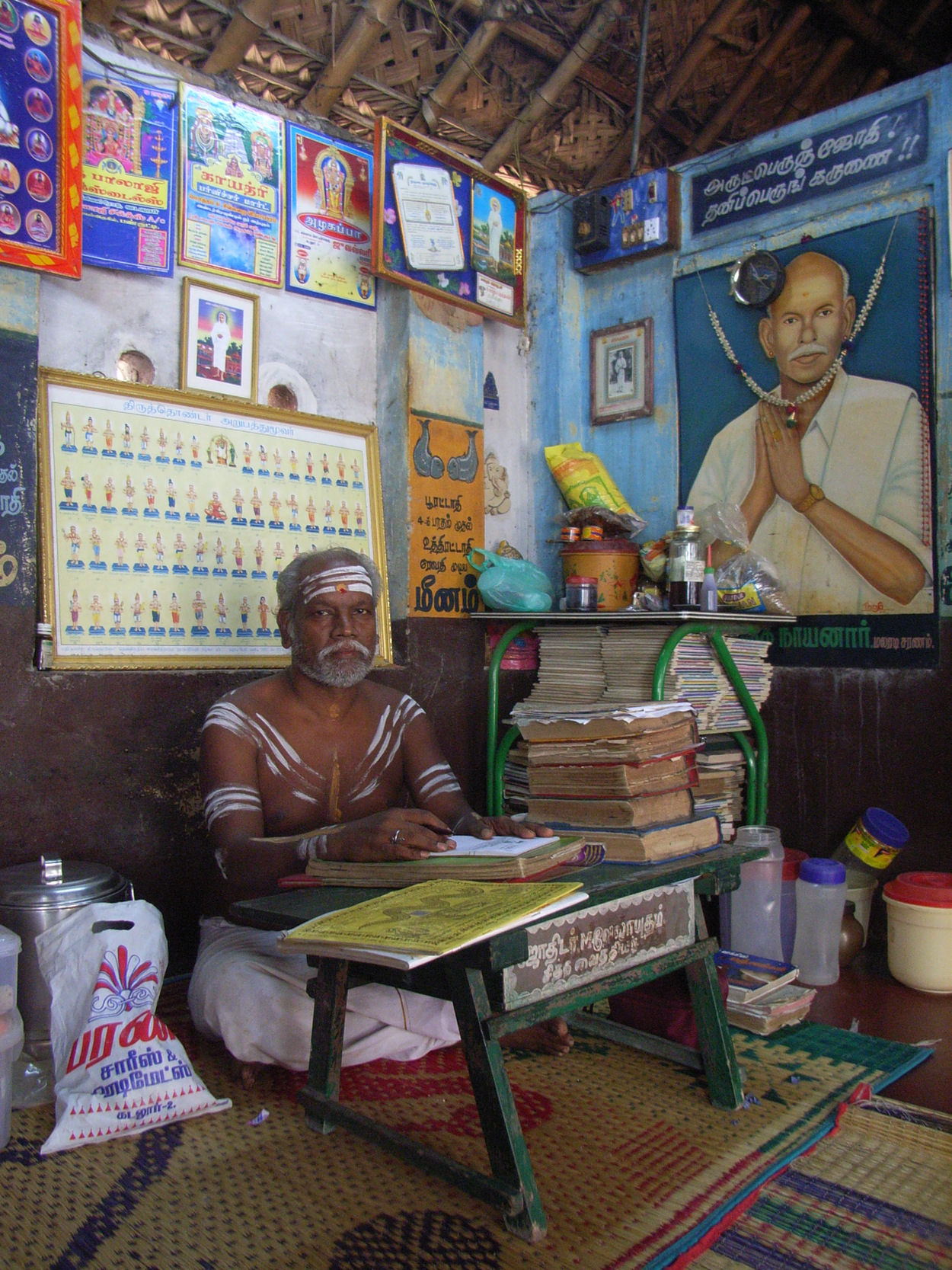
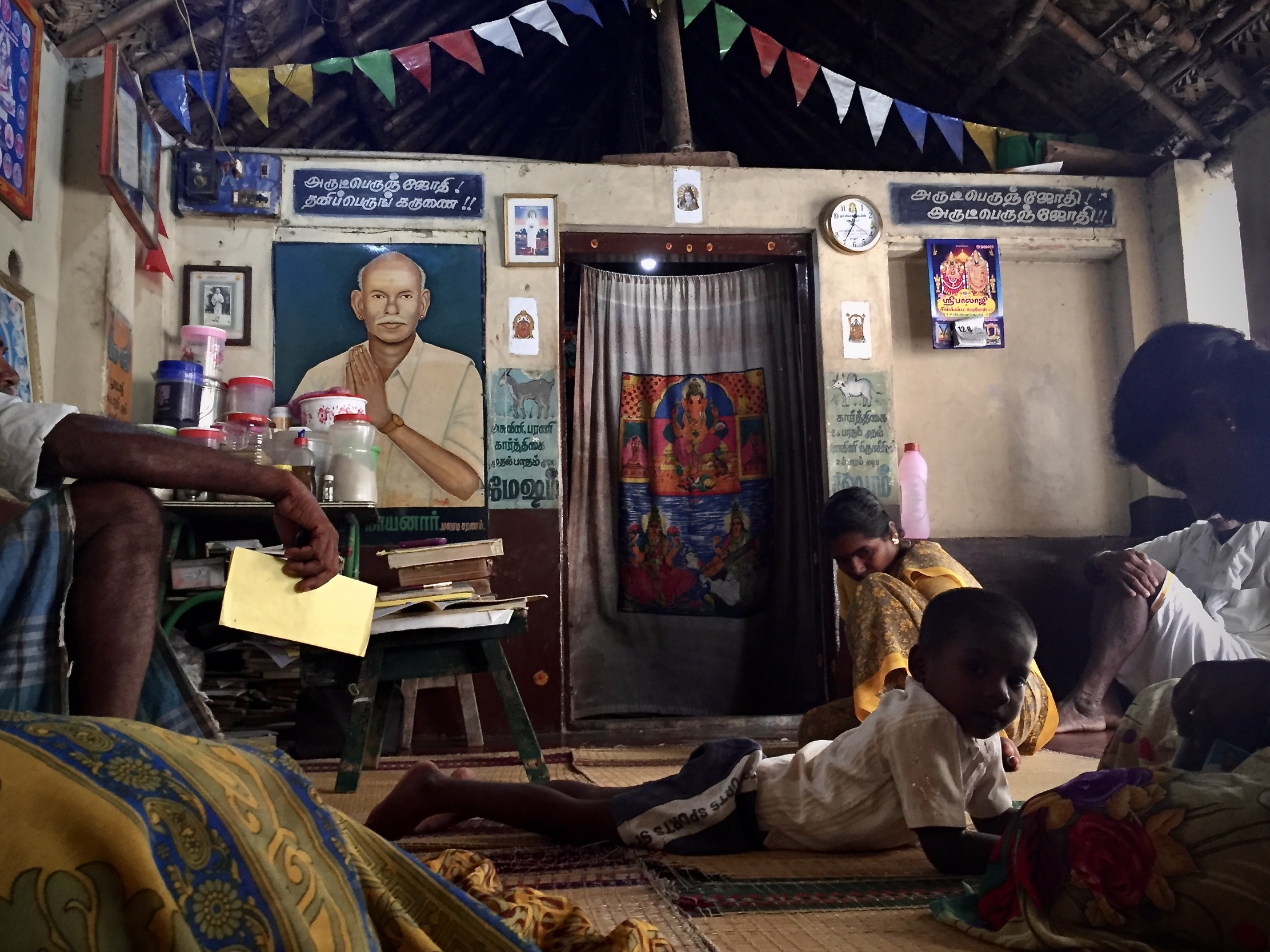
Manikka Velayudham, like some Valluvar astrologers I met during my fieldwork, is part of this Tamil poetic tradition. He receives his patients under an open-air porch (tiṇṇai) adjacent to his house, which is specially dedicated to astrological consultations. As soon as one enters the tiṇṇai, signs and other astrological symbols adorning the pillars of the space are immediately noticeable. They clearly delineate the consultative space, imparting a certain solemnity to it. This atmosphere of gravity and respect is reinforced by the numerous religious representations surrounding Manikka, notably those of the sixty-three Nayanars (nāyaṉār)[5] behind him and of Vallalar above him, reflecting the local spiritual lineages within which the practitioner situates himself.[6] Vallalar’s prayer—aruḷ perum jōti—is inscribed in several places below the ceiling of his porch where he conducts his consultations (Figure 1). The tableau’s final touch is Manikka’s private altar, located in a small dark room to his left that is closed off by a curtain. There, he performs various healing and corrective rituals following his consultations, when necessary (Figure 2). From an autochthonous perspective, all these markers contribute to establishing the soothsayer’s tiṇṇai as a delimited ritual space (Flueckiger 2008, 49–52).

The tiṇṇai is often crowded and allows patients waiting for their turn to observe other consultations, turning Manikka’s sessions into public performances (Figure 2). He consults while sitting directly on the floor in a cross-legged posture behind a reading desk, which bears the Tamil inscription, “Astrologer M. Velayudham, Citta Physician.”[7] This posture is reminiscent of the way yogis, cittar,[8] and other Hindu holy persons, including the Tamil poet and saint Tiruvalluvar, are often depicted. His torso and forehead are coated with tirunīṟu, sacred ashes reminiscent of the deity Shiva (some Valluvar astrologers also wear the pūṇūl, the sacred thread). He does not practice in his everyday clothes, and instead usually wears a finely crafted white vēṣṭi (Figure 1). Manikka pays careful attention to his appearance. As Detienne ([1967] 2006, 114) suggests, bodily posture confers a particular force on the soothsayer’s speech, and in this setting it is complemented by a distinctive mode of dress within the defined space of the consultation.
During the consultation, these extralinguistic forms of communication—posture and appearance—play a crucial role, for “it is through their use that the game of ‘identity transformation’ on which participants’ behavior relies is realized” (Severi 2009, 16). The attention given to posture and appearance highlights the specialist’s distinctiveness, allowing the astrologer to assert his professional identity, and, in turn, his authority in front of the patient. This definition of the identity of the astrologer—and implicitly that of the patient—“as one of the elements of the social indexicality plays an important role in the generation of the utterances meaning” (ibid. 17). As such, it places the astrologer’s words in a separate speech register from that of everyday life.

Each divinatory process begins with a request on the patient’s side. Whether implicit or explicit, this query is always motivated by angst or anxiety about a past, present, or future event. Regarding genethliac investigations—such as the birth of a child or the onset of menarche—the primary question is generally implicit: does the horoscope of the newborn or the nubile young girl reveal specific afflictions (tōṣam)?[9] In these cases, the parents simply provide the astrologer with the birth date and then wait patiently and silently for the astrologer to draft and interpret the horoscope. In other instances, which also rely on horoscope analysis, the patient may present the astrologer with a specific question related to a stressful event or crisis. In these cases, the reading of the horoscope—and its prior drafting, if necessary—is only the first step of the astrological consultation. It is generally followed by an in-depth inquiry into the patient’s situation by the astrologer to relate, as closely as possible, the “lights” of the horoscope with the various aspects of the event or crisis in question, as verbalized by the patient during the consultation. Typically, once the horoscope is established, the astrologer will not immediately answer the patient’s question. Instead, the astrologer will first provide the general characteristics of the patient’s life as revealed by the horoscope. Only after this “reading” and the recall of the astrological configurations can the patient ask questions, and the discussion of the problematic situation can begin. In a basic astrological consultation, putting the interpretation into words is usually very brief—scarcely a few minutes—but for some Valluvar astrologers, like Manikka, it can be more elaborate and refined, taking the form of a life story narrated like a poem that may last ten to fifteen minutes, or sometimes even longer.
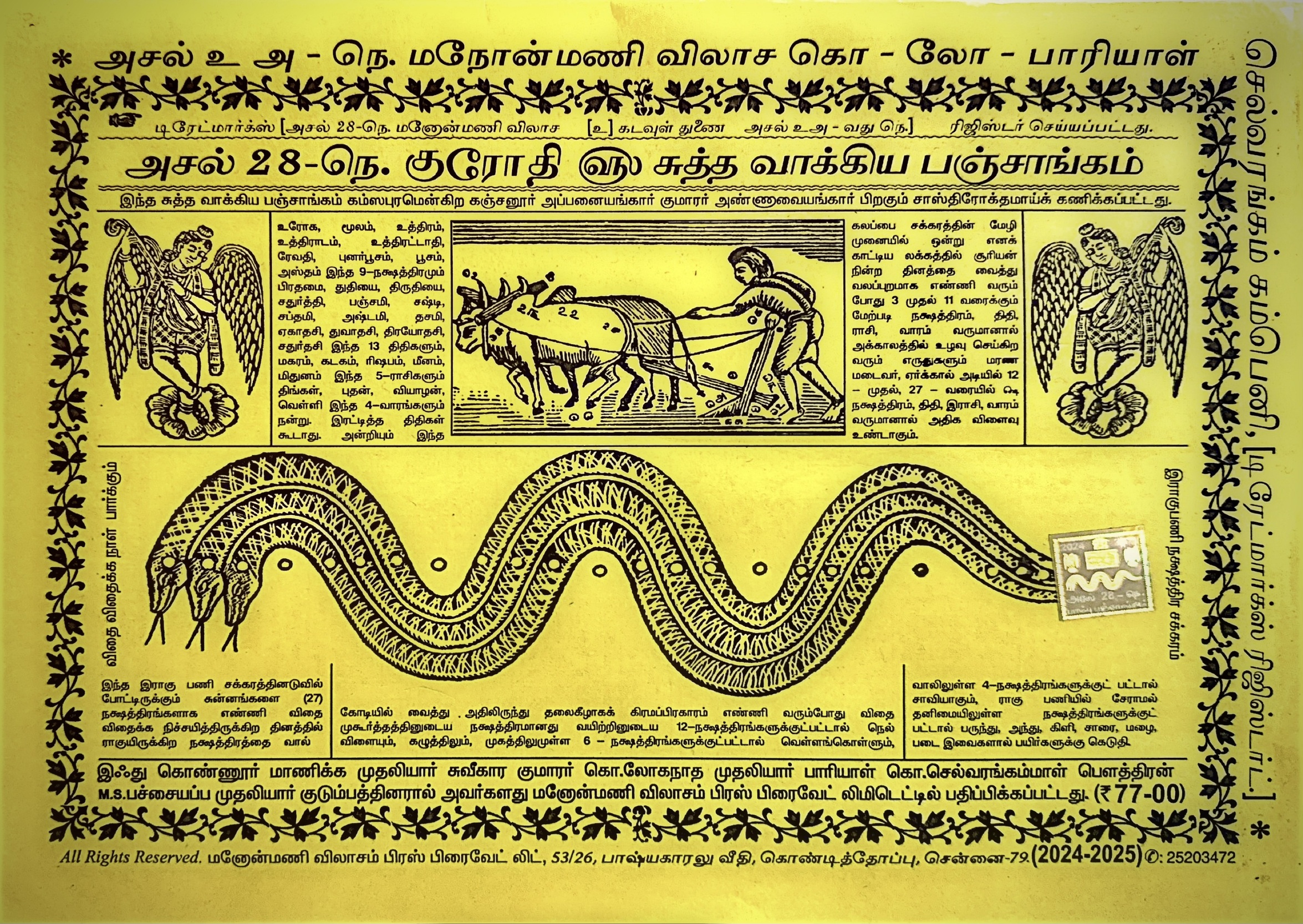
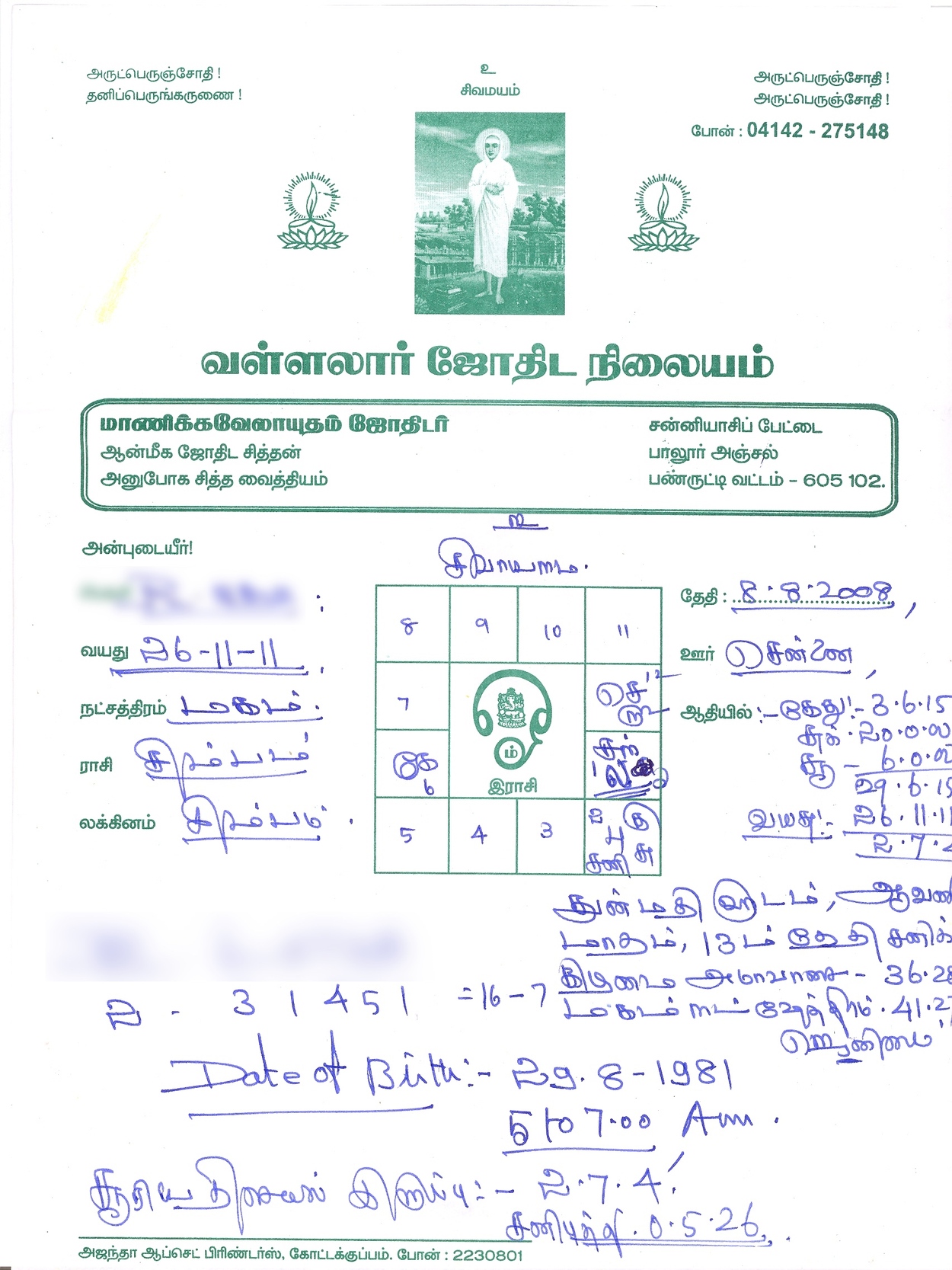
The encounter between Lalitha and Manikka took place in August 2008, on the astrologer’s tiṇṇai. While waiting for her turn, we chat, and Lalitha explains to me in detail the reason for her visit. She is in her late twenties. She comes from an urban Christian family and holds a postgraduate degree. Her issue is that a few years ago, she fell in love with a guy who was her classmate. Since then, they have been living their love story in secret, hiding their affair from their families. Now, they both wish to marry, but her boyfriend’s family refuses to accept the union, and has already arranged her marriage to someone else. She is desperate and seeks to find out whether she and her boyfriend will be able to marry despite his family’s plans. Then comes Lalitha’s turn. Manikka gestures for her to step forward and sit in front of the reading desk. She complies and, timidly, explains to Manikka that she is tormented by issues related to marriage, mentioning that she has never consulted an astrologer before and therefore has no horoscope. Raised in the Christian faith, she explains that no one in her family really considers astrology as something worth using. She says that she came along with a friend, a fellow student who had advised her to consult him. Manikka does not seem to pay much attention to what Lalitha is saying, and, cutting her off, he asks for her date, exact time, and place of birth. She then hands him a piece of paper on which she has written the requested information. He takes it silently and retrieves the astrological almanac (pañcāṅkam) corresponding to her year of birth. Like many Valluvar astrologers, Manikka uses the Pāmpu Pañcāṅkam,[10] the “serpent almanac” easily recognizable by its cover featuring a pāmpu (snake), representing the twenty-seven lunar mansions, the naṭcattiram (Figure 3). It is one of the most widely used almanacs in Tamil Nadu, if not the most popular, especially in rural areas. Nowadays, he writes astrology down only on sheets of paper or pre-printed astrology booklets. Although some people still bring him horoscopes written on palm leaves known as ōlai, especially those made by his father, he no longer writes them himself. For people like Lalitha, who are not regular patients and are unlikely to return, Manikka uses a simple pre-printed sheet of paper, which the patient will take home at the end of the consultation (Figure 4).
__the_thirty-eighth.jpeg)
Using Lalitha’s birth data, Manikka will consult the almanac to find the position of each celestial body, which he will then record in the horoscope diagram, the irācicakkaram, pre-printed on a sheet of paper. He then determines the birth star (naṭcattiram), the planetary periods, and sub-periods (ticāputti). Finally, after determining the ascendant (ilakkiṉam), the astrologer places the twelve houses (stāṉam), which are the constituent elements of destiny (Guenzi 2013, 168). Once placed, they allow the astrologer to explore the various aspects of the patient’s life. The astrologer prepares the young woman’s horoscope in an atmosphere of reverent silence for about fifteen minutes, before suddenly breaking the silence.

Chanting destiny
Manikka opens the consultation session by reciting the aruḷ perum jōti prayer to the supreme light embodying the divine compassion and wisdom taught by Vallalar.
Great Light of Infinite Grace,
You who give everything,
The gods have received your great grace,
I salute you.[11]
Afterward, shifting to a monotonous rhythm, he recites to Lalitha the general characteristics of her life, (with line breaks marking the scansions of his oral prose):
On the thirteenth of the month of Avani (āvaṇi [mid-August to mid-September]),
of the Tamil year of Tunmati (tuṉmati [1981–1982]),
which falls on Canikkilamai (caṉikkiḻamai [Saturday]),
which is amāvācai titi [new moon],
which is also August 29, 1981,
nāḻikai 36 and vināṭi 28, [these are ancient units of time]
Miss Lalitha was born.
Here is the summary of her horoscope.
[Silence]
As for today, her age is twenty-six years, eleven months, and eleven days.
In the beginning, when she was born, Ketu[12] was the ruling planet.
It was dominant for a period of three years, six months, and fifteen days.
When she was born the planet, which was ruling her life, was Ketu.
It was ruling her life for about 3.5 years.
After this period, the dominant planet from her fourth year on was Cukkiran (cukkiraṉ [Venus]), and that for about twenty years.
Likewise, when she reached 23.5 years old, Curiyan (cūriyaṉ [the Sun]) became the dominant planet.
Its influence lasted about six years.
Till her twenty-ninth year, sixth month, and fifteenth day, her life will be ruled by Curiyan.
Shifting to a normal conversational tone, he adds:
Deducting twenty-six years, eleven months, and eleven days, which is your current age, you still have to go through a period of two years, seven months, and four days under the influence of Curiyan
Then, without any other document than the paper on which he has cast the horoscope, Manikka returns to his rhythmic oral prose and begins narrating Lalitha’s life story:
The ascendant is primordial.
The ascendant reveals one’s life.
Cimmam lakkiṉam [Leo ascendant][13] is the one that gives wealth,
good health,
transportation facilities,
higher education, and so on
[…]
Persons born in this lakkiṉam,
will be stubborn in nature,
they won’t bend before others,
they will be more powerful,
they will have a strong desire to achieve their aims and goals…
[…]
Unpleasant and unexpected loss of wealth and money,
and unwanted happenings have already occurred in your life during the past 2.5 years.
Since the day the Lord Curiyan [the Sun] has become the ruler,
health issues,
mental stress,
lack of education,
immoral doings,
acts against your culture and morality, etc.,
have happened in your life.
You would have passed the past 2.5 years struggling with these situations,
which are against your wishes.
Today, Cani (caṉi [Saturn]) is the ruler of the sub-period.
During this period, you may miss many things,
many goals you have set.
You are like a sick person who does not take their medicine.
Planets and co-planets, which are ruling this period, are producing these effects.
This passage is interesting in many respects. First, when Manikka delivers the general characteristics of Lalitha’s horoscope, he uses the most respectful third-person Tamil pronoun avaḷ, as if he were narrating the life of an important person. Then he shifts to the second person singular when he directly addresses her. This alternation emphasizes the first part of the narration, placing it in a specialized linguistic register—not to say ritual speech (see Kuipers 1990, 58), which was opened by the prayer. In another context, similar pronominal shifts have been observed by Margaret Trawick in her study of Tamil laborer’s songs (1988). Drawing on Bakhtin’s insights, Trawick shows how the “confusion of voices” in that multivocal discourse can be used in ritual speech to dissolve selves and merge multiple perspectives. However, the dramatization of the speech also results from the use of tonal and, sometimes, syntactic parallelisms. Thus, the sound similarities produced by this rhythmic effect offset the irregular length of the locutions (Hamayon 1990, 173). While these basic patterns of ritual discourse aim to establish the astrologer’s mastery and authority (Kuipers 1990, 57–63), and to demonstrate his knowledge, they also lend a certain efficacy to his speech. Beyond these rhetorical devices, which give Lalitha’s life story a poetic aspect that is a “poem of the self,” this first section also shows how Manikka attempts to alter his patient’s perception of her own life. To do so, he shifts the cause of certain events, which she might perceive as her own responsibility, to external agents (see Perinbanayagam 1981, 75; Nichter 1981, 1 and 9–10). By using the analogical relationship between macrocosm and microcosm, he attributes the causes of misfortune to certain celestial bodies, to which he ascribes an agentic force over his patient’s life. A statement like “planets and co-planets, which are ruling this period, are producing these effects” allows the patient to free herself from potential feelings of guilt. At the same time, the astrologer offers hope to his patient, perhaps to soften the deterministic and implacable aspects of these cosmic mechanisms. He first insists on the temporary nature of these influences; sooner or later, they will change. He also implicitly suggests that a solution to her problems exists by employing a metaphor: “You are like a sick person who does not take their medicine.” After this, Manikka suddenly stops and adopts an elegiac tone to recite some verses:
Shall I go to the gallows?
tūkk’eṉṟa mēṭaikku cellalām ā?
Shall I drink the cup of poison?
viṣam eṉṟa pānattai aruntalām ā?
Shall I leave my home and go to another country?
ūrai viṭṭu tāṉē piṟa tēcam pōkalām ā?
Manikka recites these sorrowful verses, impersonating the young woman as if he were her. The shift in the “sound texture” (Tedlock 1982, 269), as well as the contrast between the internal focalization and the external point of view used to deliver the narration so far, emphasize the emotional state of mind the astrologer ascribes to his patient. Through this impersonation, the astrologer seems to be trying to trigger his patient’s self-awareness of her supposed emotional state. However, Manikka does not leave his patient time for a reaction or an answer, and returns to a normal conversational tone to make his words explicit:
This is your state of mind now. You have forced yourself to know your horoscope, to know the happenings, and to know how to keep yourself free from the troubles you are facing. With this mental distress, you have come here to know your future. You will be in the same state of mind for another twenty-six days. By using the mathematical method, the calculation of planetary positions, I can know all these things. In the past 2.5 years, you were leading your life like a cat walking on a wall that is considering whether to jump off or not. You should have passed your life in a confused state: “Shall I do this or that?,” “What a stressful life I am leading!,” “Should I stay in this world?” … You must have experienced these kinds of confusions. You should have lost all the support from all: family, friends and relatives.
Immediately after that explanation, he suddenly changes his tone to utter other elegiac verses, in the same manner as the previous ones:
I can no longer bear my own actions,
paṭa muṭiyā viṉaiyēṉ um
I can no longer bear it, my King,
paṭa muṭiyā, aracē yum (?)
I have endured it all enough.
paṭṭat’ellām pōtum
[Silence]
These sorrows, these sorrows, day after day, pull me to death,
pāṭu pāṭu nitam nitam cettu cettu
This is my miserable state.
piḻaikkumpaṭiyāṉa nilai
These verses, the tone of which is just as plaintive as the previous ones, once again illustrate the emotional state of mind that the astrologer attributes to the young woman. However, the effect they produce on the patient does not rely solely on the change of focalization. We will see below that their function within the narration is more complex than it seems. But let us first return to the end of the narration. As soon as these verses are recited, the astrologer returns to the monotonous rhythm of the prose narration:
Wherever you go, you face enmity.
You can’t be stable in any relationship.
You can’t not find a stable position.
You spend all your money.
You waste time and energy.
You will be wrongly accused for some reason.
There will be some events in some unknown places,
and you will be victimized for that.
You lie to yourself.
Your life is a delusion.
[Silence]
Oh girl! Who is enduring such a life,
who has finally decided to see her horoscope,
you still have twenty-six days to cross before the end of that panic period.
You must be careful in all your actions.
You are having Ketu tōṣam since you were born.
Ketu tōṣam prevents any action from being finished.
[Silence]
Before finishing the meal, you throw the plate away.
This is Ketu tōṣam.
Even before getting to know someone, the meeting ends in conflict, and you are left with a bad reputation.
This is Ketu tōṣam.
If you get married, you cannot live a happy life.
You may get separated.
This Ketu tōṣam.
You have not finished your studies.
This is Ketu tōṣam.
You may spoil the name and the status of your parents and family.
This is Ketu tōṣam.
[Back to a normal conversational tone] But this affliction will be soon cleared, and you will be leading a good life in the future.
It is on this note of hope that the “poem” ends. From a general point of view, the narrative structure of this performance follows a logical progression and focuses on five phases: (1) bygone planetary periods (the past of the young woman), (2) the ascendant (her temperament), (3) the current planetary period (the present), (4) afflictions and obstacles (related to her birth and the current planetary period), and finally (5) the next planetary period (the immediate future). The identification of planetary agents responsible for the patient’s current condition (the period governed by the Sun and the sub-period governed by Saturn) and those responsible for recurring problems encountered throughout her life (the afflictions related to Ketu) is accompanied by pictorial examples and everyday situations. In this passage, too, the astrologer uses tonal and syntactic parallelisms to reinforce the content of the utterances. This allows him to underscore the patient’s lack of responsibility by again attributing the source of misfortune to an external agent (Ketu). Readily understood by the patient, the repetition of such illustrative situations enables her to incorporate them into, or at least reconcile them with, her own experience. In doing so, the patient can view her experience—and the cause of her misfortune—in a new light, without being confronted by the complexity of a divination system and its dense technical language (Pugh 1983, 279).
Poiēsis and prosody: The weaving of a meaningful world
As in other cases of chanted astrological narratives observed, the astrologer, drawing from the horoscopic canvas, always weaves his oral text in a special way, alternating different manners of speaking to enhance the comprehensibility of his speech. This way of proceeding echoes the findings of Stuart Blackburn’s study of the bow song tradition (villuppāṭṭu) in Tamil Nadu. During the performances, he discerns different “delivery styles,” which he defines as “performance marker[s]” (Blackburn 1986, 177). According to him, these stylistic devices, forming a coherent set, alert the audience to important changes during the narrative. As real interpretative clues integral to the story, these markers direct the audience’s attention to key moments in the narrative (168). In our case, alternating between these delivery styles could help to reinforce or even clarify certain parts of the chanted narrative that the audience might not understand due to their form. Indeed, it often happens that the patient—due to their background, education, or geographical origin—may not fully understand the chanted passages by the soothsayer. Although they usually grasp the general meaning, certain terms used can remain obscure. However, this generally does not affect their adherence to the astrologer’s narrative. On the contrary, the seer’s arcane terms are often perceived as carrying an ancient or esoteric meaning and are thus interpreted as a mark of truth, reinforcing their authority.
In addition to the alternation of these delivery styles, Blackburn also notices the extensive use of special alliterative arrangements (ibid., 179). These rhyme schemes are characteristic of toṭai, a central concept of Tamil classical prosody that can be translated as “ornamentation” (Niklas 1988, 177). Toṭai can be defined as “the art of joining the lines of a poem in succession, making use of ‘rhyme,’ alliteration, assonance, contrast, etc.” (Zvelebil 1973, 66). Some of these rhyme schemes also appear in the poetic insertions of the chanted narrative produced by Manikka and are of different kinds. In the stanzas discussed above, we can distinguish mōṉai (alliterations of the first tone indicated by underlining) as well as iyaipu (end rhymes, indicated in bold; see Niklas 1988, 178). For example,
paṭa muṭiyā viṉaiyēṉ um
paṭa muṭiyā aracēyum (?)
paṭṭat’ellām pōtum
tūkk’eṉṟa mēṭaikku cellalām ā?
viṣam eṉṟa pānattai aruntalām ā?
ūrai viṭṭu tāṉē piṟa tēcam pōkalām ā?[14]
Thus, these stanzas are not merely elegiac poetic passages reflecting the patient’s state of confusion; they truly belong to the register of love poetry, recalling motifs deeply rooted in the Tamil poetic tradition (Parthasarathy 2003, 63; see also Selby 2000, 46–58). Inseparable from the narrative weaved by the astrologer, they serve to accelerate the pace and embellish the prose. Moreover, these verses are designed to draw attention to the most critical points of the horoscopic story, and their form and rhythm make them easily memorable for the patient. Other Valluvar astrologers, like Subrahmaniyan, clearly recognize the purpose of these stylistic devices as they “chant” the destiny of their patients:
There are songs and proverbs for each astrological configuration … If I were just using common terms to tell the horoscope, they [the patients] would interpret my words in their own way and distort them, imagining things according to their own point of view. They would invent things that are not in the horoscope. They would have misconceptions. With songs and rhymes, they cannot twist my words. It remains in their heads as I said it.[15]
While the alternation of styles serves to clarify the message conveyed by the oral text, the alliterative arrangements help the patient memorize the astrologer’s utterances, ensuring that they cannot later be distorted. Thus, thanks to the expertise of the Valluvar astrologer, the complexity of astrological theory and its abstruse technical aspects are transformed into a memorable and intelligible speech. Astrology—the language of the stars—is primarily an illuminating language. As Guenzi points out, “Astrology, just like the word jyōtiṣa (from jyotis, ‘light’), is seen as a language of clarity, truth, certainty, visibility” (2013, 210). However, in our case, this language of clarity and truth takes a very specific form: the chanted narratives. Through a constant interplay between meaningful horoscope data and the corresponding interpretative resources stored in his memory—resources mostly transmitted orally since his childhood—the astrologer weaves a poem of the self for his patient. And he delivers it as a rhythmic narrative punctuated by sententious and poetic utterances.
These utterances, interspersed throughout the narration, create a shift in rhythm that contrasts with the narrative prose. Rather than disrupting the rhythm, they press and punctuate it, illustrating and illuminating parts of the narrative from within. Their structure, grounded in classical Tamil prosody, makes them easy for the patient to memorize, providing a summary of the most relevant aspects of the interpretive story. But what seems most important here is that the patient remembers them in the manner of a poem—or at least retains certain lines—rather than processing them as ordinary information.
Drawing on Jean Paulhan’s remarks about the use of proverbs in Madagascar (Paulhan and Judrin 1945, 102), we can see in these utterances a way for the astrologer to regularly assert the “truth” of his words. By linking the horoscopic narrative with evocative ready-made expressions drawn from the broader poetic tradition, which address everyday concerns or archetypal emotions, the astrologer secures the patient’s agreement with these timeless truths, thereby encouraging compliance with the horoscopic narrative (see also Blackburn 2003, 72). In this light, alternating different modes of enunciation during performance makes sense. These memorized utterances, rooted in local culture, authenticate the rhythmic prose. The oral text, performed in this way, places the astrologer’s words within a ritual framework, gradually constructing a world of truth distinct from everyday life (Severi 2009, 12), thus endowing his words with power. From this perspective, the composition and declamation of this “poem of the self” may be understood as homologous to the mechanisms of the shamanistic cure analyzed by Lévi-Strauss, insofar as symbolic discourse provides a formal framework through which diffuse affects and embodied states are rendered intelligible and, in being so structured, become susceptible to transformation (Lévi-Strauss 1949, 18–20). This ritual process, as Francis Berthomé and Michael Houseman describe, is conceived “as a cognitive subordination and ordering of chaotic and unexpressed affective disturbances” (2010, 61). Thus, in some respects, the chanted narrative serves to order and structure a mental state of confusion or unexpressed distress (see also Laderman 1996, 125).
If these chanted narratives clearly provide a solid foundation for the verbal exchange that will follow between the astrologer and his patient, they are much more than that. They appear as genuine therapeutic sessions, distinct and autonomous, within the overall astrological consultation, each with a beginning, development of varying length, and an end. Unlike the dialogical exchange, they allow no room for interruption by the patient, taking them on a journey between anxiety and hope, leading to an outcome that is generally positive, or at the very least, encouraging and constructive (Contreras and Favret-Saada 1990, 21). Thus, even before the discussion between the astrologer and the patient begins, through this performance, the soothsayer has already largely defused the stressful situation and demonstrated that the crisis is not unchangeable.
Whether in the case of Lalitha or in other similar situations, these performances that open the astrological consultation consistently evoke a strong response from the patients. For some, the chanted horoscopic narratives act as a true shock; for others, they induce a state of introspection. In all cases, they help to soothe dark thoughts and alleviate distress right from the start, while also introducing the divinatory session in a remarkable manner. According to the testimonies collected, these performances leave a lasting impression. It is precisely for these reasons that many patients choose to consult Manikka rather than another astrologer, even if it means traveling long distances.
From dialogue to remedies
If until now Lalitha had remained silent, in this second part of the session, the young woman is invited to speak and to question her situation from different angles. Manikka initiates the dialogue by asking,
M: Do you understand what I am saying? Are you able to follow me?
Now, you can clear your doubts. One should know the basic and detailed characteristics of one’s life based on the ascendant. And now you can ask questions.
L: Will I get married?
M: It has been blocked for some reason. You must have faced some crisis and this situation may have ended with some problems. But there is a possibility that you may get married soon.
L: When will I get married?
M: In the beginning of January 2009. You will be completing your twenty-seven years on August 27. But you will still experience the effect of the panic life till Markali (mārkaḻi) 13 [December 28, 2008]. So, the return to a good life will begin in January 2009. If you get married at that time, you will have a marital life—good understanding and a pleasant relationship with your husband. You will live according to your wishes. If you do it before, for various reasons, you cannot lead a happy life. You may feel happy at the beginning, but that marriage will not satisfy you fully. Stay cautious, because people surrounding you will try to marry you before that good period. Hence, from January to February is the suitable period. The effects of Raku tōṣam and amāvācai titi [the new moon] will be following you. This astral combination won’t allow you to lead a pleasant life. We tend to think that any problematic situation ends at one time or another, but in your case, it may last longer than expected by creating some other problems related to marriage. Whatever we may say about your future wedding, keep in mind that some things, some obstacles may still occur. It is the nature of individuals who have Ketu in the sixth house. It is bad luck that has been pursuing you since birth. This misfortune started with your birth. People born on amāvācai titi have troubles of all sorts and must face unpleasant situations, obstacles in major life events. They lead a dull life, even if they try their best to avoid troubles. These are all the main characteristics of amāvācai titi. [Silence] However, I can assure you that a marriage will occur in your life…
Manikka’s words guide the young woman, providing her with precise answers about her future. He predicts that she will marry at the beginning of 2009, after overcoming a difficult period caused by unfavorable astral influences (Raku tōṣam). The soothsayer warns her about obstacles related to her birth under the influence of amāvācai titi, an astrological configuration that brings significant challenges, particularly in matters of marriage. He advises her not to rush into marriage before January 2009, as doing so could lead to an unsatisfactory union. Lalitha is also concerned about her parents’ acceptance of her marriage. Manikka assures her that she will choose her partner herself, though her family may not initially accept him due to the influence of amāvācai titi. However, with time, and by acting with prudence and gentleness, her family will eventually come to accept her choice. Regarding her career, the astrologer predicts that the young woman will continue to work after her marriage, possibly even abroad. He reassures her that she will find a husband who supports her professional aspirations. Throughout the consultation, the astrologer emphasizes the importance of patience and the efforts required to overcome the challenges posed by her unfavorable birth astrological configurations.
However, Manikka senses that Lalitha is not revealing everything and is hiding something important. After questioning her, she timidly, and with some embarrassment, confesses that she has been in a secret romantic relationship with a classmate she met at university. Their relationship, although serious and lasting, is unknown to their respective families. Unfortunately, her boyfriend’s parents recently arranged a marriage for him with another girl, and he opposed it by revealing their relationship. As a result, his parents have forbidden him to see Lalitha. She wants to know if a marriage between her and her boyfriend is still possible despite his family’s opposition. The astrologer then casts the boy’s horoscope and, after a meticulous examination, compares it with Lalitha’s. He notes that although the boy was born in the lunar month of Chittirai (March/April), often associated with bringing harm to their family, he sees a happy marital future for them both. He reassures her that their signs and stars indicate a happy life together, despite the current challenges. Manikka advises planning their marriage during Tai (January/February), as a favorable period will open for them then. At this point, the friend accompanying Lalitha, who had remained silent until now, speaks up and informs the astrologer that the marriage arranged by the boy’s parents is scheduled for the twentieth of this month, complicating the situation. Faced with this revelation, Manikka, eager to help the young woman, suggests some remedies (parikāram) by performing special rituals (pūcai) to prevent this arranged marriage and eliminate any obstacles that might arise. He explains that although the boy’s parents believe their son will be happy with the other girl, it is merely an illusion that will not last. The soothsayer sees in the boy’s horoscope that this union will not prosper and predicts that tensions will quickly arise, possibly leading the bride to abandon the marriage soon after. Finally, Manikka reassures Lalitha once again, telling her that, although challenges remain, she can still hope for a long and happy life with her partner. He asks if she agrees to perform the rituals to remove the current obstacles, to which Lalitha responds positively. Manikka concludes by stating that these ritual actions will put an end to the arranged marriage and pave the way for their conjugal happiness.
With each of her questions, Lalitha reveals a new concern related to the crisis she is experiencing. Manikka systematically responds, always concluding on an optimistic note, even when there seems to be no apparent reason for it. In this verbal exchange, the astrologer’s discourse dominates, leaving little room for his patient’s voice. Throughout the session, the soothsayer’s word—borrowing the expression of Josée Contreras and Jeanne Favret-Saada (1990, 31)—envelops the patient and never abandons her. Like Ariadne’s thread, it helps the patient navigate the complexities of her crisis. It guides her steadily through the exchange, supports her in facing emerging difficulties, and gently offers small pieces of advice on how to act in ways that may calm and positively influence the situation (see Kakar 1982, 251; Flueckiger 2008, 106–135). Drawing on the “truth” of the horoscope he has rigorously casted and empowered by the authority of the poetic narrative he has woven, the astrologer neutralizes the young woman’s underlying concerns, either by attributing responsibility to external forces beyond her control or by showing her that planetary periods are limited and that a favorable outcome is always possible. Eventually, when the situation seems hopeless, the astrologer suggests a ritual action to restore the necessary balance.
Concluding notes
While astrological consultation in India is a therapeutic process, it can also unfold as a performative event, whose dynamics further enhance its effectiveness. The uniqueness and originality of the chanted horoscopic narratives, as illustrated by the case study presented here, allow us to explore more deeply these therapeutic and performative dimensions, highlighted in previous studies. In many respects, chanted consultations—with their rhymes, alliterations, and delivery styles—perfectly illustrate Robert Perinbanayagam’s definition of astrological consultation as a series of interactions between the patient and the soothsayer, taking place within defined discursive universes and using specific terminologies that serve rhetorical functions, which are, in essence, communication rituals with a therapeutic impact (1981, 78–79). They also notably allow for the expansion of the concept of “therapeutic space” put forward by Pugh (1983, 281–82). To the three arts of medicine, she highlights the art of dialogue, the art of prediction, and the art of remedy, which organize the therapeutic effectiveness of the counseling session. We can now add a fourth: the art of creation, or poiēsis, which lies at the crossroads poetry and performance.
The entirety of the consultation—whether it involves the chanted portion or the verbal exchange—demonstrates the omnipresence of the astrologer’s speech. The Valluvar astrologer, through his verbal virtuosity, creates a genuine therapeutic space in which, from the very beginning of the consultation, he places his patient. He then captivates—or even subjugates—the patient, guiding them and ultimately bringing them to a state of soothing. As Contreras and Favret-Saada have noted, “this broad envelopment of the patient by the therapist’s voice is an essential element of the “care” the soothsayer provides to his patients” (1990, 31) and, we might add, extends beyond and even precedes therapeutic prescriptions. As Mark Nichter observed in vaidya (ayurvedic doctors) consultations in South Kanara, a significant part of the therapy offered by the astrologer rests on the consultation process itself (1981, 8). The astrologer successively shifts responsibility onto external agents, demonstrates that inauspicious periods are temporary, uncovers buried emotions and unexpressed anxieties, and finally proposes a framework for action. In doing so, he reconfigures the patient’s perception of their past, present, and future.
The astrological consultation thus emerges as a transformative process aimed at altering the patient’s consciousness and emotional state. However, unlike standard astrological consultations (see, for example, Guenzi 2013), in the case of chanted horoscopic narratives, it is the spoken text and the manner of its delivery that form the foundation and core of this soothing process, with the rest of the consultation continually referring to it. In doing so, the astrologer guides the patient toward embracing a comforting image of their life. At the same time, the sound texture and the poetic dimension of the narrative give the soothsayer’s word a particular strength that impacts the patient. The use of poetic devices and insertions does not only serve aesthetic and rhetorical purposes; it truly contributes to the active process of creating a culturally meaningful and memorable world carried out by the soothsayer (Demmer and Gaenszle 2007, 7). If the poetic shaping of the text allows the patient to memorize the cruxes of the narration, it also gives the astrologer’s word the privilege of truth (see Detienne [1967] 2006, 203–205; Sales and Lecomte-Tilouine 2016, 181–87), by linking the life story of the patient with the expression of a timeless truth—or an archetypal emotion contained therein—within a specific cultural framework. Here lies the authority and efficacy of the Valluvar astrologer’s word (see Perinbanayagam 1982, 118–19; Kailasapathy 1968, 55–93). The tropes, parallelisms, delivery styles, poetic insertions, and their rhyme schemes seen throughout our analysis are all culturally codified and pertain to the long tradition of Tamil poetry, for which Valluvar are seen as its heirs, even though this way of delivering astrology tends to fall into disuse today.
Finally, we can also say that the astrological consultation is the scene of an asymmetrical encounter between two subjectivities—one “astrological,” one experiential—where the act of divination itself plays a relatively limited role. This is perhaps even more evident in the context of chanted horoscopic consultations than in standard ones, as the technique of chanted narrative amplifies this asymmetry. However, this aspect remains imperceptible to the patients, as the process of emotional healing is subsumed within what they perceive as the normal course of the divination session, thanks to the verbal virtuosity of the astrologer. Viewed in this light, the divinatory discourse is less a means of delivering “real” predictions and more of a persuasive tool—a tool that mobilizes the categories of the microcosm (the patient) and the macrocosm (the celestial bodies), linking the perceptible elements of the patient’s situation with those revealed by astrological theory through analogical reasoning, in order to produce a therapeutic word aimed at bringing meaning and hope to the patient, much like an enchanting tale.
Acknowledgments
The writing of this paper has been made possible in part by a grant from the Fyssen Foundation. In this regard, I warmly thank Professor Valentine E. Daniel for welcoming me at the Department of Anthropology at Columbia University. Thanks go also to Judy Pugh, Phyllis Granoff, Michael Houseman, Robert Perinbanayagam, and the anonymous reviewers for their constructive critiques and comments.
Her name has been altered to protect her identity.
Regarding nāṭi astrology, I refer the reader to the pioneering work of Martin Gansten (2003).
As far as possible, the transliteration of these excerpts follows the norms used in the Tamil Lexicon of the University of Madras (1982). I would like to warmly thank Dominic Goodall and M. Vigneshwaran of the EFEO Pondicherry Centre for their invaluable assistance in this rigorous transliteration work.
Tarabout (1999, 17) evokes the renewal of issues in this field influenced by performance-oriented studies that emerged in the mid-seventies, citing the work of Claus (1975, 1979), Obeyesekere (1969, 1975, 1984), Kapferer (1983), and Tambiah (1985).
The sixty-three Nayanars (nāyaṉār) are a group of Shaiva saints and poets of the Tamil tradition, who are thought to have lived between the sixth and eighth centuries CE.
Vallalar, also known as Ramalinga Swamigal, is a Tamil reforming saint and poet of the nineteenth century. The principles he promulgated and practiced—such as the belief in one supreme God in the form of effulgence (aruḷ perum jōti) and non-discrimination based on caste and religion—have made him a highly popular saint in Tamil Nadu, particularly among people from certain lower castes.
Siddha medicine, or citta maruttuvam in Tamil, is an ancient and vernacular system of medicine originating in southern India.
Cittar, from the Sanskrit term siddha, is an individual who has attained spiritual elevation and acquired spiritual powers (citti). This term can also refer to the eighteen Cittars, saints from the Tamil Shaivite tradition gifted with yogic powers, who are said to have lived in a mythical past. Today, they are often presented as the founding figures of Tamil traditions in medicine, alchemy, and astrology (Weiss 2009, 46).
From the Sanskrit term dōṣa, meaning fault, defect and, by extension, affliction or illness.
A Mudaliyar family has been publishing this text since 1884 with Manonmani Vilasam Press. It is what is known as a vākkiya pañcāṅkam, an almanac based on mathematical data derived from a simplified astronomical calculation system called Parahita, developed by the Keralite astronomer Haridatta in the seventh century (Pingree 1981, 47). One of the major works of this “method” of astronomical calculations is the Vakyakarana, an anonymous fourteenth century Sanskrit treatise composed near Kanchipuram (ibid., 48), still used today by those who produce Tamil vākkiya pañcāṅkam (Kuppanna Sastry 1989; Sarma 1985, 13–14). Today, in the rest of India, the creation of almanacs is based on data derived from direct observation of celestial bodies (dṛka gaṇita in Hindi, tiru kaṇitam in Tamil) to avoid errors that may be contained in the algorithms of ancient treatises. Therefore, there are slight differences between tirukaṇitam pañcāṅkam and vākkiya pañcāṅkam, with the latter often being regarded as containing inaccuracies by proponents of the former. However, vākkiya pañcāṅkam are also regarded as “authentic” or “traditional” almanacs, as shown by the Tamil terms cutta (pure, true) and acal (original) printed on the cover of the Pāmpu Pañcāṅkam.
In the chanted narrative reproduced here, vernacular language is included selectively. Where poetic and stylistic features (such as rhyme schemes or rhythmic patterns) are central to the analysis, the vernacular text is retained in the body of the article, as these elements are essential to understanding the performative force of language. In other segments, where the focus lies primarily on technical astrological terminology, the vernacular wording is omitted or relegated to notes in order to maintain analytical clarity.
Rahu (rāhu) and Ketu (kētu) are the lunar nodes, respectively the ascending and descending nodes. In the Indian astrological system, they are considered as “planets” or celestial bodies (kirakam, from Sanskrit graha). Along with the Sun, the Moon, Mercury, Venus, Mars, Jupiter, and Saturn, they are known as the navakkirakam (from Sanskrit navagraha).
The sign in which the moon is found at birth.
The verses are translated above.
Extracts from a conversation with Subrahmaniyan on May 13, 2007, which occurred in Vadakarai, Thiruvarur district (Tamil Nadu).