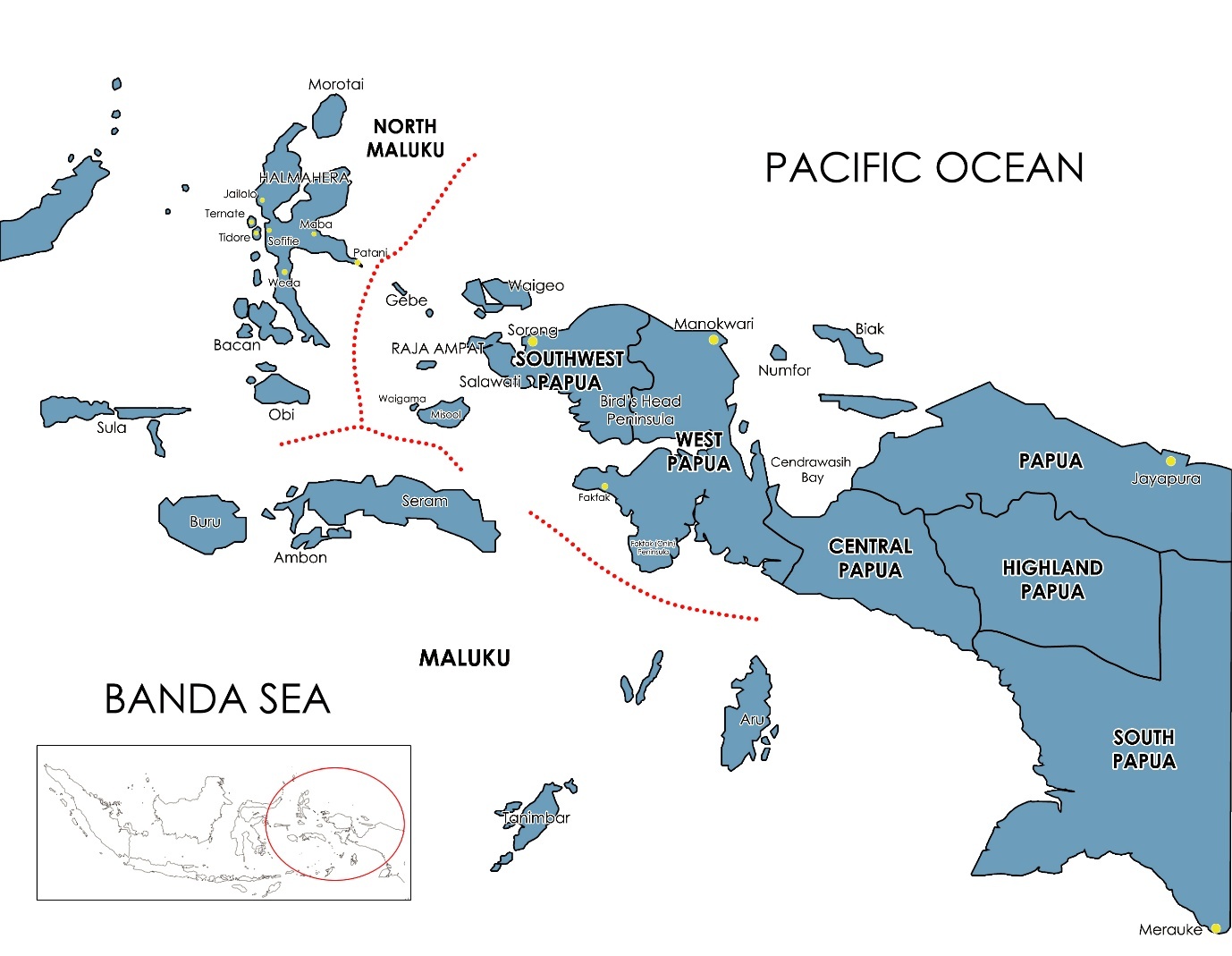
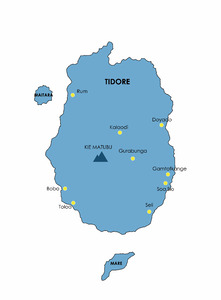
This article examines the recent debate surrounding the ethnic origins of the Bobonese, a community of mixed Melanesian descent in Tidore, North Maluku, Indonesia, and explores how their ethnic identity has been strategically mobilized by a faction of politicians, centered on the revived sultanate, to advance both regional and personal agendas. Spanning an area of 1,550 square kilometers, the island of Tidore has a population of 114,480 (BPS 2021). Despite its status as an economically marginalized frontier, the Tidore Sultanate (1450–1967), alongside its neighbor the Ternate Sultanate, once thrived on international trade in exotic spices like cloves and nutmeg, establishing itself as a pivotal political, economic, and mythical center of the Maluku world (Andaya 1993). Tidore embraced Islam in the late fifteenth century; today, nearly all its residents are Muslims.
Kampung (village) Bobo, located on the western coast of the island, is home to a population of 1,714 individuals, all practicing Islam (BPS 2021). The majority work as fishermen or small-scale plantation growers and generally have limited education and income. In contrast to most other villagers, who are predominantly of Austronesian (or Malay) descent, the Bobonese exhibit distinct Melanesian physical features, characterized by dark skin and kinky hair. While Indonesia’s primary Melanesian population is concentrated in West Papua—denoting the western part of New Guinea in this article—a noteworthy proportion is dispersed across eastern Nusa Tenggara and the Maluku islands.[1] The Tidorese refer to Kampung Bobo as Kampung Papua due to the villagers’ distinctive physical attributes.
Over the past two decades, debate over the Bobonese’s ethnic origins has intensified. In early 2016, Sofyan Daud, a member of the local parliament, publicly asserted at a history forum that the Bobonese were descendants of Papuans who migrated centuries ago from Raja Ampat, an archipelago off the northwest tip of New Guinea’s Bird’s Head Peninsula (Sofyan Daud, personal communication, August 14, 2022). The Bobonese community leaders promptly refuted this claim, asserting that their ancestry is diverse and originates from various parts of Indonesia, but not from West Papua. A parallel dispute arose when the Tidore Tourism Office (Dinas Pariwisata Tidore Kepulauan) released a video titled “Sejarah Kesultanan Tidore” (History of the Tidore Sultanate), which briefly claimed that the Bobonese were brought from Papua by the Tidore Sultanate centuries ago.[2] The promotion of this Papuan origin narrative appears to have been strategically driven by the nominal sultan, Husain Sjah (in office since 2014), the city government, and a faction of secular politicians, who recognized its potential advantages for the city.
The Bobonese community strongly refuted this narrative, rejecting the claims regarding their alleged Papuan ancestry. In response, they took to the streets and staged demonstrations a few years earlier, expressing their discontent with this interpretation of their ancestry (Usman Konong, interview, August 9, 2022). On October 26, 2020, the Bobonese community leaders extended an invitation to Sultan Husain, urging him to scrutinize the historical evidence supporting their Papuan origins.[3] They also protested a claim made by a city government official to Sri Mulyani, the then Minister of Finance, during her visit to Tidore in March 2018, which stated that the Bobonese had originated from West Papua centuries ago. Sultan Husain left the village without offering a definitive statement. Following this encounter, Alfian Kene, a resident of Kampung Bobo, voiced his disappointment in the following statement (Alfian 2020):
The City Government asserts that the Bobonese are Papuans relocated by the Tidore Sultanate to the Bobo sub-district. However, this historical claim appears to be a deliberate fabrication intended for political purposes and lacks substantial evidence. Up to this point, there has been no official statement from the Tidore Sultanate addressing the request to authenticate the historical background of the Bobonese.
The political use of the Bobonese’s ethnic origins can be understood within the broader adat (customary law) revival that gained momentum during Indonesia’s reformasi period, which followed the fall of Suharto in 1998 and ushered in a new era of democratization and regional autonomy. Various adat organizations emerged as influential agencies, seeking to renegotiate the relationship between the state and their respective regions, and to assert control over contested resources and territories. Ethnic and historical identities, then, serve as rallying and legitimating ideologies for these efforts (Wee 2002; Hawkins 2010). In the case of Tidore, the symbolically restored sultan assumes a central role in these adat movements.
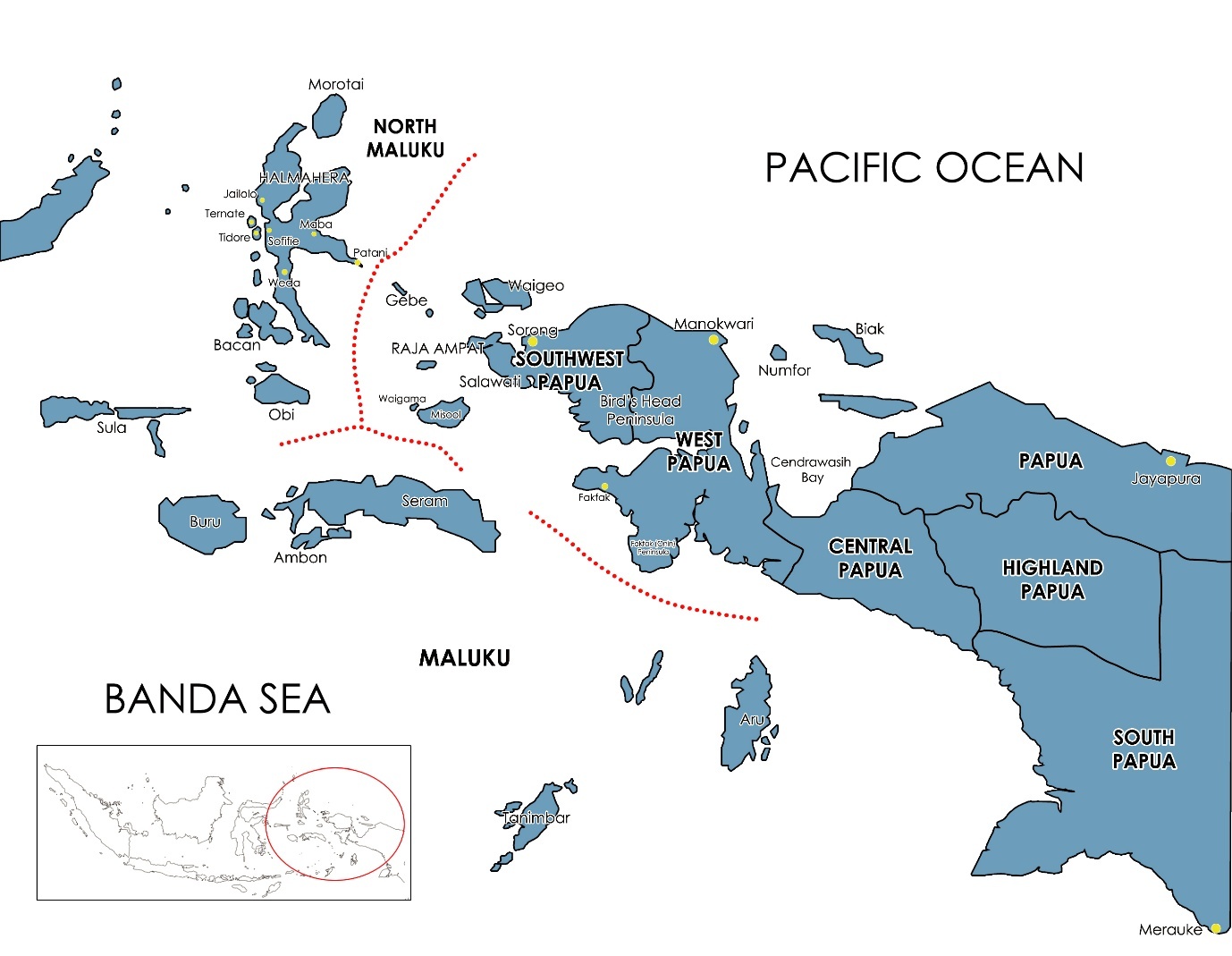
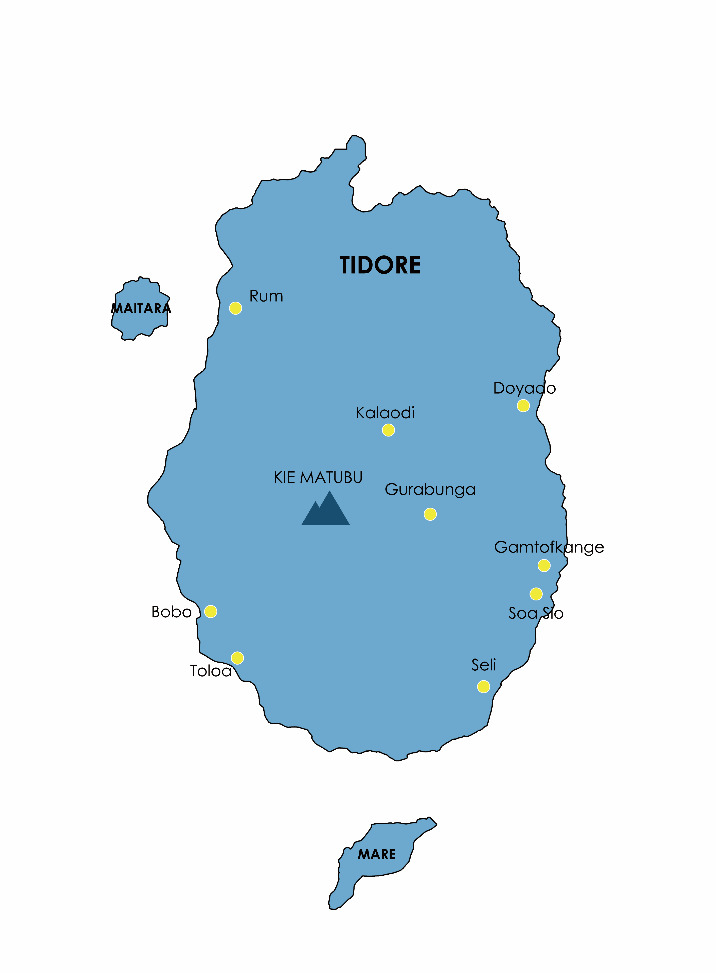
This study moves beyond the question of who claims the Bobonese identity to ask why such claims have become politically salient at this point in Tidore’s history. It argues that the recent redefinition of Tidorese identity reflects a broader revivalist attempt to reassert Tidore’s imagined authority over West Papua—a process in which Kampung Bobo serves as a symbolic focal point for reactivating this historical claim.
The Bobonese identity debate is intricately intertwined with multiple themes, including ethnicity, ethnic and racial hierarchies, and hybridity. First, this article demonstrates that many ethnic identities in Indonesia are of fluid, situational, and changeable nature, particularly in regions with high demographic mobility. Moreover, it highlights the perceived existence of ethnic hierarchies, where groups positioned on the lower tiers may seek to elevate their status by redefining their ethnic identity. Drawing on constructivist approaches to ethnicity, it will scrutinize the strategies and elements employed in the alteration or construction of ethnic identities.
Second, the discussion turns to the challenges of ethnic switching when ethnicity intersects with race. The Bobonese case shows that even for racially mixed groups, such transitions are complex. While traditional societies often facilitated relatively seamless assimilation into new ethnic identities, such transitions have become increasingly constrained in modern contexts. The analysis further considers how colonial constructs of racial hierarchy, purity, and hybridity—uncritically inherited by Indonesian society—have deepened these complications.
Third, the study examines how the intensification of identity politics during the reformasi era has driven local politicians to leverage historical memories to reinforce their ethnic identity and pursue higher positions within Indonesia’s ethnic hierarchies. In doing so, it explores the intersections—and potential tensions—among race, memory, myth, and religion within these ethno-historical constructions.
This article is organized as follows: first, it clarifies the conflicting memories of the Tidorese regarding the origins of the Bobonese and analyzes the constructivist nature of ethnicity. It then explores how colonial perceptions of racial hierarchy and purity have shaped modern Indonesian understandings of race. The following section examines the historical processes of West Papuan integration into colonial and republic states, with a focus on how colonial views on race were applied to Melanesian populations. Finally, it analyzes the socio-political objectives of Tidore politicians in promoting ethno-historical narratives and shows how the Bobonese identity debate aligns with these agendas.
Myth, Memory, and the Politics of Origin
In this section, I explore multiple mythic and mnemonic narratives concerning the origins of the Bobonese. Drawing on the divergent perspectives of interviewees, three distinct groups emerge: those of the Bobonese community leaders, local politicians, and non-Bobonese villagers residing in the vicinity of Kampung Bobo.[4] As previously noted, the Bobonese community leaders vehemently deny their Papuan origins, emphasizing instead that their ancestors hailed from diverse regions, including Halmahera, Sula, Seram, and Sulawesi. Usman Konong, the village head, acknowledged the limitations of his memory but asserted that no one in the village has Papuan origins (interview conducted on August 9, 2022, at the village head’s office in Kampung Bobo). He identified six major clans in the village: Marsaoly, Fabanyo, Goreho, Tongaru, Sula, and Kalaodi. The Goreho clan traces its roots to Tobelo, North Halmahera, while the Sula clan originated from the Sula Archipelago. The remaining clans bear names associated with major clans in Tidore. Usman disclosed that he is a sixth-generation patrilineal descendant of the Sula clan, with maternal ancestors tracing their lineage to Halmahera. According to him, the Bobonese express frustration at perceived outsiders neglecting their memories of ancestral lineage and disseminating inaccurate narratives about their alleged Papuan origins.
It is important to note that the most vocal interpretations of the Bobonese origins come from political figures rather than from the Bobonese themselves, illustrating how ethnic identity is often articulated through intermediaries of power. The interviewees from the political circle included Sultan Husain; Ishak Naser, a royal family member and local parliamentarian who holds the adat title sowohi kiye; Amin Faaroek, an adat officer bearing the title jojau; and Sofyan Daud.[5] Both Naser and Faaroek were highly respected for their extensive knowledge of local history. Collectively, these interviewees asserted that the Bobonese originated from coastal Papuan regions, though their references to specific locations varied. The sultan alluded to coastal Papuan origins without naming specific places—possibly to avoid potential backlash from the Bobonese. Faaroek speculated that most Bobonese hailed from Raja Ampat, Patani, and Biak, with some tracing their roots to more interior regions. Naser claimed that the Bobonese came from Fakfak on the Onin Peninsula, while Sofyan Daud maintained that they originated in Raja Ampat. The shared claim of the Bobonese “coastal Papuan origin” was echoed by other villagers, who remarked on their physical resemblance to coastal inhabitants of West Papua. These observations highlighted traits such as medium height, dark skin, and long kinky hair, which set them apart from interior Papuans, characterized by darker skin and shorter, kinkier hair.
According to Tidore politicians, Sultan Mansur (ca. 1475–1526) established connections with coastal Papuans and orchestrated their mass migration to Tidore in 1512. These Papuans are said to have become the ancestors of the Bobonese, although, as Sultan Husain admitted, the kedaton (royal court) lacked written evidence to substantiate this claim. The narrative involving Sultan Mansur’s engagement with coastal Papuans is embedded in the well-known myth of Gurabesi, as presented by Andaya (1993, 105):
Before the arrival of Islam, Ternate and Tidore were constantly at war with one another. The ruler of Tidore, Sultan Mansur, thus summoned the Sangaji Patani Sahmardan to ask him whether there was any man in his village or in neighboring areas who was brave, strong, and able to assist him against the Ternatens . . . At a place called Kabu [of Waigeu], he [Sahmardan] met the Kapita Waigeu named Gurabesi. . . . Gurabesi then summoned his men and travelled to the Tidore court, where they were greeted by the ruler and hosted to as feast in their honor. . . . In battle, Gurabesi distinguished himself and was given the ruler’s daughter, Boki Taebah, for his wife. They later returned to Waigeu to live.
A local legend recounts that Gurabesi adopted four boys hatched from eggs found on a beach. As they grew, Sultan Mansur anointed them as kings of the four kingdoms of Raja Ampat (Andaya 1993, 105; Knaap 2010, 157). According to Faaroek, the Tidore capital at that time was in Toloa, approximately two kilometers inland from the present-day Kampung Bobo. Sultan Mansur granted a portion of this land to the Papuan migrants, an act later remembered in local narratives as a gesture of generosity. Despite subsequent capital shifts to Rum and then Soa-Sio, the Bobonese remained in Toloa until their eventual relocation to the current coastal area in 1967. This myth, which links the Tidore kedaton to the kings of Raja Ampat, holds a significant place in kedaton history. It is often recounted during royal ceremonies, where invitations are extended to the Umlati clan of Raja Ampat, believed to be descendants of Gurabesi and Taebah. The members of this clan were also invited to Sultan Husain’s enthronement ceremony in 2014.
The third group consists of several villagers from Kampung Tongaru and Kampung Seli. Tongaru, a part of Toloa, is home to residents with extensive knowledge of the Bobonese. Unlike the narratives presented by the politicians, these villagers have no recollection of a mass Papuan migration orchestrated by the kedaton. Instead, their memories recount small-scale individual migrations. Ismail Abita, a former village head of Seli, recounted the arrival of two Papuans, Banya and Hasan bin Raba, in the village during the 1930s. Both were already Muslims upon their arrival in Tidore. Ismail was uncertain about their exact place of origin in West Papua but explained that Tidorese often traveled to West Papua, returning with small numbers of Papuans as adoptees or workers. These Papuans held freeman status. Banya was allocated barren land suitable only for growing bananas and gourds, while Hasan rented a portion of the mosque’s land without gaining ownership. Banya remained unmarried until his death; however, Hasan married a Tidore woman, and their descendants still reside in the village. Ngofa Seli (pseudonym), an elder in Seli Village, recalled that Kapita (army leader) Koroti brought two Papuans—a man named Sadalei and a woman named Sadaliti—to work on sugarcane plantations and fetch water from distant wells. Similarly, Muhammad Wanboko, the current village head of Seli, recounted the arrival of two Papuans: a man named Seta and his younger sister, Benya. They, too, were Muslims upon their arrival. Neither married, and their Islamic tombs remain preserved in the village. The consistent accounts of these Papuans arriving as Muslims suggest the possibility that they originated from coastal West Papua, influenced by their interactions with the outside world.
These interviewees claim that, until recently, the Bobonese openly acknowledged their Papuan origins. However, opinions differ on the reasons behind the Bobonese’s current reluctance to identify as Papuan. Faaroek and some villagers from Tongaru suggested that the Papuans had been brought to Tidore as slaves. Although they were treated like family members and allowed to marry local women, they still faced discrimination. Faaroek recounted a historical instance involving a royal family member named Dano Said. Despite being known for his intelligence and character, Dano was not elected sultan because his mother was of Papuan descent. Faaroek speculated that the lingering stigma associated with their ancestral ties to slavery may contribute to the Bobonese’s rejection of their Papuan identity today.
However, Naser and Sofyan contested Faaroek’s explanation, arguing that slavery did not exist in Islamic society and that the Papuan migrants were considered freemen.[6] According to them, the people of Raja Ampat were renowned as skilled rowers of the kora-kora, the traditional sailboat of Maluku, and played significant roles in the sultan’s navy forces. Naser further explained that the term “Bobo” referred to nipa walls, symbolizing the Bobonese as protectors of the sultans.[7] Ngofa Seli shared an example of a Papuan freeman who earned respect and was promoted to the position of village headperson due to his abilities, even though this position was not formally authorized by the sultan due to racial differences. This perspective challenges the notion that Papuan migrants were treated as slaves, instead emphasizing their valued contributions and respected roles within Tidore society, even though their socio-political status was somewhat diminished by being identified as Papuans.
Dismissing speculation by outsiders regarding Papuan origin, Usman Konong clarified a crucial aspect of the origin controversy. According to him, the Bobonese have lived in Tidore for centuries, undergone racial mixing, and fully embraced local adat and Islam. Therefore, they should be regarded as orang asli (indigenous people), not pendatang (migrants). Usman highlighted that other migrant communities are considered orang asli without reference to their origins, whereas the physical differences of the Bobonese make them appear as “outsiders,” causing an identity crisis. His assertion that adherence to local adat and Islam qualifies one as orang asli reflects a constructivist view of ethnicity. His statement sheds light on the local tradition of integrating heterogeneous migrants, who arrived in Tidore seeking economic opportunities in the spice trade and assimilated into the Tidorese ethnic identity. Local inhabitants emphasize that Tidore has no orang asli and that all residents are considered pendatang. However, these migrants have collectively constructed a strong ethnic identity as Tidorese. As Baker (1988, 59–70) notes, in the past, migrants who met specific criteria—such as obtaining the sultans’ sanction for residence and adhering to local adat and Islam—were recognized as Tidorese.
In regions characterized by high mobility, a distinct tradition appears to have emerged during the assimilation process. In her study of the Langkawi tradition in Malaysia, Carsten (1995) observed that diverse migrant groups often developed a tradition of intentional forgetting of ancestral identities. This practice served to shed former identities and embrace new ones within Langkawi, thus fostering a distinct, place-based identity. Similarly, Geertz and Geertz (1964, 100–101) described the Balinese as possessing limited knowledge of their collateral kinship ties. Drawing on the Geertzs’ analysis, Carsten describes this phenomenon as “structural/genealogical amnesia” (Carsten 1995, 317–18; Geertz and Geertz 1964, 101, 106). According to Carsten, the Langkawi people sought to establish broad (horizontal) kinship networks by fostering relationships between second or third cousins and, thereby, “turning distant and vague relatives into potential affines” to create a kinship out of new ties (Carsten 1995, 319, 325). This intentional ignorance of their origins can be interpreted as a pragmatic and empowering strategy for migrants, facilitating their assimilation into newly imagined ethnic communities and supporting rapid population growth. In such societies, inquiries about origins or ancestry were often met with nervous denials or claims of ignorance.
Similarly, in Tidore, the practice of “forgetting origins” has been instrumental in integrating diverse migrants into the local identity. Baker (1988, 60) observed that in Tidore, “everyone considers himself to be Tidorese, and to be reminded of difference is discomforting at the least and more often considered insulting.” Consequently, ancestry and migration histories have not been adequately passed down to descendants, leading to the near-complete loss of this information. It is, therefore, not surprising that the Bobonese do not recall their exact origins. Then, the fact that the Bobonese—who have already adopted Tidore adat, embraced Islam, and undergone intermarriage—are still not fully recognized as part of the Tidorese and are instead classified as “the others” represents a notable exception to the traditional process of ethnic assimilation.
My interviewees unanimously agreed that racism is the primary reason for the Bobonese rejecting their Papuan identity. Despite cultural and racial assimilation, their phenotypical traits serve as powerful identifiers, subjecting them to the negative connotations associated with Papuans. Racial discrimination was explicitly addressed in an interview with Alfian Kene, who described a “collective anxiety” stemming from racist acts against the Bobonese (“Terima Kunjungan Jou Sultan Tidore, Warga Bobo Minta Meluruskan Sejarah ‘Kampung Bobo.’” 2020). Instances of small-scale racist actions have been observed. For instance, a few Tidore students recently used the derogatory term puha, a slur referring to Papuans, to address a group of Bobo students, leading to physical retaliation by the latter. Further interviews revealed deeply ingrained discriminatory attitudes. One villager attributed the Bobonese’s poverty to their persistence in outdated economic practices and alleged laziness, traits they claimed were inherited from their “old land,” West Papua. The ongoing debate surrounding the Bobonese identity demonstrates the process of “ethnic switching” appears to vary significantly depending on one’s racial background, even for people of mixed race—a dynamic that will be explored further in the next sections.
Ethnic Construction and Perceptions on Race
The debate surrounding Bobonese identity reflects two prominent theoretical approaches to the nature of ethnicity: primordialism and constructivism. Primordialism posits that each ethnic group possesses an immutable and distinct identity rooted in shared beliefs about common ancestry, biological origins, history, culture, and territorial ties, even when the specific details of these elements remain ambiguous. However, as exemplified in the Tidore ethnicity, numerous ethnic identities in Indonesia are not primordial or ascribed but are instead constructed by manipulating the symbols of ethnicity (Anderson 1991; Klinken 2003, 72–73; Li 2000). Consequently, ethnic identities often exhibit “shifting,” “situational,” “fluid,” or “imagined” characteristics (Hawkins 2010; Sillander and Alexander 2016, 95–96; Tanasaldy 2012, 29–30). Yet the shifting nature of ethnic identities appears to manifest differently across racial groups in present-day Indonesia, with even racially mixed groups encountering challenges in altering their ethnic affiliations. Notable cases involving the Dayaks and Chinese Indonesians in the context of interethnic dynamics provide a framework for analyzing the Melanesian case, which will be explored in the later sections.
The Dayaks are the natives in Kalimantan, belonging to the Austronesian racial group. The term “Dayak” is an external construct imagined by “outsiders” such as colonial and republic governments. It primarily encompasses non-Muslim communities—adherents of Christianity or indigenous religions—and shifting-cultivating tribes residing in the interior. These communities are further categorized into multiple sub-groups including Iban, Kenayant, Punan, Ngaju, and others (Schiller 2007, 73; Tanasaldy 2012, 51–56). It has been reported that some Dayaks have undergone transition to Malay ethnicity by converting to Islam—the religion of the Malays—and adopting Malay adat. Here, the term “Malay” refers to an ethnic group traditionally residing in the Malay Peninsula and the coastal areas of Sumatra and Kalimantan (König 2016, 123–26; Prasojo 2011). However, as will be discussed later, during the colonial era, this ethnic term evolved into a broad racial label used to represent the Austronesian population in Indonesia, distinguishing them from “outsiders” like European, Chinese, Arabic, and Indian migrants.
Many scholars have argued that feelings of inferiority and experiences of discrimination were significant factors motivating some Dayaks to undergo ethnic switching (Sillander and Alexander 2016; Tanasaldy 2012, 30–40). Unlike the Malays, who established prosperous maritime kingdoms and were incorporated into colonial modern systems, the Dayaks were often associated with negative stereotypes such as savagery, backwardness, and destitution, frequently epitomized by the outdated practice of headhunting. Adopting Malay ethnicity was perceived as a strategic move to ascend the “ethnic hierarchies” and gain access to the privileges associated with a politically influential group (Chua 2007, 272).
Unlike the case of the Dayak, ethnic transition between different racial groups appears to be more challenging. A notable example is the Chinese Indonesians. Chinese traders had been present in Indonesia for centuries, but the influx of Chinese migrants during the nineteenth century, brought by the Dutch authorities to support the colonial economy, introduced new dynamics. The earlier group, known as the peranakan Chinese, assimilated into local culture through intermarriage and cultural adaptation, while the later totok Chinese maintained a distinct identity by rejecting assimilation and intermarriage. The Dutch administration used the Chinese as middlemen, creating a racial hierarchy with Europeans at the top, Chinese in the middle, and natives at the bottom (Suryadinata 2001, 502). This imposed hierarchy sowed deep resentment among the indigenous population toward the Chinese community.
During the construction of racial hierarchies, perceptions of racial purity and hybridity were both established and perpetuated. The concept of racial purity framed races as biologically and culturally distinct entities. These perceptions were used to enforce segregation between white colonizers and colonized natives, legitimizing practices of exclusion, exploitation, and control within the colonial framework. This notion also casts hybridity in a negative light. Young (2005) highlights the ambivalent attitudes of colonial powers toward hybridity. In his analysis of the British colonial context, Young argues that while hybridity was feared as a threat to racial purity and imperial authority, it was also fetishized and exploited for economic and cultural gain. This ambivalence underscores the instability of colonial ideologies, which sought to impose rigid divisions while benefiting from the hybridity they aimed to suppress. Homi Bhabha (1994) and others critique the concept of racial purity, emphasizing its inherent flaws within the colonial context (see Brah and Coombes 2000; Gunaratnam 2014). They argue that colonial hybridity—marked by cultural interactions, exchanges, and contradictions—effectively disrupts the rigid boundaries between colonizers and the colonized. Hybridity exposes the artificial and constructed nature of such binaries, challenging the legitimacy of racial superiority claims that underpinned colonial ideologies. In this light, hybridity emerges as a potent site of resistance, unraveling the internal contradictions and power imbalances inherent in colonial systems. In such socio-political contexts, the mixed-race groups often bore negative stigmas, perceived as “rootless beings” associated with degradation, impurity, marginalization. Stoler (2000, 43) describes their perception as “stateless subversives without a patrie” whose very existence disrupted the colonial binary of racial categorization.
In the Dutch East Indies, Indo-Europeans—individuals primarily born to Malay mothers and European fathers—occupied a precarious position within the colonial hierarchy. Envisioned as a loyal intermediary class to bridge the divide between colonizers and natives, their role was fraught with tension. Neither fully accepted by the colonizers nor the colonized, they faced systemic discrimination, denial of equal rights, and marginalization within the racial hierarchy. Their tenuous status underscored the contradictions of colonial systems, which relied on rigid racial classifications yet struggled to reconcile the complexities of hybridity (Stoler 2000).
In independent Indonesia, the racial hierarchy rooted in the perception of a “pure race” became even more pronounced. While Chinese Indonesians were legally recognized as citizens, on an epistemological level, a sharp divide persisted, framing them as non-pribumi (outsiders) in contrast to the pribumi (indigenous people). They were treated like perpetual foreigners, excluded from the imagined national identity (Elson 2005; Hoon 2006, 151–52). This perception was exacerbated by the strained relationship between the two groups, driven by Chinese dominance in the national economy and Malay dominance in politics. This divide entrenched systemic inequalities, fueled discriminatory policies, and reinforced deeply ingrained societal prejudices.
As racial dynamics became entangled with economic rivalries, the historically diverse and fluid Malay and Chinese communities—each shaped by a confluence of varied origins, ethnicities, religions, and cultural influences—were increasingly recast in rigid, essentialist terms. This shift redefined these groups as two distinct and primordial entities, each with an ostensibly fixed, singular identity. Such portrayals fed exclusionary ideologies, framing interactions between the groups through an oppositional lens. Elson (2005, 159–60) notes that while the Indonesian state successfully co-opted and subordinated regional ethnic expressions under the banner of a unified Indonesia, it simultaneously fostered a new and peculiar concept of an “Indonesian [Malay] race,” defined in opposition to migrant groups. Similarly, Hoon (2006, 157–58) examines the Chinese community’s experience of “resinicization [sic],” a deliberate process of reconstructing a singular and “authentic” Chinese identity. This process erased the nuances of their diverse cultural histories, reducing their rich heritage into a monolithic identity that denied their hybridity and complexity. To address the increasingly contentious “Chinese problem (masalah Cina),” the Suharto regime implemented aggressive assimilation policies aimed at integrating the Chinese into a constructed “Malay culture.” However, these policies ultimately failed, as deep-rooted racial sensitivities and mutual distrust between the groups persisted.
The “strategic essentialization of self-representation” placed people of mixed ancestry in a dilemma regarding their identity. Like the case of Indo-Europeans in the colonial context, the Malay-Chinese mixed group was often negatively perceived as “identity-ambiguous,” unable to fully belong to either side. In her analysis of the situational nature of ethnic identities in Penang, Malaysia, Nagata (1974, 345–46) highlighted the challenges faced by those of mixed Chinese-Malay parentage. She observed that even when Chinese people embrace Islam and marry Malays, they are often still regarded as Chinese by others. Nagata emphasized that factors such as social distance and the perceived political hierarchies between Malays and Chinese play a significant role in shaping such ethnic sentiments.
However, Nagata (1974, 335) observed a different dynamic in the case of mixed Arab-Malay or Indian-Malay groups, whose identities tended to shift between the two sides depending on situational interests. Unlike the Chinese, whose economic power was perceived as a threat to the Malays, Indians and Arabs, due to their smaller numbers and weaker associations with dominant economic sectors, faced fewer barriers in transitioning to a Malay identity. This dynamic highlights how the establishment of racial boundaries serves as a strategic tool for certain groups to reinforce hierarchies and secure an advantageous position in the competition for political and economic dominance.
Following West Papua’s incorporation in Indonesia, notions of racial purity and hierarchical order began to shape the racial and ethnic dynamics surrounding Melanesians and Malays. The next section will explore the integration and how these notions have influenced the evolving relationships and tensions between these groups.
Integration of West Papua and Racial Politics
Like the Dayaks, the term “Papuan” is commonly used as an umbrella term, encompassing hundreds of ethnic and linguistic groups, each with significant differences in customs, religions, and cultures. Historically, the coastal regions of West Papua have undergone significant intermixing with Austronesians, resulting in a blending of races, languages, and customs. In the late nineteenth century, a small number of Arab and Chinese traders arrived, with the former playing a significant role in spreading Islam in some coastal regions (Slama 2015, 250–54). However, for most Indonesians, the image of Papuans is predominantly shaped by the tribes residing in inland regions, who are predominantly Christian or adherents of indigenous animistic religions. Furthermore, individuals with Melanesian physical features are often indiscriminately labeled as Papuans without careful consideration of their specific living spaces or distinct ethnic identities. This generalization has caused dissatisfaction among people from other regions, such as Nusa Tenggara, who emphasize their specific regional identity and reject the Papuan label.
The concept of race emerged as part of the Dutch strategy to incorporate West Papua into their colonial territory. This incorporation can be traced back to the seventeenth century when the VOC (Vereenigde Oostindische Compagnie; Dutch East India Company) sought to extend its influence to West Papua after securing strategic locations across the archipelago. In the premodern era, Tidore wielded significant authority as a symbolic center and overlord of vast regions in Halmahera and coastal regions of West Papua, encompassing Gamrange, Raja Ampat, Cenderawasih Bay, Onin, and Biak Islands (Warnk 2010, 111–12). From the fifteenth or early sixteenth century onward, Raja Ampat chiefs had tributary relations with Tidore, perceiving it as a source of power and wealth (Andaya 1993, 99–110; Kamma 1982, 61, 80). Coastal Papuans under the Tidore Sultanate’s authority engaged in piracy in neighboring regions and delivered regular tributes to the sultans. They adopted Tidore adat and embraced Islam, although their Islamic practices were often superficial (Warnk 2010, 120). The close association between Tidore and coastal Papua became particularly evident during Nuku’s rebellion (ca. 1725–1805) against Dutch encroachment, when Raja Ampat provided crucial support (Andaya 1993, 221; Widjojo 2009). Recognizing Tidore’s influence over coastal West Papua as a means to reach the interior and curb European rivals in the spice trade, the VOC sought to exploit this alliance to its advantage (Viartasiwi 2013, 864).
Many scholars have challenged Dutch claims that Tidore held sway over all Papuan territories, including interior tribes. Rutherford (2018, 10) noted that the Tidore sultan “ostensibly ruled New Guinea on behalf of the Dutch,” yet many Papuans encountered during Dutch expeditions with Tidore fleets had never heard of Tidore. Similarly, VOC official Johannes Keyts, during his visit to Onin in 1678, found no direct influence from Tidore, despite the area being nominally part of Tidore’s suzerainty. Bone (1958, 21) argued that while Dutch officers upheld the façade of Tidore’s sovereignty, they privately acknowledged its limited reach, a sentiment also reflected in a personal interview with Sultan Husain Sjah.
Dutch colonial rule was briefly interrupted by Japan’s invasion in 1942, which ended in 1945. After reclaiming their colony, the Dutch faced a revolutionary war against Sukarno’s Republic forces. During this period, a series of conferences were convened to address territorial disputes, at which the Dutch advanced a plan to restructure Indonesia into multiple states within a federal framework. This arrangement included the Republic, comprising Java and Sumatra, as well as the Dutch-controlled federal state of NIT (Negara Indonesia Timur; East Indonesian Nations), which encompassed Sulawesi, Maluku, Bali, and Nusa Tenggara, while excluding West Papua. Some scholars argue that the Dutch excluded West Papua from the NIT with the underlying intention of establishing it as a Eurasian homeland, anticipating the eventual loss of Indonesia as a colonial territory (Viartasiwi 2018, 144; Fatgehipon and Utomo 2020, 55).
To justify their efforts to establish West Papua as a separate nation, the Dutch emphasized the distinct physical traits of Papuans—such as their black skin and kinky hair—contrasting them with the brown-skinned and lanky-haired Malays (Viartasiwi 2018, 144; Klinken 2003, 67). They also emphasized the animist origins of Papuan societies, later transformed through Christian missionary activity, to further distinguish them from the predominantly Muslim Malays. Moreover, the Dutch portrayed West Papuans as “Stone Age survivors” living a hunting-and-gathering lifestyle—a narrative that rationalized colonial domination and reinforced their supposed isolation from the Malay world. This constructed discourse legitimized systematic racial discrimination against Papuans (Rutherford 2018; Slama and Munro 2015).
In response to the discourse on racial disparity, Sukarno invoked the historical relationship between Tidore and West Papua, claiming Tidore’s suzerainty over West Papua to justify its inclusion in Indonesia. This strategy mirrored the VOC’s earlier approach of interpreting Tidore’s influence over coastal areas as extending to the interior regions, thereby legitimizing its claim over entire West Papua.
The Malino Conference, held in southern Sulawesi from July 16 to 24, 1946, addressed territorial issues. Prior to the conference, the Dutch took the unilateral step of separating West Papua from Maluku’s authority, designating it as an autonomous region. During the conference, Frans Kaisiepo, a Papuan representative from Biak, advocated for the integration of West Papua into the NIT during the conference. At the subsequent Denpasar Conference on November 15, 1946, Sultan Zainal Abidin (r. 1947–1967) of Tidore and Sultan Djabir Sjah of Ternate represented North Maluku, while delegates from West Papua were excluded from participation (Viartasiwi 2018, 144–45). Sultan Zainal Abidin voiced opposition to the idea of separating West Papua from the NIT, asserting that it was an inseparable part of Tidore and that the sultanate had “full authority” over the region. However, his objections were disregarded by the Dutch (Hasim and Faroek 2021, 4).
After years of wrangling, the Dutch ultimately granted full independence to Indonesia at the 1949 Round Table Conference but retained control of West Papua. On December 19, 1961, Sukarno launched military operations to annex the region, leading to the 1963 New York Agreement and United Nations–supervised plebiscite known as the Act of Free Choice, held in 1969. Initially, the United Nations proposed a direct vote by West Papuans; however, the Suharto government advocated for an indirect vote by 1,025 regional representatives, primarily clan leaders, citing security concerns and the lack of education among the general population. The selected participants unanimously voted for integration into Indonesia. Since then, West Papuan activists have accused the Indonesian government of coercing representatives, calling the plebiscite the “Act of No Choice.” These allegations have fueled decades of separatist guerrilla warfare, which was harshly suppressed by Suharto’s military. Following Suharto’s ousting in 1998, calls for self-determination intensified, leading the government to grant West Papua special autonomy in 2001. Despite these measures, separatist forces continue to operate within the region’s dense jungles.
Following West Papua’s forced incorporation into Indonesia, colonial stereotypes of Papuans as primitive not only persisted but intensified. Harsher labels, such as “sexually promiscuous Stone Age people,” began to shape governance policies and practices (Slama and Munro 2015; Chao 2021, 278). The colonial “white versus black” framework, once used to contrast Europeans and Malays, shifted to contrast Malays with Papuans, elevating the former to a superior position. These negative portrayals continue to serve as tools for rationalizing the denial of fundamental rights to Papuans and remain deeply embedded in Indonesian media. They dominate public discourse, reinforce negative stereotypes, and justify systematic marginalization (Chao 2021; Munro 2018). As separatist movements gained momentum, West Papuans were further stigmatized as threats to national unity, exacerbating their marginalization and intensifying public hostility toward their struggle for self-determination.
The depiction of Papuans as “Stone Agers” denies their place in the modern world, disregarding their status as contemporaries in an increasingly interconnected global context (Slama and Munro 2015, 3–10). This narrative fails to acknowledge the dynamic transformations within Papuan societies, driven by education and growing interaction with the outside world. Furthermore, the rigid racial categorization imposed by colonial and republican governments homogenized all West Papuans, often reducing them to stereotypes of highland tribes. This narrow portrayal marginalizes the diversity of Papuan societies, which have undergone significant racial and cultural blending with the Austronesians, as well as to a limited degree with Arabs and Chinese, while actively participating in trade with external groups. Such diversity is largely omitted from national narratives on West Papua, perpetuating a narrow and reductive understanding of the region and its people.
A recent and intriguing trend shows that, much like the colonial and republican governments leveraged racial differences and distinguished culture to assert control over West Papua, contemporary Papuans have begun using racial distinctions as a political tool to assert their rights over land and resources, demand political recognition, and unite in the pursuit of independent statehood (Bertrand 2004; Gietzelt 1989, 201; Kusumaryati 2019). Previously lacking a strong sense of collective belonging, they have started constructing a more homogeneous racial identity by articulating their distinct racial markers such as black skin and kinky hair, thereby creating the stereotype of “authentic Papuans.” This strategy mirrors the tendency of Malays and Indonesian Chinese to reinforce distinct racial categories, imagining each group as “pure” and homogenous in their racial identity.
Within the national discourse that collectively portrays Papuans as an inferior and subversive racial group, they have endured systemic racism (Munro 2018). In this context, the Tidorese exhibit a tendency to “otherize” Papuans while asserting their own distinct identity. This process of otherization serves as an effort to distance themselves from the stigmatized image of Papuans—often framed in negative terms—and to construct a sense of ethnic superiority. However, this distancing is complicated by the significant racial and cultural hybridity between the Tidorese and Papuans. For example, the Tidore language is classified within the Papuan phylum, underscoring deep racial and historical interconnections that challenge the narrative of separation. While local media often highlights the hybridity between the Tidorese and Papuans, many Tidorese remain uncomfortable with being associated with Papuan origins, as evidenced by the case of the Bobonese. In discussions about their identity, the Tidorese tend to emphasize their ethnic distinctiveness over connections, likely as a strategy to distance themselves from Papuans. By downplaying their racial ties and prioritizing their distinct ethnic identity, the Tidorese navigate a complex socio-political landscape—acknowledging their shared history with Papuans while simultaneously obscuring it.
The essentialist perspective on race and the systematic discrimination against Papuans have inherently excluded mixed-race Melanesians from being fully recognized as belonging to either Papuan or Malay racial categories. The case of the Bobonese illustrates how such groups living outside Papua often attempt to overcome racial prejudice by assimilating into the identities of local communities to which they have migrated. This strategy parallels the experience of the Dayaks, who regarded ethnic switching as a means of overcoming discrimination. However, mixed Papuans often experience profound identity confusion during this process, encountering barriers rooted in constructed racial hierarchy and the stigma associated with Papuan identity (Surya 2016, 103). Labeling the Bobonese as “Papuans living in Tidore” perpetuates a sense of exclusion and foreignness within the community. The Bobonese’s rejection of their Papuan identity highlights how mixed Melanesians living outside Papua navigate their ethnic identities amidst the broader identity crisis faced by Papuans in Indonesia.
Regional Politics and Tidore-Papua Relations
This section analyzes how Tidore politicians have strategically employed narratives about Bobonese ethnicity to advance their political agenda. Following the collapse of Suharto’s state-hegemonic regime, Indonesia transitioned toward a more democratic and decentralized system. The implementation of regional autonomy provided marginalized regions with an opportunity to voice their concerns regarding land and resource rights, greater autonomy, and even outright independence. Amid this transition, identity politics surged, with ethnic solidarity and the energetic re-articulation of ethnicity serving as potent tools for negotiating regional interests. In many regions, including Tidore, revived feudal elites assumed leading roles in this process (Bräuchler 2011).
Following the state’s anti-feudal directives after independence, the Tidore kedaton remained vacant after Sultan Zainal Abidin’s death in 1967. However, Djafar Sjah was reinstated as a nominal sultan in 1999, followed by Husain Sjah in 2012. As with other regions where feudal elites leveraged their authority to gain administrative power—such as the sultan of Yogyakarta, who automatically assumed the governorship without election under the special autonomy status granted in 2012—Husain Sjah also entered politics. In 2019, he was elected to the House of Regional Representatives (Dewan Perwakilan Daerah) and ran for North Maluku governor in the November 2024 election, though he was ultimately unsuccessful.
Tidore politicians, through media and public statements, have actively sought to reconstruct ethno-historical identities by highlighting historical ties between Tidore and West Papua. They have articulated several claims and demands against the state, including: (1) West Papua was historically under Tidore’s jurisdiction; (2) Sultan Zainal Abidin relinquished control of West Papua to Indonesia with the support of Tidore villagers; (3) These contributions remain unrecognized by Indonesians and excluded from national history, leaving the island marginalized with no historical or economic significance; (4) The Indonesian governments should acknowledge these contributions and provide reparations or compensation.
Tidore politicians emphasize three key contributions in their narrative. First, during the revolutionary period, Sultan Zainal Abidin faced a pivotal decision when the Dutch offered three options (Tiga Opsi): Tidore and Papua could join the Dutch kingdom; become an independent state; or join Indonesia. He opted for the third, ultimately bringing both Maluku and West Papua into Indonesia (Hasim and Faroek 2021, 7–8).
Second, Sultan Zainal Abidin supported Sukarno’s establishment of the West Irian Province of Struggle (Provinsi Perjuangan Irian Barat) in 1956 to assert Indonesia’s claims during territorial disputes. Recognizing that annexing West Papua would require more than diplomatic negotiations, Sukarno adopted a more assertive approach. By asserting that West Papua fell under Tidore (and, by extension, Indonesian) jurisdiction, Sukarno sought to strengthen his bargaining position in discussions with the United Nations. To this end, Sukarno appointed Sultan Zainal as the province’s first governor (1956–1961) and designated Soa-Sio as its capital. Both the gubernatorial office and the State Police Office were established in Soa-Sio. However, since this occurred before West Papua’s formal recognition as Indonesian territory, the governorship was largely symbolic. Sultan Zainal’s tenure was brief, and Soa-Sio soon lost its status as the provincial capital. Tidorese contend that the sultan’s role was purposefully overlooked by Sukarno, who attributed the success of West Papuan integration solely to his own efforts.
Third, as highlighted by Ishak Naser, hundreds of Tidore civilians participated in the 1969 referendum. While most participants have since passed away, making direct interviews impossible, some names remain prominent in collective memory. Among them is Achmad Kaya, who notably served as the chairperson of the local parliament in the Central Halmahera District.
The Bobonese were reportedly involved in a political campaign during Sukarno’s visit to North Maluku on July 18, 1954, aimed at garnering local elite support for West Papua’s integration. In preparation for the presidential visit, Sultan Zainal instructed residents to identify Tidore-born girls who bore physical resemblances to “authentic Papuans.” Three girls from Tongaru (former seat of Bobo) were shortlisted, but only Halima Jauhar was selected. Two other girls, nicknamed Nene Bo and Nene Iya, were ultimately excluded because their physical features did not fully align with typical Papuan traits. Despite Nene Bo having dark skin, her hair lacked the curliness, while Nene Iya possessed frizzy hair but a lighter skin tone. Along with another girl named Fabanyo from a different village, Halima greeted Sukarno by adorning him with a floral garland during the ceremony held at the Ahmad Yani Port in Ternate. Sukarno affectionately nicknamed Halima Biji Negara, or “the seed of the nation,” as a gesture of appreciation. Usman Konong asserted that this event sparked prolonged debates regarding Bobo’s origins. He argued that Halima was not originally from Papua, although he did not specify the ancestry of her family. According to him, both Zainal Abidin and Sukarno manipulated Halima’s background to symbolically link Papua to Tidore’s historical legacy. Decades later, during Sultan Husain’s enthronement ceremony, Halima and Fabanyo were invited as honored guests, symbolizing their historical significance.
Tidore politicians have put forward two key demands to the central government. First, they advocate for Sultan Zainal Abidin to be recognized as a national hero (pahlawan nasional), arguing that it is unjust for his significant contributions to the nation to remain unacknowledged. They draw comparisons to Frans Kaisiepo, who was declared a national hero in 1993, despite his role being perceived as less significant (Fatah 2019). In 2021, the Research and Study Team for Regional Titles (Tim Pengkaji dan Peneliti Gelar Daerah), established to assess candidates for national hero status, proposed Zainal Abidin for the honor to the Ministry of Social Affairs. The team included prominent Tidore politicians such as Amin Faaroek, Ishak Naser, and Sofyan Daud. However, their efforts were unsuccessful. Bakri Dano, a chief adat officer of kedaton, expressed regret over this outcome in a local media interview:
We cannot dismiss our doubts when scrutinizing the biographies of individuals chosen by the central government as national heroes, as their actions may not have necessarily been in defence of the people and the nation . . . The government should acknowledge the late Zainal Abidin, whose [historical significance] is evident even without an in-depth investigation, given that one third of Indonesian territory was once part of the Tidore Sultanate . . . While Frans Kaisiepo has already been given the title of national hero . . . it is important to note that at that time, he was just an activist, and the strategic decision rested in hands of Sultan Zainal Abidin Sjah (Konoras 2021).[8]
The second demand of the Tidore politicians is for the region to be granted special autonomous status. Initially focused on the city of Tidore in 2011, the demand later expanded to propose North Maluku as a special autonomous province, garnering strong support, particularly from aristocratic elites. This demand partly arose in response to the special autonomy granted to West Papua and Aceh, which was designed to quell separatist movements following East Timor’s independence in 2001. Many Indonesians perceived this treatment as unfair, feeling that regions loyal to the country were being overlooked while separatist regions received preferential treatment. This sentiment was particularly pronounced in Tidore, where locals witnessed West Papua—regarded as their former “child”—being granted special status, while Tidore itself remained marginalized. The demand for special autonomy included calls for sultans to play a more active role in local administration, akin to the model in Yogyakarta. However, the Tidore politicians clarified that they were not seeking automatic governorship, as is the case in Yogyakarta. Instead, they advocated for a special budget allocation like those provided to Aceh and West Papuan provinces.
Another factor fueling the demand for special autonomy was the controversial debate over the designation of Sofifi as the provincial capital. Despite the historical prominence of Ternate and Tidore, Sofifi—a politically and economically marginalized area on the western coast of Halmahera under the jurisdiction of the Tidore City Government—was selected. This made Sofifi the only provincial capital in Indonesia that falls under the authority of a city government. Former North Maluku governors Thaib Armaiyn (2002–2013) and Abdul Gani (2014–2023) proposed granting Sofifi autonomous city status to promote balanced development within the province (Aziz and Cahyono 2020, 115). However, the proposal faced strong opposition from Tidore politicians (Rasyid and Purwaningsih 2021, 204). This controversy further motivated them to advocate for a more prominent status within the province by pushing for special autonomy.
To advocate for their demands, Tidore politicians ground their discourse in historical claims. In October 2019, the Committee for Special Autonomy of North Maluku (Dewan Otonomi Khusus Provinsi Maluku Utara) was established, comprising local parliamentary members, including Sofyan Daud, intellectuals like Muhamad Asghar Saleh, and city government officers (Rasyid and Purwaningsih 2021, 198–99). Hasby Yusuf, the founder of the committee, emphasized in a newspaper interview the significant role played by the Tidore Sultanate in West Papua’s integration into Indonesia. He lamented that this contribution remained unrecognized by the state, leading to the region’s marginalization. Yusuf juxtaposed this with the granting of autonomous status to the Yogyakarta Sultanate in 1950 as a reward for its support for Sukarno’s revolution. In an interview with a local media outlet, he stated (Fadli 2019):
The local bureaucrats in North Maluku should no longer act like cowards and allow the region to be exploited by the capitalist bureaucrats . . . We demand an immediate end to all this cowardice and call for the courage to demand what is honorable . . . Special autonomy or a referendum! . . . We played a significant role in the integration of Papua (West Irian) into the Republic of Indonesia. Soa-Siu[o] Tidore was the capital of Papua Province, and the Sultan of Tidore Zainal Abidin Sjah was its first governor. It is a shame that our history and significant contributions have not been leveraged as “political power” in negotiations with the national government. This historical awareness is the starting point for our declaration of the establishment of the North Maluku Special Autonomy Region.
At a court ceremony on April 12, 2021, Sultan Husain Sjah officially declared the necessity for special autonomy and underscored its basis in historical legitimacy, particularly highlighting the significant contributions of Sultan Zainal Abidin (Rasyid and Purwaningsih 2021, 196). However, the request for special autonomy faces several obstacles. First, it lacks unanimous approval from relevant regions, and concrete action plans have yet to be developed. Moreover, non-aristocratic elites opposed this idea, fearing it could enable the sultan to assume the governorship, consolidating power among feudal elites (Arsad 2018, 120–21). Additionally, central government approval might trigger similar demands from other provinces (Aziz and Cahyono 2020, 110). Critics have also speculated that the proposal was less a viable political agenda and more a populist campaign by Sultan Husain Sjah ahead of the governor election.
In summary, the Tidore politicians strive to foster a sense of solidarity and pride by revisiting a selective historical period. Their objective is to reimagine Tidore ethnicity as the former “master” of West Papua, using this narrative to highlight Tidore’s historical significance. By re-examining and idealizing the positive aspects of their past, they seek to assert the prominence of the Tidorese within Indonesia’s ethnic hierarchies. Central to their narrative is the emphasis on the pivotal role of the sultans, seemingly aimed at enhancing their political influence in the region.
Concluding Remarks
This article offers insights into the evolving dynamics of identity, memory, and regional politics in decentralized Indonesia. It highlights a notable transformation in the perception of ancestry and origins—once considered sacred and taboo subjects—now leveraged as powerful tools for shaping regional agendas and negotiations. The discourse surrounding the purported Papuan ancestry of the Bobonese serves to bolster historical narratives highlighting the pivotal roles played by the Tidore Sultanate in cultivating relationships with West Papua. These historical ties have become not only a source of pride but also a foundation for local demands for recognition and compensation from the state, as well as for bolstering the status of aristocratic elites. Kampung Bobo functions as a “site of memory,” as conceptualized by Pierre Nora (1989, 7), where memory crystallizes and preserves itself.
This analysis shows how colonial racial hierarchies perpetuate identity ambiguity and exclusion for mixed-race Papuans in Indonesia. The lingering colonial legacy not only reinforces social marginalization but also complicates the Bobonese’s efforts to redefine their identity within the Tidorese community. The findings of this study highlight that ethnicity and identity are not static or immutable but are continuously reconstructed and reinterpreted in response to socio-political needs. The Bobonese’s rejection of their Papuan identity reflects not only a desire to distance themselves from the social stigma associated with being labeled as Papuan but also an effort to elevate their social standing within the Tidorese ethnic framework. This rejection demonstrates their determination to establish a distinct ethnic identity separate from West Papuans, with the goal of achieving full assimilation into the Tidorese community. This case sheds light on the challenges faced by mixed Melanesians living outside Papua as they navigate the intricate process of selecting and reconciling their ethnicity with their lived experiences.
Acknowledgments
This research was supported by a 2025 Hankuk University of Foreign Studies Research Grant. The author thanks two anonymous reviewers, as well as Muhammad Sabri, Nadia Sabri, Syahruddin, and Rizal M. Zainal for their generous and sustained assistance during field research. Any remaining shortcomings are the author’s own.
Formerly known as the Province of Irian Jaya, the territory of West Papua is now carved up into six provinces: Papua, West Papua, South Papua, Central Papua, Highland Papua, and South-West Papua.
“Sejarah Kesultanan Tidore,” Tidore Tourism Office video posted by Muhammad Basir, April 26, 2013. https://www.youtube.com/watch?v=eGkmegGsoV8.
“Terima Kunjungan Jou Sultan Tidore, Warga Bobo Minta Meluruskan Sejarah ‘Kampung Bobo,’” Report Malut, October 27, 2020, accessed June 1, 2023, https://www.reportmalut.com/2020/10/terima-kunjungan-jou-sultan-tidore.html.
The interviews were conducted in Tidore, Ternate, and Jakarta from August 3–26, 2022, and from July 14–17, 2023.
Sowohi kiye entails guarding sacred royal heirlooms and overseeing royal rituals. The jojau holds a role equivalent to that of a prime minister.
While Islam theoretically rejects the concept of slavery, Islamic kingdoms in Indonesia practiced and sustained it until the late nineteenth century, with Papuan slaves being widely traded and exported to various parts of the archipelago.
The woven leaves of nipa palms were commonly used to construct the walls of houses.
As this paper was nearing publication, a long-standing aspiration among the Tidore people was realized when, on November 10, 2025, Sultan Zainal Abidin was officially designated a national hero by the Indonesian government.