Hanamatsuri is the name of a range of midwinter festivals performed in fourteen villages in Oku-Mikawa, the north-eastern corner of Japan’s Aichi Prefecture. They belong to a genre termed shimotsuki kagura, named after the eleventh month of the traditional calendar. Festivals of this kind can be found around the country, from Tohoku to Kyushu. The origins of this genre are likely to be found in Kumano and Ise, from where it was spread around the country by wandering yamabushi and pilgrimage agents (oshi, sendatsu). Shimotsuki kagura follow a shared pattern, but with many local variations (Inoue 2004). They center on a large cauldron in which water is heated. One or more canopies made from paper cuttings hang above the stage, which is surrounded with a rope with similar adornments. In the morning or afternoon of the first day, the “gods and buddhas” are invited, addressed, and presented with offerings. The festival then continues through the night with dances (with and without masks) around the cauldron. In some places there are rites of spirit possession and oracular predictions for the upcoming year. There may also be more theater-like performances, enacting tales about the gods or merely offering comical relief. On the second day, the assembled deities are sent off and the stage is dismantled.
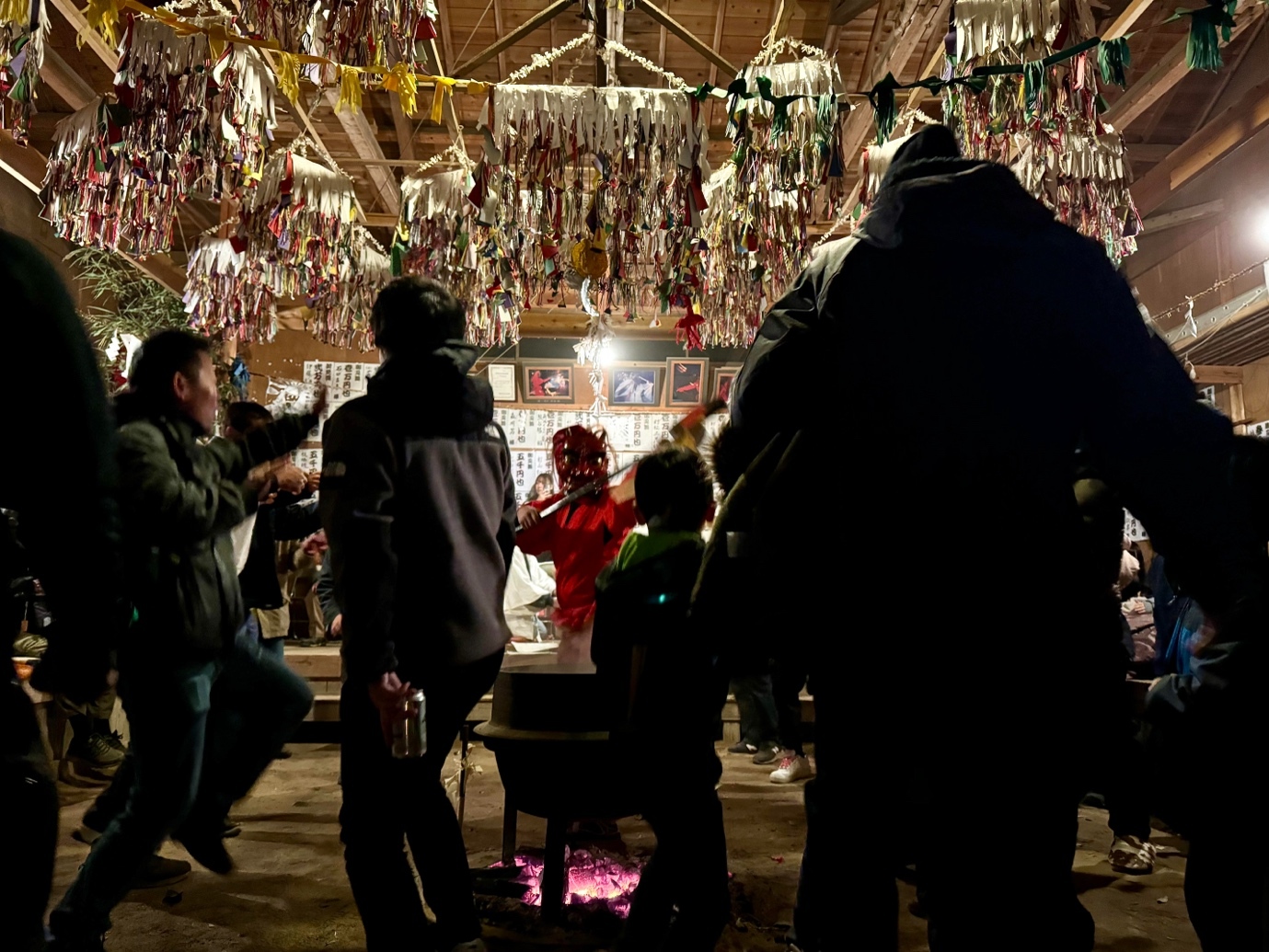
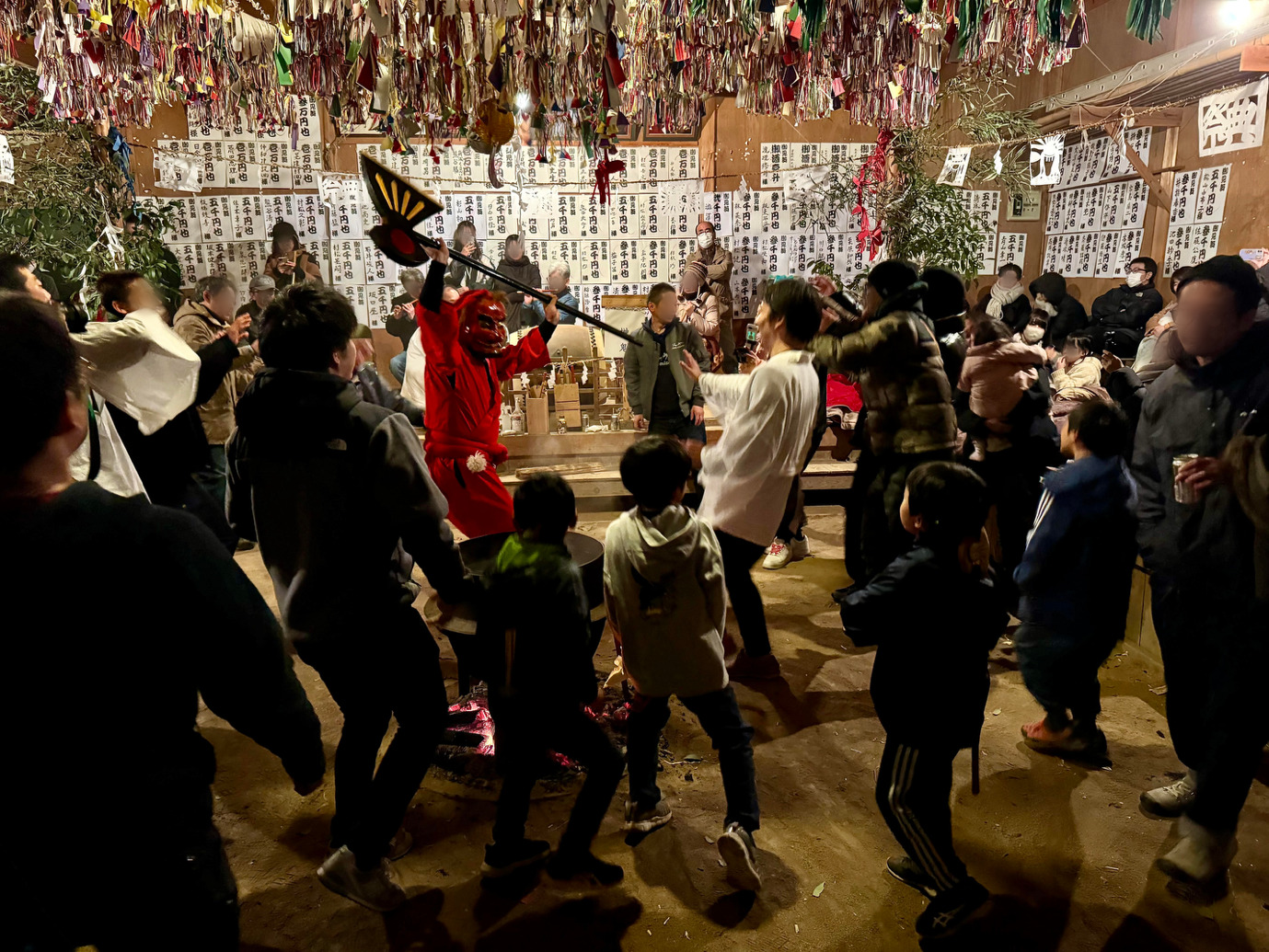
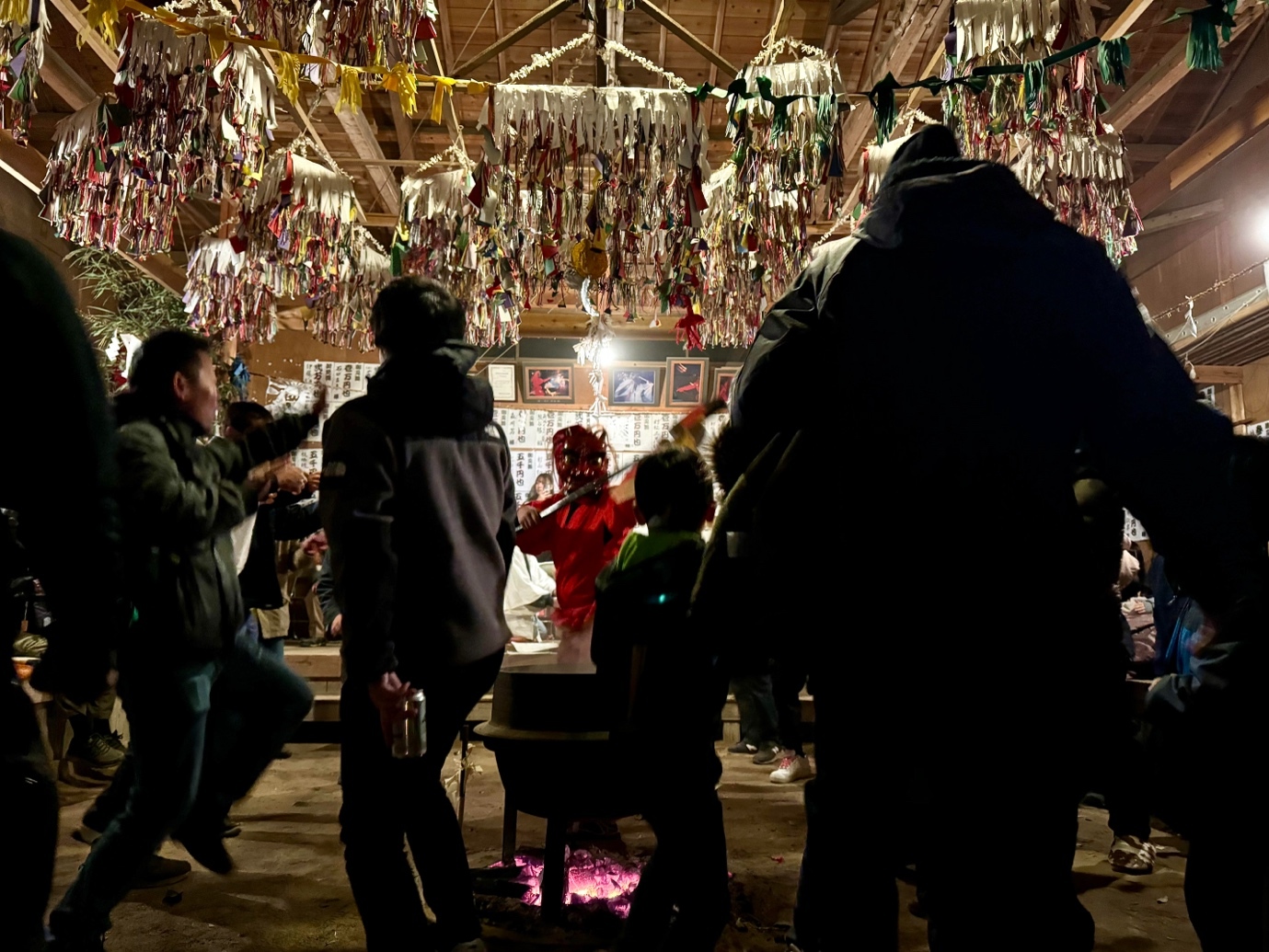
The hanamatsuri of Oku-Mikawa are a typical example of shimotsuki kagura. The dancing site consists of a dancing space (maido) with a cauldron in the middle; a stage (kanza) where gods are enshrined, from where a ritualist (tayū) and his assistants (myōdo) direct the proceedings while playing the taiko drum and flutes; and a backstage area (kanbeya) where the masks and other paraphernalia are kept, and where the dancers prepare themselves. The dances are interspersed with appearances of masked “demons” (oni), and of comical figures wielding ladles with miso paste and mushed sticky rice that they smear onto people’s faces. The climax occurs in the morning, when the fire under the cauldron is lit. After a lengthy build-up, four youngsters use large whisks made of bundled straw (yutabusa) to splash copious amounts of hot water over everybody present. Parts of the festival are solemn, while others are chaotic, loud, or even hilarious. The dancers range from young children to adults, and in the audience, families with small kids mingle with drunk and rowdy men, curious tourists, and anthropologists (Figure 1).
The history of the hanamatsuri stretches back to the first half of seventeenth century. Throughout the Edo period, village hanamatsuri coexisted with a larger event called ōkagura, which was held at irregular intervals by multiple cooperating villages. The ōkagura is first documented in 1581, when it already had acquired a very elaborate form. This festival expanded the shimotsuki kagura format with three rites of passage, aimed at children, youngsters, and adults. The first two, often referred to in one word as umare-kiyomari (“birth and purification”), integrate children and youngsters into the community as “children of the gods” (kamiko), while the third, called Jōdo-iri (“entering the Pure Land”) is a more complex initiation that grants adults passage across the river of death into the Pure Land. The hanamatsuri is thought to have begun as a smaller, one-village version of the ōkagura, without these rites of passage. Although its early history is not documented, it appears likely the hanamatsuri originated in Shimo-Kurokawa or Sogawa (in today’s Toyone-mura) in the first half of the seventeenth century.[1] Hanamatsuri festivals spread from one village to the next during the Edo and Meiji periods. After World War II, however, the number of hanamatsuri festivals has decreased from twenty to fourteen. The ōkagura was held for the last time in 1856; there proved to be no place for it in the new setting of Meiji.
The villages where the hanamatsuri is performed are tiny. The largest among them have a few hundred inhabitants, while the hamlet of Nakanzeki has only nine households. Each of these festivals attracts no more than two or three hundred people at most. Yet, the hanamatsuri punches above its weight in the history of Japanese ethnography (minzokugaku). Orikuchi Shinobu (1887–1953) and Shibusawa Keizō (1896–1963) made frequent fieldtrips to the hanamatsuri, and the very first Japanese ethnographical monograph, Hayakawa Kōtarō’s (1889–1956) two-volume Hanamatsuri (1930), offers a comprehensive analysis. In that same year, a special issue of the recently founded journal Minzoku geijutsu (vol. 3) carried five articles on the hanamatsuri, including a fifty-page analysis by Orikuchi. A decade later, in 1941, Honda Yasuji did fieldwork in Oku-Mikawa, adding both ethnographic accounts of the festivals he witnessed and transcribing additional documents (Honda 1954). In short, the hanamatsuri was studied in more detail than any other folk event. Aspiring ethnographers learned about it and had the hanamatsuri at the back of their mind as a model for their own research.
These prewar studies formed the first of what Hoshi Yūya has identified as three phases of intense hanamatsuri research.[2] More will be said on these phases below, but let me first state my own intentions with this article. Working through the rich body of existing research, I am struck by its heavy emphasis on origins. The focus is almost invariably on reconstructing older forms and identifying the “beliefs” that those forms once expressed. Attempts to understand hanamatsuri festivals in their more recent forms are rare, because there is a tendency to regard them as eroded remnants whose authentic meanings are no longer understood by present actors. As a result, the post-Meiji and postwar development of the hanamatsuri is understudied.
In response to this, in this article I employ a method proposed by Moumita Sen, Aike Rots, and myself that analyzes festivals by focusing on the interplay between “patronage, play, and piety” (Teeuwen, Sen, and Rots 2023). We stress the fact that traditional festivals are always in a state of flux. One important reason behind this constant change is the fact that festivals are shaped by networks of actors and stakeholders with different agendas. While priestly leaders may express their agendas in the form of ritual texts, they are not the only or even the most important festival actors. Without a crowd, there is no festival; and the crowd, too, shapes the festival by participating actively in certain parts of it while ignoring others. While some are worshiping, others are drinking, doing deals, or socializing. In fact, most participants will during a festival shift between acting as worshipers, patrons, and players—between praying, paying, and playing. All these “modes” are crucial to the festival’s success.
A festival must have space for many interests and serve many agendas. Crucially, there must be patrons who fund, facilitate, and promote festivals. If such patrons lose interest, a festival must be reinvented in a way that appeals to new patrons—if other stakeholders want it to survive. Our rather straightforward argument is that while both actors and students of Asian festivals often stress elements of faith and piety as their sacred core, this perspective marginalizes central dynamics that have shaped festivals’ development both in the past and the present. Our proposed method, then, is to make a conscious effort to understand all these aspects of a festival and reflect on the interplay between them. We argue that a triple perspective—focusing on the interplay between prayer, play, and patronage—can be helpful in identifying and avoiding biases in the study of festivals. If we take play and patronage as seriously as acts of worship and prayer, we will stand a better chance to understand both the festival’s diachronic development and its synchronic functioning.
In this article, I hope to gain a broader perspective of the dynamics of the hanamatsuri by combining fieldwork (conducted in the villages of Nakashitara, Nakanzeki, Kobayashi, Sakauba, Tsuki, Ashikome, and Kōchi over five years, 2021–2025) with ethnographic reports from the late 1920s (Hayakawa 1930) and 1941 (Honda 1954). It is not my goal to contest the accuracy of other scholars’ reconstructions of the intentions of the yamabushi who contributed to the creation of the “early” hanamatsuri (on which more below). Instead, I will reflect on the ways in which prayer, play, and patronage have formed—and continue to form—the festival in the recent past and today.
Rather than reading the hanamatsuri as a coded text that is no longer fully legible, I follow Michael Houseman in looking for “patterns of relationship” (Houseman 2006, 413) that occur between ritual participants. Houseman proposes to give analytical precedence to the “network of interpersonal ties” between people who perform or observe a particular ritual (414). He points out that ritual provides “highly integrative contexts in the light of which the myriad relationships that make up the participants’ social world may be conventionally reappraised and redefined.” He observes that for this to work, participants must be personally committed; but this commitment, he argues, is “less to abstract ‘beliefs,’ than the ongoing reality of the relationship they ritually enact” (425). This perspective shifts our focus away from a ritual’s elements and their symbolism, to the people who are in some way moved by it, even while being uninterested in or unaware of symbolic meanings or associated beliefs.
Phases of Hanamatsuri Research
If we conceptualize the development of hanamatsuri scholarship as three phases, the first arose in the 1920s and ‘30s. Most influential was the work of Orikuchi Shinobu, who saw the hanamatsuri as a unique source for the reconstruction of ancient practices—whether it is early Japanese “faith” or performative arts. The second, epitomized by Yamamoto Hiroko in the 1990s, likewise used the hanamatsuri as an “excavation site” where vestiges of long-vanished practices may be uncovered. Yamamoto, however, looks for echoes of medieval spirituality, rather than ancient beliefs and practices. She builds on historical and archival work done by such scholars as Honda Yasuji (1954), Gorai Shigeru (1972), and Takei Shōgu (1977), who unearthed many documents from the archives of tayū, the hereditary ritualists who lead the hanamatsuri. The third phase, which is still ongoing, offers a wide range of different reactions to both Orikuchi’s and Yamamoto’s readings. Most importantly, authors like Yamazaki Kazushi (2015), Inoue Takahiro (2004), and Kubota Hiromichi (2011) insist on reading the hanamatsuri as a product of the Edo period, rather than a relic of ancient or medieval belief systems.
What made the hanamatsuri so fascinating to pioneering Japanese ethnographers in the 1920s? The villages in the narrow valleys of Oku-Mikawa were poor and relatively untouched by the accelerating modernization that was transforming life in urban centers. Rural communities of farmers and fishermen were seen as repositories of ancient Japanese traditions, and in their descriptions of Oku-Mikawa ethnographers stressed its isolation. Hayakawa writes: “If there were such a place as the ‘hidden village of legend,’ [Oku-Mikawa] certainly fulfils all the conditions. And indeed, it proved to be a legendary place” (Hayakawa 1930, 13). In Oku-Mikawa, time appeared to have stood still; Orikuchi writes that in its villages, “our new age is thick with the presence of fantom-like images of the old” (1930, 4). He goes on to identify traces of long-gone “mountain people” (yamabito) and “mountain witches” (yamauba), who would once have visited isolated villages at the beginning of the new year to bring divine blessings (Orikuchi 1930, 11–14).
Orikuchi used the hanamatsuri to shed new light on ancient concepts, taken from classical sources. The word kagura first occurs in Kogo shūi (807), where it is explained as a procedure to “pacify the spirits” (chinkon). Orikuchi argues that this Chinese term glosses over two far more ancient words: tamafuri, which he took to mean “swaying” or “touching” (furi) a powerful spirit (tama) and settling it in one’s body; and tama no fuyu, referring to a technique to “strengthen” or “expand” such a spirit, and thus the blessings that it can bring. It is no coincidence, he imagines, that fuyu also means “winter.” Through this web of associations, Orikuchi arrives at a scenario where “on a winter day, [the mountain dwellers of Oku-Mikawa] descended to the villages and performed tamafuri. The mountain witches performed witch dances and the mountain men danced in the guise of [mountain] gods.” He was fascinated by “the chanting okina, the masked miko walking by with downcast eyes, and the infinite number of oni,” and imagined that the okina (an old man), the miko (an old woman), and the oni (demons) represented the ancient mountain men and witches. These mountain people, Orikuchi proposes, would embody the gods, bring mountain products, purify and bless people’s houses, and thus “transform the winter into a new spring” (Orikuchi 1930, 13–14).
Orikuchi recognized ancient tamafuri techniques in the hanamatsuri at the very time that the country was preparing to celebrate the 1928 daijōsai of the new Shōwa emperor.[3] In that same year, Orikuchi ([1928] 1995) wrote a famous essay in which he argued that the performance of the daijōsai imbued the emperor with the “imperial spirit” of Amaterasu in an act of tamafuri, transforming him from a man into a god.[4] In 1930, he argued that the ancient culture of tamafuri was preserved (though imperfectly) in the “hidden villages” of mountain people in Oku-Mikawa. In October of 1928, only a few weeks before the daijōsai, Orikuchi presided over a performance of the hanamatsuri of the village of Yamauchi at the Shinto university of Kokugakuin in Tokyo, personally offering comments on the proceedings. In April of 1930, marking the publication of Hayakawa’s monograph, a group from Nakanzeki performed its hanamatsuri at the newly completed villa of Shibusawa Keizō, the patron of early ethnography, in front of an audience of two hundred prominent guests, including some of the most active ethnographers. The hanamatsuri, and Orikuchi’s understanding of it, thus became a central classic of the field of Japanese ethnography.
After the war, interest in the hanamatsuri waned until the 1970s. The Shugendō scholar Gorai Shigeru drew attention to the countless saimon texts (ritual recitations) that have survived in tayū archives. Hayakawa had included many of these in his 1930 monograph but found them of little relevance to the performances that he witnessed and largely ignored them in his ethnography. Gorai (1972, 11) pointed out that these saimon reflect the non-canonical, “sundry” (zatsu) beliefs and practices of Shugendō practitioners (yamabushi). This marked a paradigm shift in approaches to the hanamatsuri. The mountain men and witches were now dismissed as figments of Orikuchi’s imagination, and the leading role in the development of the hanamatsuri was passed on to yamabushi who had brought practices from such places as Ise, Kumano, and Suwa to the villages of Oku-Mikawa.
This shift coincided with a new interest in medieval “syncretic” ideas and practices. Medieval re-imaginings of classical texts and rituals had long been scorned as corruptions, but now some scholars proposed that they should be studied as a “medieval mythology” (chūsei shinwa) that revealed a lost world of exciting creativity—in contrast to the spiritually arid and rationalist teachings of modernity. Yamamoto is one of the pioneers of this field of study, and her interest in the hanamatsuri must be seen in this light.
In contrast to the scholars of phase one, Yamamoto bases her analysis on close readings of saimon recitations. In the 1990s, she published a string of articles that seek to unveil the original medieval meanings of the ōkagura and its derivative, the hanamatsuri. Among others, Yamamoto analyses a saimon called Hana no hongen (The Origin of the Flower), recited during a hanamatsuri rite called “growing the Flower” (hanasodate). The Flower of the hanamatsuri, this recitation states, is a lotus that grows in the Pure Land. Those who sponsor and participate in the festival will “grow a lotus flower” and secure passage to the Pure Land after death.
Yamamoto points out that this hanamatsuri rite echoes the Jōdo-iri of the ōkagura.[5] She concludes that “the main aim of the hanamatsuri was to recreate that greatest event of the ōkagura: the Jōdo-iri” (1997, 117). The yamabushi who initially designed the hanamatsuri achieved this by inventing the hanasodate rite, which expressed the idea that sponsors of the hanamatsuri would attain rebirth in the Pure Land by “growing a Flower.” In the late seventeenth century, Yamamoto argues, the “strong impact of the religious idea of the Flower” inspired villages throughout the region to start their own hanamatsuri, transforming Oku-Mikawa into a “hanamatsuri commune” (1997, 118). She sees the spread of the hanamatsuri across Oku-Mikawa in the mid-Edo period as a process of conversion to a new religious teaching, which was summed up in the concept of “growing a Flower.”
While not all scholars of the second phase of hanamatsuri research agree with Yamamoto’s analysis, many likewise see the festival as an expression of strong religious feelings and beliefs, often with a focus on death and rebirth.[6] As in Yamamoto’s work, evidence of such beliefs is primarily distilled from saimon texts. However, the hanamatsuri that is reconstructed from such sources shows little resemblance with the festivals described by Hayakawa in 1930 and by Honda in 1954—or with the hanamatsuri of today. Not only have ideas of death and rebirth disappeared from the festival; so too has the crucial hanasodate rite. This is sometimes decried as a corruption of the “original” hanamatsuri. Yamamoto, for example, blames this on the displacement of a medieval by an early modern mindset in the eighteenth century: “The hanasodate lost its connection with the Other Realm and its visions of rebirth, and it was reduced to a rite for good luck in this world” (1997, 120). In this perspective, the current hanamatsuri appears as a mere shadow of what Yamamoto calls its lost “heroic age” (119). Most hanamatsuri, however, were started in the eighteenth and even nineteenth centuries, when that heroic age had already passed. This raises the question how we can understand the hanamatsuri in its “post-heroic” form.
Both Orikuchi’s and Yamamoto’s analyses of the hanamatsuri stress worship and prayer as more “essential” than play, while ignoring questions of patronage altogether. Orikuchi saw villagers in awe of the blessings brought by semi-divine mountain dwellers, who embody the gods through tamafuri. Yamamoto deplores the loss of medieval spirituality in the more “secular” late Edo period and has no explanation for the growing popularity of the hanamatsuri after that loss. In effect, her argument confirms that the popularity of the hanamatsuri did not depend on worship and prayer alone.
These readings still echo in the public domain today. The same focus on the festival as a faith event is dominant in the information provided by the municipality of Tōei-chō, which is home to ten out of the remaining fourteen hanamatsuri:
The hanamatsuri has been transmitted over centuries thanks to the simple but strong faith of the people of this region, and it has been sustained by the energy of the entire village community. Welcoming the eight hundred myriad deities to the hanamatsuri, people offer prayers that their wishes may be fulfilled, that misfortune may be avoided, and that they may experience umare-kiyomari.[7]
Similar phrases in sources of tourist information have a considerable influence on visitors’ expectations and, for some, also on their experience of the festival. But is it the festival’s spiritual qualities that have kept it going, or have there been other, more compelling forces at play? Below I address aspects of prayer, play, and patronage separately to arrive at a more comprehensive, holistic understanding.
Prayer
In all villages, the hanamatsuri starts and ends with a sequence of so-called shinji (“rituals for the gods”). These rituals prepare the dancing site, purify every part of it, ward off potential harmful spirits from all directions, and invite all the gods of Japan to attend. The gods invoked are listed in a long recitation that systematically goes through all the provinces of Japan. Of particular importance are two deities called Mirume and Kirume no Ōji, which are enshrined in some of the hanamatsuri villages (e.g., in Sakauba and Futto). Kirume has its roots in Kumano, where Kirime (sic) no Ōji was among the most famous among the ninety-nine “princes” who protect the pilgrimage route from Kyoto (Suzuki 2018, 83–87). Mirume, however, appears to be a local invention. Mirume represents the “Eye that Sees”—the divine gaze that watches, enjoys, and blesses the festival and its participants. This deity, otherwise unknown, is often the first to be invited to take a seat on the kanza stage during the series of rituals that invite the gods. The presence of the gods brands the entire festival as a performance for both gods and humans.
The first dances are likewise regarded as shinji; they are differentiated from the somehow less “sacred” dances that follow (known simply as mai, “dances”) by the fact that they are performed on a straw mat in front of the cauldron. There is a wide variety in the number of shinji; in Tsuki and Nakashitara they take many hours, while they are much reduced in places like Sakauba and Nakanzeki. In all villages, the shinji attract very few spectators. Even locals who are present tend to ignore the proceedings, bustling about and talking over them freely.
Some shinji, however, are attended by so-called vow-makers (gannushi, ryūgansha), for whom special dances are performed in a procedure called mikagura or gannushi mai (Hayakawa 1930, 124–27). Vow-makers offer special donations for personal goals. They have typically promised the gods to offer a dance during the upcoming hanamatsuri in return for received blessings. Hayakawa describes how mikagura was performed in Tsugu in the 1920s. Here, there used to be one dance per vow-maker, but the number of vow-makers had risen to as many as fifty or sixty, and dances were now performed for five vow-makers at the same time—which still took multiple hours. Hayakawa described mikagura as “monotonous.” Clearly, this is not a performance designed to entertain a human audience. Rather than a spectacle, mikagura is an expression of the role of prayer in the hanamatsuri.
In his 1941 account of the hanamatsuri of Ōnyū village, Honda Yasuji (1954, 334–35) describes a different practice. This isolated village was abandoned in 1960 and its hanamatsuri no longer exists (Tōei Chōshi Hensan Iinkai 2004, 522). Here, the vow-makers were invited to sit on the kanza stage, together with the tayū, another ritualist referred to as the negi, and, not least, the temporarily enshrined gods. The negi performed a ritual to present the wishes of each vow-maker to the gods while the hana no mai dance (performed by young children) was going on around the cauldron below. This ritual included purification rites, recitations, mudras, and calling on the deities (kamiyose). Honda explains that this type of vow-making was thought to replace so-called ichirikibana (“one-man Flower”), an entire hanamatsuri performance sponsored by a single vow-maker in his own home. Since this was very costly, the cheaper format of “adding a Flower” (soebana) to the annual village performance came into vogue.[8] Vow-makers would offer extra paper canopies (also called soebana), which were hung from the ceiling. Although Ōnyū was a hamlet of only seven households with sixty inhabitants in 1941, Honda counted “fifteen or sixteen” soebana. Clearly, the Ōnyū festival was popular also among vow-makers from other villages.
Soebana, often carrying the names and wishes of the donors, cover the ceilings of all hanamatsuri dance sites today. In Tsuki, the names of all vow-makers and their formulaic wishes (recovery from illness, safety in the home, success at work or in examinations) are read out as part of the opening shinji. Toward the end of the festival, there is a two-hour sequence of gannushi mai dances. In Ashikome and Kōchi, larger soebana are—confusingly—called ichirikibana. These ichirikibana are brought out at different points in the proceedings, each followed by a gannushi mai dance. At the very end of the festival, the soebana (and ichirikibana) are taken down and handed to the vow-makers, who take them home as tangible proof of their prayers.
Both Hayakawa and Honda write that the hanasodate rite, mentioned above, was performed by vow-makers when the soebana were taken down from the ceiling. Honda explains that in Ōnyū in 1941, vow-makers carried their soebana on their heads or shoulders as they circled the cauldron while pounding their Flower staffs on the ground and singing about the Flower that blooms in the Pure Lands in the five directions. Hayakawa describes similar procedures for other villages, but notes that by the 1920s, many vow-makers did not have the patience to participate in this rite and simply skipped it, taking their soebana home without further ado (1930, 151).
The hanasodate of Yamauchi, on the other hand, was different in the sense that it was not performed for the benefit of vow-makers. Here, Honda was told that the soebana were a recent innovation (as a “short-cut” replacing ichirikibana in the meaning of an entire hanamatsuri sponsored by one household) that Yamauchi had chosen not to adopt. Instead, the hanasodate was performed to offer prayers for local draftees who had been dispatched to Manchuria (Honda 1954, 393–94). During the war, then, Yamauchi’s hanasodate served as a collective prayer addressing the village’s most pressing concern.
After the war the hanasodate survived only in Yamauchi, until the hanamatsuri of this village was discontinued altogether in 2008. In the meantime, Yamauchi’s procedure had been incorporated in the hanamatsuri of Shimo-Kurokawa in 1978–1979. This was likely inspired by the 1976 designation of the hanamatsuri as an Important Intangible Folk Cultural Property. As formerly in Yamauchi, the hanasodate of Shimo-Kurokawa does not have the function of distributing soebana to vow-makers. Rather, it has become a stand-alone rite that is performed primarily in order to preserve it. I have not seen this rite myself, but a video of the Shimo-Kurokawa hanasodate as it was performed in 2018[9] shows about fifteen white-clad participants. Eight strike the ground with decorated Flower staffs while the hanasodate song is sung from handheld notes. The ritual looks more like a performance than a prayer; as if to confirm this impression, onlookers react to it with polite applause.
The main reason why the hanamatsuri can be regarded as a faith event is the fact that it is performed in the presence of the gods. As we have seen, the gods are invited, presented with offerings, and sent off in elaborate rituals, performed with great dedication by the tayū and their myōdo assistants. The layout of the dancing site conveys a clear sense that the gods are watching, and that less benevolent spirits may be lurking in the shadows. On the other hand, however, the gods remain somewhat abstract. Apart from the mysterious Mirume and Kirume, who remain a riddle to most visitors, the gods form a nameless crowd. Honda notes that vow-makers in Ōnyū addressed their prayers to “the tutelary deity of the village or to any other deity that they have faith in” (1954, 335). “The gods,” therefore, form an anonymous and indistinct collective. Houseman (2006, 416) proposes to give “analytical precedence to ties between persons,” arguing that links with nonhuman entities like gods are best “envisaged as being dependent upon ties between persons.” In the hanamatsuri, this approach appears very appropriate.
The intrusion of divine figures into the dancing site is enacted most dramatically not by these immaterial gods, but by the masked oni. Three main demons enter the stage in the course of the festival, named Yamami Oni, Sakaki Oni, and Mokichi Oni. They wear oversized masks, in some villages (e.g., Nakanzeki) more than half a meter high, which are treated as divine objects themselves. In the kanbeya, these masks are displayed on an altar and presented with offerings. Before the oni dancers have the masks fitted, they perform ritual acts that acknowledge their status as divine objects (Sasaki 2006).
Sakaki Oni is the undisputed “general” (taishō) among the three demons. When he enters the dancing site, this oni is met by a priestly figure (mostly performed by the tayū) who demands that he identifies himself. Hayakawa describes the scene as it was performed in Tsugu. Here, Sakaki Oni claims to be the king of the tengu of Mts. Atago and Hiei, and of the wild tengu who traverse mountains; his age, he claims, is 80,000 years.[10] The priest, on the other hand, replies that the festival is attended by the gods of Ise, Kumano, and Mt. Fuji, who are 120,000 years old and thus Sakaki Oni’s seniors. He challenges Sakaki Oni to prove his powers by pulling a sakaki branch out of his hand; the oni proves unable to do so. Admitting defeat, Sakaki Oni then performs “magical steps” (henbe, henbai). Demonstrating his wild nature, he attempts to break the cauldron and throws burning logs from the fire in the yard into the air with the handle of his halberd, filling the dancing site with ash and smoke. The appearance of Sakaki Oni, usually well after midnight or even close to dawn, is one of the highlights of the hanamatsuri. The watching crowd suddenly grows, and people show their engagement by shouting and dancing. Sakaki Oni is accompanied by a host of masked “assistant demons” (banki), who add to the excitement. According to Honda, in Ōnyū the Sakaki Oni sequence took as long as two and a half hours.
Although Sakaki Oni is part of the mai section of the festival, his performance incorporates shinji-like aspects. Only Sakaki Oni performs the ritual henbe steps. Also, he displays the paradoxical nature that Houseman (2006, 417) identifies as typical of ritual relationships: threatening and yet bringing blessings, violently chaotic and yet performing henbe with precision. In Ōnyū, Sakaki Oni retired to the kanbeya after losing the pulling match and performed henbe there, out of sight of the crowd at the dancing site (Honda 1954, 340). People suffering from pains in some part of their body followed Sakaki Oni to the kanbeya (which is usually out of bounds for the public), asking the demon to step on the ailing body part. This solution emphasized ritual efficacy (enhanced by secretive invisibility) over audience engagement. The audience was kept waiting while Sakaki Oni was performing hidden rites behind closed doors. Today the same rite is performed in Kobayashi, but in the dancing site itself, where all can see it. When I witnessed this in 2024, the queue was quite long. People were laughing, but clearly also praying, though perhaps in a half-serious manner.
The Sakaki Oni sequence is an example of the way in which prayer and play, or piety and entertainment, can coexist in a single rite. It stands in contrast to less entertaining shinji, which are regarded as the responsibility of the tayū and myōdo and seldom attended by others. On the other hand, it is also clearly different from other festival sequences that are designed simply to amuse and excite. It is to those rites that I will now turn.
Play
We return to Ōnyū in 1941. After Sakaki Oni had finished, the people of this hamlet were treated to a very different performance. First, two figures wearing comical “brine blowing” (shiofuki) masks entered the stage. These are male masks with inane expressions and pouting mouths, also known as hyottoko. One carried a rice scoop and the other a pestle. As they started to dance, they were joined by two equally hilarious men in female dress and okame masks, smiling with plump cheeks and tiny bright-red lips. Their movements struck Honda as “obscene” (waisetsu): they kept embracing each other, pulling each other down and rolling across the floor in a suggestive manner. Meanwhile, the two cross-dressing men went around the dancing site, using their scoop and pestle to smear the faces of the onlookers with sticky rice paste and salty miso. Flippant protestations and shrieks of laughter filled the dancing site (Honda 1954, 341).
The shiofuki and okame were followed by two other masked figures called negi and miko—a male and female “priest,” usually portrayed as an old man and an old woman who perform a dance on a straw mat. Like Sakaki Oni, they used to be approached by a questioner, to whom they would reveal that they are visitors from Ise. Already in 1941, however, Honda notes that the dialogue was very short, inaudible, or skipped altogether. Both the negi and the miko were accompanied by attendants with comical masks. They were dressed in ridiculous outfits and danced with hilariously exaggerated gestures. When I attended the 2024 hanamatsuri in Kobayashi, a male student who visited the festival for the first time was picked out and asked to perform as one of the miko’s attendants, in a costume that was downright lewd. He went all in and became the star of the evening, duly rewarded with much praise at the post-festival celebration party. In Kobayashi, the acts of the negi and miko are followed by the appearance of an old man (okina), who in dialogue with another questioner expresses thanks to all involved in a semi-improvised, humorous manner. The okina is portrayed as a tottering old fool, senile but well-meaning. His appearance quietens down the audience after the chaos of the shiofuki and okame by offering a less ebullient and more subtle kind of humor. All these acts feel more like sketches in a vaudeville theater than ritual acts.
These, then, are the miko and okina who to Orikuchi suggested ancient mountain-folk traditions of tamafuri. Orikuchi read these comical acts as degenerated shinji, in which village folk had once embodied visiting deities who transformed the deepening winter into a new spring. Yet there are many signs that these rites are intentionally distinguished from shinji rituals. The masks of the negi, miko, okina, and all their attendants are treated differently from those of the oni. Sasaki (2006) notes that while the oni masks are handled with ritual care, these masks are no more than props. Also in the 1920s, Orikuchi’s notion that the dances and dialogues of the negi, miko, and okina involve rites of deity possession was far-fetched. If anything, this interpretation shows that Orikuchi was determined to ignore aspects of play even where they were blatantly obvious.
Play here takes many forms. These sketches, for lack of a better word, involve ribald comedy, teasing breaches of taboos, and interactive invasions of onlookers’ private space, forcing people out of their comfort zone and pulling them bodily into an atmosphere of liberating chaos. There is cross-dressing, role-play, silliness, and laughter. Any thoughts of prayer—let alone prayer inspired by serious concerns—are blown away. Rather than bringing people into the presence of divine beings, these interludes offer an escape from social restrictions and daily worries.
Deliberately comical scenes are inserted into other parts of the festival as well. In Kobayashi, as in many other places, the mai dances end with a lion dance performed by two young men, one holding the lion mask and the other providing the lion with hind legs. In the middle of the performance the lion falls asleep. The man in the rear is hit multiple times on his bottom with a flat stick, a bit harder for every try, while the man in front refuses to wake up. In this way, the festival ends with laughter—although the tayū and myōdo still have several shinji to perform.
The audience, too, provides much entertainment. Already before the age of tourism hanamatsuri were attended not only by locals but also by visitors from nearby villages. These visitors are referred to as the seitoshū, after the log fire (seito) that is kept burning near the dancing site. Also today, their behavior can be rowdy; there is much to suggest that it was even more so in the past. Hayakawa (1930, 354) describes the seitoshū as “a crowd without any restraints or coordination” who shower abuse (akutai) on the dancers, the musicians, the honored guests seated on the kanza stage, and each other.
They appear from the dark in small groups of two or three, hurrying into the dancing site as it starts to snow. Huddled around the log fire, they cast glances at the kanza, giving the impression of a gentle and placid bunch. It is hard to believe that such people would suddenly start bawling such shocking abuse. As the dancing site becomes more and more crowded, they start yelling insults at the people on the kanza. The locals pay them little attention, but those who are not familiar with this custom cannot help being jolted, worrying that something serious might be afoot.
Hayakawa notes that at times, the seitoshū were a nuisance. Yet they also played an essential part in creating the excitement that energized the festival. They acted in a “paradoxical” manner (in the sense of Houseman) not unlike Sakaki Oni: supporting and energizing the festival while disrupting it with sarcastic humor. Most seitoshū came from other hanamatsuri villages, and acting as a visiting seitoshū in other villages than one’s own was a common way of enjoying the festival. In 2002, Nakamura Shigeko interviewed Shirakawa Yoshiharu (b. 1920), priest of Kumano Shrine in Komadate, about his memories of the hanamatsuri. Shirakawa told her: “Young men used to compete by going to dance at as many hanamatsuri as they could. In the hanamatsuri season, we would wear down four of five pairs of geta.” He remembers that he was given a warm welcome wherever he went. During the war the festival was conducted under a dark cloud, but after the war’s end the festival seemed to return to its former glory. However, there were multiple deaths due to the use of methyl alcohol as a replacement for sake, and Shirakawa reminisces that “we never again got to experience the hanamatsuri as it had been until 1940” (Nakamura 2003, 123).
Intoxication is another form of play that has always had a prominent role in the festival. Intoxication alters one’s experience of the festival. One is drawn into the dances and the oni performances in a more physical and less detached manner. The presence of drunk people inspires all visitors to sing and dance along in a way that would not feel comfortable when everybody is sober. Drunk people are treated with consideration and appreciation, even when they get in the way of the dancers. In Kōchi, free sake is offered to all present throughout the night. In Kobayashi, I saw how an intoxicated visitor borrowed the mini-halberd of a wide-eyed little boy after Sakaki Oni’s performance, and mimicked the oni’s steps around the cauldron. The tayū kept his drum going to accompany the man’s efforts for quite a while. When he finally stumbled back into the audience, he was congratulated on his performance by his equally inebriated friends.
Play and prayer cannot always be clearly distinguished. If play is defined as “acting as if,” as suggested by Huizinga (1938, 8), one could even argue that some of the acts of prayer are in fact a form of play. While prayers clearly play a significant role in the hanamatsuri, it is also clear that for many participants and visitors, some acts of worship are part of the “acting as if” that they perform to immerse themselves more fully in the festival atmosphere. In this and other festivals, displays of worship and prayer authenticate the festival experience, proving that it is more than a mere “show” (Teeuwen 2021). Playfulness does not make the hanamatsuri less “real” or “serious”; in fact, it is seen as a central component of the festival’s authenticity.
Houseman (2006, 428) distinguishes “play and spectacle” from ritual, arguing that the former “represent other, equally distinctive means of enacting relationships” that are otherwise associated with ritual. In the hanamatsuri, however, I argue that play is closely integrated within ritual and functions as the festival’s most effective tool to enact and transform relationships among the participants.
Patronage
In the context of festivals, the term patronage is mostly used to refer to elites who play a central role in financing a festival, and who may use festivals to make their leadership visible to all. In this sense, the most obvious patrons are political or financial leaders who sponsor a festival and may utilize it for their own purposes in exchange for their support. This can be seen, for example, in Kyoto’s Gion festival, where the city’s rulers inspected the float parades from pavilions, visibly inserting themselves into the festival as its high protectors (Teeuwen 2023). Also in rural festivals, local elites have tended to hug the spotlight. By distributing festival tasks, paying a good portion of the costs, and making themselves visible in the festival performance, patrons have been known to reinforce social hierarchies. As Scott Schnell has described for the Fukagawa festival in Gifu Prefecture, this can turn festivals into stages for social struggles (Schnell 1999). In the hanamatsuri, a similar dynamic may well offer one explanation for the once widespread “custom” of akutai abuse.
On the other hand, patronage is not limited to elites. In the postwar period, especially, such forms of patronage have become less visible as society has become more egalitarian. In the case of hanamatsuri, patronage comes from three different sources: the villagers themselves, visitors, and heritage authorities. Let me discuss them in reverse order of importance.
Because of its prominent place in the history of Japanese ethnography, hanamatsuri was designated by the Agency for Cultural Affairs (Bunkachō) as an Important Intangible Folk Cultural Property (IIFCP) in 1976, the very first year that this category became established. In the official description of the festival, the Agency for Cultural Affairs states that the “Flower” refers to flowering rice plants and explains the hanasodate rite as a prayer for a good harvest. The festival is valued for its “performing arts as ritual for the gods” (shinji geinō) that retain a “pure, ancient style” (sugasugashiku kofū). The Agency stresses the festival’s importance as a living fossil that sheds light on the historical development of folk arts in general.[11] In this description, we recognize the now-familiar stress on shinji, faith, and ancient origins, and a glaring disconnect with the lived reality of the hanamatsuri. The only relationship that is awarded significance is that between the participants and the gods. Yet IIFCP status gives the festival great prestige, and it is proudly advertised on banners, happi coats, and merchandise in all villages.
This designation has some concrete effects. The hanamatsuri of the different villages are now organized as Preservation Associations (hozonkai), small foundations with a board, a budget, and a bank account. These associations can apply to the Agency for Cultural Affairs for public support for new costumes, instruments, masks, and other festival paraphernalia. Status as an IIFCP increases the chance of securing subsidies from Aichi Prefecture and the municipalities where the festival takes place. In 2002, for example, Aichi and Tōei-chō provided 45% of funds (5 out of 11 million yen) needed to build a new hanayado (a hanamatsuri hall) in Nakashitara. The festival is featured prominently on the websites of the involved municipalities, and the only train station in the region (Tōei on the Iida line) sports the shape of an oni. After the IIFCP designation, Tōei-chō, which is home to ten hanamatsuri, built an ambitious Hanamatsuri Kaikan exhibition hall (opened in 1978) that functions as an archive, a museum, and a stage for performances—although today, it only opens its doors by appointment. There have been occasions to perform hanamatsuri dances for new audiences, including the so-called “Hanamatsuri Festival” staged on Culture Day in Tōei-chō, and at venues in Nagoya and Tokyo. These performances, however, take the dances out of their festival context, and participants are increasingly reluctant to join such excursions.[12]
Even while assisting the Preservation Associations of the various hanamatsuri, Tōei-chō nevertheless makes sure to keep its distance. When the Preservation Association of Fukawa decided to discontinue its hanamatsuri in 2019, Tōei-chō’s Education Committee (which oversees cultural affairs) did not involve itself in any way. Its role is largely limited to mediating applications for subsidies to the Nagoya office of the Agency for Cultural Affairs and organizing annual meetings of the heads of the associations in the town to discuss shared issues. There is no public funding for the annual costs of performing the festival.[13]
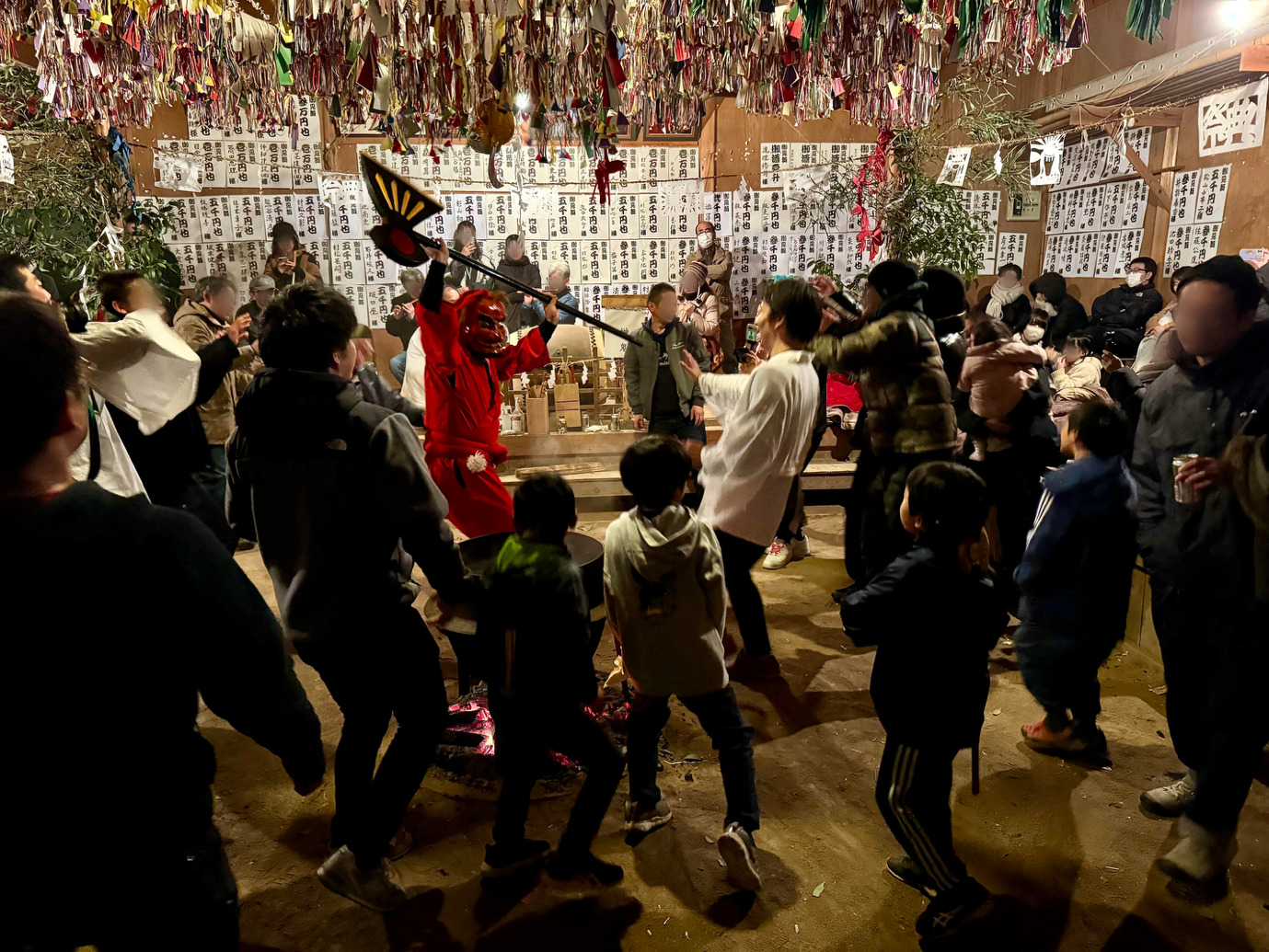
In addition to the donations of vow-makers, these costs are mostly covered by visitors. Most visitors make donations when they arrive at the dancing site. These donations are regarded as voluntary contributions (mimai). In return, visitors receive a “prayer amulet” (kitō ofuda) to add to their deity shelf (kamidana) at home, or hanamatsuri merchandise like towels or cups. Also, their names and the amount of their donation are printed on a sheet of paper and stapled to the wall of the dancing site (as can be clearly seen in Figure 2). These sheets can number well over a hundred, covering one or two walls completely. In official guides to the hanamatsuri, published by the Economy Division (Keizaika) of Tōei-chō, visitors are encouraged to contribute 3,000 yen per person to support the festival.[14] Some, however, sponsor the festival with 30,000 yen or more—as well as purchasing a soebana. The borderline between a religiously motivated donation and more secular voluntary contributions is not at all clearcut. Taken together, mimai contributions and soebana donations are usually sufficient to cover the costs of the festival.
The most important patrons, however, are arguably the organizers themselves. Behind the façades of modern Preservation Associations, older structures persist. In Kobayashi, a village of about twenty households with forty inhabitants, the back wall of the kanza carries the names of the households that are assigned specific tasks for the year’s festival, from acting as tayū and myōdo to staffing the “office” where donations are received and amulets handed out, preparing food, serving sake, and keeping the seito fire burning. In total, twenty households are involved, meaning that in practice, every single house is contributing in some role. Here, the atmosphere is one of familiarity and relaxed equality. I witnessed the same in Sakauba, where the hanamatsuri is now run by a group of energetic people in their thirties. Sasaki (2006, 78) likewise stresses that in Futto, special care is taken that duties and positions of power are shared equally between inhabitants.
Hayakawa (1930, 336–54) offers a detailed analysis of social relations within the festival in the 1920s. He finds that in many places, the festival was already in a phase of transition. In the recent past, central roles had been strictly reserved for myōdo families, which formed the village elite. Hanamatsuri were typically held in the houses of these families, who would also pay for a fair portion of the costs (although also at this time, mimai contributions and soebana donations covered half or more of the expenses[15]). By the 1920s, however, things were changing rapidly. Most radical was Futto, where functions in the festival were no longer hereditary but allocated by rotation (Hayakawa 1930, 336). Writing about Ashikome, Hayakawa notes that some myōdo there felt alienated from the rowdy festival and were happy to let others with more dedication and skill take their place. On the other end of the scale was Misawa, an area that includes Yamauchi and five other hamlets, where the two tayū of Yamauchi ruled supreme.
The crucial importance of village relations is illustrated by the demise of Misawa’s hanamatsuri some decades later. Every year, representatives from these villages would gather on January 3 to decide where the festival would be held, and to divide tasks. In 1961, long-held resentment caused the five hamlets to stop participating. Their main grudge was that even if a household in a hamlet other than Yamauchi housed the hanamatsuri in a particular year, with all the costs that this involved, local youths were excluded from the more attractive performing roles. The tayū and myōdo from Yamauchi dominated the stage, while households from the other hamlets were obliged to perform subservient roles behind the scenes, as well as carrying the burden of supplying resources like firewood (Yamazaki 2015, 115–16). Yamauchi continued the festival on its own, but was forced to throw in the towel in 2008 due to advanced depopulation and aging.
The contrast between Misawa and such places as Futto, Nakanzeki, Kobayashi, and Sakauba indicates a shift in structures of patronage. Where even in the recent past, the festival was dominated by first sons from leading families, today most people in hanamatsuri villages are not only allowed to take part but also expected to contribute, if their health allows it. As a result, the festival has become more relaxed and “democratic” than it was in the past. This trend has been reinforced further as hanamatsuri performances moved from private homes to communal spaces—ranging from community centers (kōminkan) to purpose-built hanayado.[16] The simple fact that costs are shared, and that the hanamatsuri is no longer dependent on the sponsorship of local elites, has changed both the atmosphere of the festival and its place within the network of relations that carries it.
Conclusion
This article argues that a three-pronged analysis of the hanamatsuri (or any other festival), focusing on elements of prayer, play, and patronage, can provide a broader understanding of its synchronic and diachronic dynamics. While this is a rather intuitive notion, it appears timely considering the body of existing Japanese research, in which aspects of prayer and faith are the focus of attention while elements of play and patronage are rarely deemed worthy of consideration. As noted by Kubota Hiromichi (2011, 24) the prime object of hanamatsuri research has been to overcome the problem that “historical and folkloric change has advanced so far that the meaning of rituals is no longer understood,” making “grasping the original form prior to these changes” a difficult task. Kubota feels the need to point out that “beyond the rituals that were created by specific religious figures, the perplexing transformation of those rituals within folklore is, in fact, also a form of culture.” The fact that this needs saying is striking.
The emphasis on the “perplexing” (fukakai) nature of the hanamatsuri in its “post-heroic” form (in Yamamoto’s terms) reveals a perspective that expects rituals to be readable as symbolic systems that transmit a clear meaning in terms of distinct beliefs. We have seen that already in the 1920s, or even the latter half of the Edo period, the hanamatsuri was not like that.[17] When a small group in Nakanzeki started their own hanamatsuri in 1872, they faced such opposition that they had to perform it secretly to evade repercussions (Hayakawa 1930, 345–46). This bespeaks their passion for the festival, but what they coveted was not a symbolic ritual that enacted transparent beliefs. Rather, it was an opaque event of masked and unmasked dances that combined aspects of prayer, play, and, once it became established, patronage.
Houseman stresses that ritual relationships “are not, in the manner of myths for example, reducible to logical or metaphorical connections between abstract terms or categories” (2006, 415). Rather than communicating a clear message, ritual actions tend to combine antithetical elements in an evocative and at times shocking manner. The hanamatsuri abounds in such actions: the oni demons who bring blessings while acting in an aggressive, threatening way; the juxtaposition of solemn worship with akutai mockery; the cross-dressing, and more. In Nakanzeki, the pioneers initially relied on help from the hanamatsuri village of Ashikome but performed the roles of the main oni themselves—focusing on the most paradoxical and spectacular part of the festival as their first priority (Hayakawa 1930, 346). In Sakauba, there is a sequence where everybody present is invited to stand in a circle around the cauldron to receive blessings. These are bestowed by a figure holding two sakaki branches, who runs around the circle while whipping people’s backs with all the force he can muster, combining benefaction with violence and evoking both laughter and yelps of pain.
Today, it is obvious that the hanamatsuri is not primarily informed by sincere faith in the powers of the invoked deities. Yet, worship and prayer are performed with great seriousness and appreciated by participants who are quite agnostic in their daily lives. Perhaps Houseman’s stress on paradoxical patterns in ritual can explain the role of prayer in contemporary hanamatsuri: it is needed to create the tension between contrary modes of action (controlled solemnity and chaos, dread and merriment) that is necessary to engage the participants and affect the relationships between them. We also need to ask, however, whether this is a contemporary phenomenon. Was there no play in the hanamatsuri of the seventeenth century? Or are interpretations that focus excessively on prayer falling into the trap of assuming that the past was a more pious place than our own age? At the very least, there is no doubt that the hanamatsuri of the past, too, was designed to create ritual relationships between participants, and not only to bring vow-makers into contact with divine beings.
There is only circumstantial evidence. Yamazaki Kazushi (2015, chap. 3) argues that the hanamatsuri may have been created by local yamabushi in the 1620s or 1630s. Yamazaki refers to a mask dated to 1637 as the first concrete evidence of its existence. However, this mask (depicting the “Fire King,” Hi-no-ō) is used in a rite (shizume) that was originally quite separate from the hanamatsuri and that may have been attached to it only at a later date (Yamazaki 2015, 300). This mask may therefore predate the hanamatsuri. Local tradition ascribes the creation of the hanamatsuri to a yamabushi named Manzōin (d. 1702), who likely lived in Shimo-Kurokawa.
Presentation at Nihon Shūkyō Minzoku Gakkai, October 8, 2022.
Daijosai is a large-scale ritual in which a newly acceded emperor makes offerings to and shares a meal with the gods.
This article, titled “Daijōsai no hongi,” was delivered as a lecture in 1928 and published in 1930.
See Lee 2006 for an outline of her argument in English.
For an early critique of this approach (with focus on the ōkagura), see Kobayashi 1990.
In fact, the term soebana occurs for the first time in a document from Ōnyū, dated 1841. Tōei chōshi dentō geinō hen, 36.
www.youtube.com/watch?v=o6sIAqLVsag, titled “Shimo-Kurokawa hanamatsuri 2018 hanasodate.”
Tengu are threatening beings who roam the mountains, , often depicted as long-nosed demons. In the hanamatsuri offerings are made to misaki (roaming spirits) and tengu as part for the preparation of the dancing site.
Interview with Hasegawa Shin of Tōei-chō’s Education Committee, November 2024.
Interview with Hasegawa Shin.
Thanks to Sasaki Shigehiro, I gained access to two hanamatsuri accounts from Kobayashi, dated 1915 (Ohanamatsuri seibichō) and 1922 (Ohanamatsuri kanjōchō). These show that about a third of the costs was covered by mimai contributions, another third by the sale of ichirikibana and soebana, and most of the rest by “interest on loans.” The 1915 festival left the house owner with a deficit, most of which was covered from the surplus generated by the hanamatsuri of the previous year. The 1922 festival generated such a surplus. The reference to interest on loans indicates that these house owners supplied their fellow villagers with credit and belonged to Kobayashi’s elite.
A few villages perform their hanamatsuri at a local shrine (Kōchi, Kobayashi, Kami-Kurokawa, Sakauba, Tsugu).
On the shifting meanings attributed to the hanamatsuri, see Teeuwen, forthcoming.